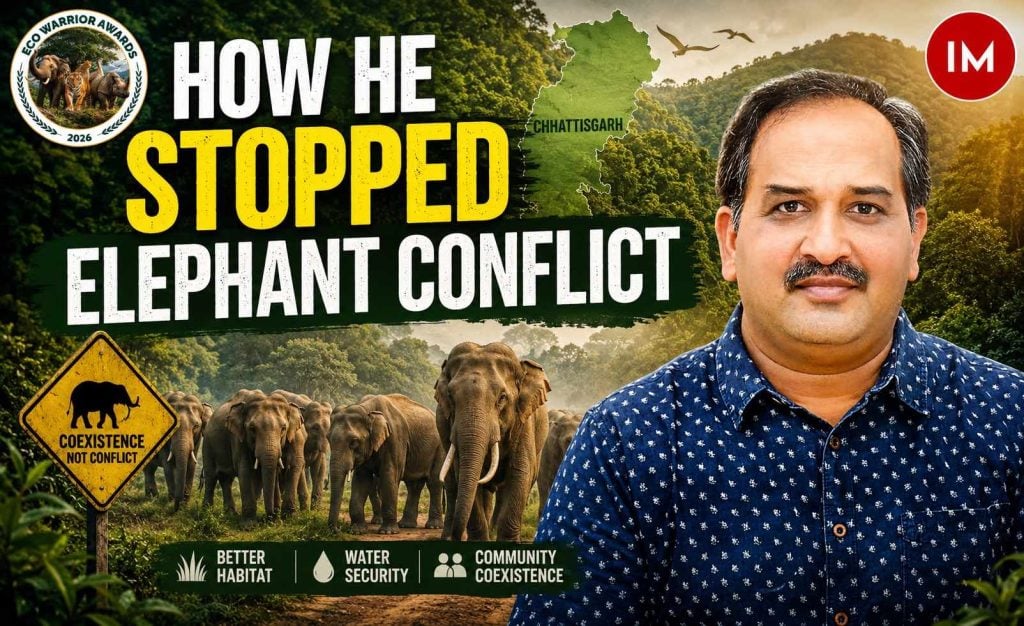
Conservation succeeds when forests offer wildlife not just protection, but a reason to stay. In Chhattisgarh’s Tamor Pingla Elephant Reserve, that principle has translated into a sustained effort to improve habitat, secure water and food resources, strengthen protection infrastructure and make the forest safer for both wildlife and frontline personnel.
At the centre of these interventions was 2015-batch Indian Forest Service (IFS) officer Shrinivas Tenneti, who served as Deputy Director of the Elephant Reserve, Surguja, from September 2022 to August 2026. During his tenure, habitat development across the reserve included pasture development, weed eradication and creation of water bodies. Around 70–80 wild elephants now inhabit Tamor Pingla Sanctuary for much of the year, while broader habitat interventions have helped reduce the need for elephants to move into villages in search of food and water.
But the story is about more than numbers. It is also about rebuilding a relationship between elephants and people in a landscape where elephants had returned after decades of absence and communities had gradually forgotten how to live alongside them.
Indian Masterminds interacted with Mr Tenneti to understand his initiatives, their implementation, and the impact they have had on elephant conservation and human-elephant coexistence.
How It Started: When Elephants Returned
According to Tenneti, the return of elephants to the Surguja region is a relatively recent phenomenon.
“Elephants started coming back to the Surguja area after the 1990s,” he explained. Historically, elephants had inhabited the region, but there was a long period when they were no longer present. Their gradual return from neighbouring Jharkhand and Odisha created a new conservation challenge.
“People had almost forgotten how to live with elephants,” Mr Tenneti said, describing one of the biggest challenges facing the region.
Read Also: How Science, Intelligence and Community Power Are Giving Similipal’s Tigers a New Lease of Life
The elephant population subsequently expanded across Chhattisgarh. The state now has several hundred elephants, with a significant proportion found in northern Chhattisgarh and the Surguja landscape.
The Elephant Reserve was created around the idea that if elephants could find adequate habitat within forests, their movement into human settlements could be reduced. The reserve brought together three sanctuaries – Tamor Pingla in Surajpur, Badalkhol in Jashpur and Semarsot spread across the Balrampur region.
The challenge, however, was to turn a legally protected landscape into a genuinely suitable elephant habitat.
From Protection to Habitat Management
Tamor Pingla already had the basic ecological characteristics of an elephant habitat. Yet merely declaring an area a sanctuary could not guarantee that elephants would remain there.
“They used to come and go, but there was nothing to make them stay,” Tenneti said.
That changed with a more habitat-centric approach. Water bodies were developed, fodder areas were created and the landscape was gradually modified to meet the ecological needs of elephants.
Between 2022 and 2026, habitat-development works were undertaken across the three sanctuaries, including pasture development, removal of invasive weeds and creation of water bodies. These interventions were particularly important during the summer months, when scarcity of food and water can drive elephants towards agricultural fields and villages.
The objective was straightforward: make the forest more attractive to elephants than the farmland outside it.
Over time, this approach helped elephants spend substantially longer periods inside the sanctuary. Approximately 70–80 elephants now inhabit Tamor Pingla for eight to ten months of the year.
Building the Infrastructure to Protect the Forest
Habitat improvement alone cannot secure a wildlife landscape. It also requires a strong and motivated frontline protection network.
During Tenneti’s tenure, nine patrolling camps, nine watchtowers and eight barrier huts were constructed across the Elephant Reserve.
For IFS Tenneti, improving the working conditions of forest staff was an important part of conservation.
Frontline personnel often spend long periods inside remote forests, where the absence of basic facilities can make patrolling difficult. In 2025, solar lights and solar pumps were installed at protection camps and watchtowers with assistance from the Earth Brigade Foundation, improving lighting and water availability for personnel stationed there.
The officer also drew inspiration from protection models in other landscapes, including Kaziranga, to make camps safer for staff working in elephant habitats.
“We wanted our frontline staff to be safe and able to monitor the area properly,” Tenneti said.
The result was an approach in which conservation infrastructure was designed not only for wildlife protection but also around the safety and welfare of those responsible for implementing it.
Preparing People to Protect Wildlife
The creation of the Guru Ghasidas-Tamor Pingla Tiger Reserve in 2024 brought another dimension to the conservation landscape. With the new tiger reserve came the need to strengthen the skills of frontline personnel.
Foot guards, forest guards and other staff were sent to Kanha Tiger Reserve for training so they could better manage the newly established protected landscape.
Special attention was also given to elephant-handling skills. Mahouts and assistant mahouts from the Elephant Relief and Rehabilitation Centre at Ramkola were sent to established elephant camps, including Mathigodu and Vantara, for skill enhancement. Vehicles were also procured to facilitate the transportation of trained kumki elephants.
For IFS Tenneti, capacity building was inseparable from conservation.
“The forest guards, frontline staff and mahouts are the people who actually implement conservation on the ground. Their safety and skills are extremely important,” he said.
A Second Chance for Jagdamba
Perhaps the most emotionally compelling part of the initiative is the story of an orphaned elephant calf named Jagdamba.
In September 2022, a one-month-old female calf was separated from her herd in Jashpur Forest Division. Wildlife veterinarians found that she had suffered an injury to her umbilical cord. She was subsequently brought to the Elephant Relief and Rehabilitation Centre at Ramkola for treatment in October 2022.
Her condition was critical.
Working with veterinarians Dr Ajit and Dr Pawan Kumar Chandan, the team developed a milk formula to sustain the calf. What followed was years of intensive care and hand-rearing.
Read Also: When Technology Meets the Forest: How IFS Nitish Kumar Is Reimagining Conservation in Odisha
Today, Jagdamba is four years old, healthy and increasingly independent.
“It is an amazing survival story,” Mr Tenneti said, reflecting on the calf’s journey from a fragile one-month-old animal to a healthy young elephant capable of feeding herself and moving into the forest.
The story also reflects the human side of wildlife conservation – where survival sometimes depends on the patience and commitment of people working behind the scenes.
Strengthening Elephant Care at Ramkola
The Elephant Relief and Rehabilitation Centre itself underwent several improvements between 2022 and 2026.
Facilities for kumki elephants were strengthened through drinking-water arrangements, feed-storage platforms, a calf-rearing centre, Napier grass cultivation and a fogger system to protect elephants from excessive heat. The training hall used for staff development was also improved.
Medical teams and mahouts from the centre were also deployed to forest areas in Surajpur and Jashpur whenever wild elephants required treatment.
This created a system in which the centre was not merely a rehabilitation facility, but also a support base for wildlife emergencies across the wider landscape.
Beyond Elephants: Rescue and Rapid Response
The conservation effort also extended beyond elephant management.
Wildlife rescue teams responded to emergencies involving other species, including two tigresses. One wounded tigress was rescued from the Kalamanjan forest in Surajpur Forest Division, while another was rescued from a populated area in Chirmiri in Koriya Forest Division. Both were subsequently released into Achanakmar Tiger Reserve.
Such operations require coordination between field staff, veterinarians, mahouts and senior forest officials.
For Tenneti, these interventions formed part of a larger philosophy: conservation infrastructure must be capable of responding quickly when wildlife and people come into difficult contact.
The Impact: Making the Forest a Safer Home
The cumulative impact of these interventions is visible in the changing relationship between elephants, forests and surrounding communities.
With improved food and water availability, elephants have increasingly remained within the reserve for longer periods. This reduces their movement towards agricultural fields and, consequently, the chances of negative human-elephant interaction.
Tenneti believes the central lesson is that conflict cannot be addressed only after elephants enter villages. The solution must begin inside the forest.
“If elephants have sufficient food, water and a suitable habitat inside the forest, they are less likely to move into residential areas,” he said.
The approach has therefore combined habitat restoration, protection infrastructure, staff safety, capacity building, veterinary care and rapid wildlife response.
A Model Built on Coexistence
The transformation in Tamor Pingla is ultimately a reminder that conservation is not achieved through a single intervention. It is built through hundreds of practical decisions—where to create water, how to improve fodder, where to establish a protection camp, how to train a forest guard, how to treat an injured animal and how to keep frontline staff safe.
Under Tenneti’s tenure, these efforts came together around one central objective: allowing elephants to remain where they belong while making it easier for communities to live safely alongside them.
“People have to be involved, our forest guards and frontline staff have to be involved, and they have to be safe to do their work properly,” IFS Tenneti said.
That philosophy has helped move Tamor Pingla beyond the conventional idea of wildlife protection towards a more durable model of coexistence – one in which a healthier forest becomes the first line of defence against human-wildlife conflict.
Read Also: From Conflict to Conservation: How IFS Manish Singh Is Reimagining Forest Protection in Pilibhit