On the battlefield, a commander does not watch only his own formation’s progress. He watches the map for the adversary’s regrouping, a fresh concentration of forces, a change in axis or an unexpected alignment between formations.
Sometimes, the significance lies not in what has happened, but in what the new disposition suggests may happen next. For India, the Mecca Pact needs to be read in precisely this way, not as an isolated diplomatic event, but as a possible shift in the strategic disposition around its western flank.
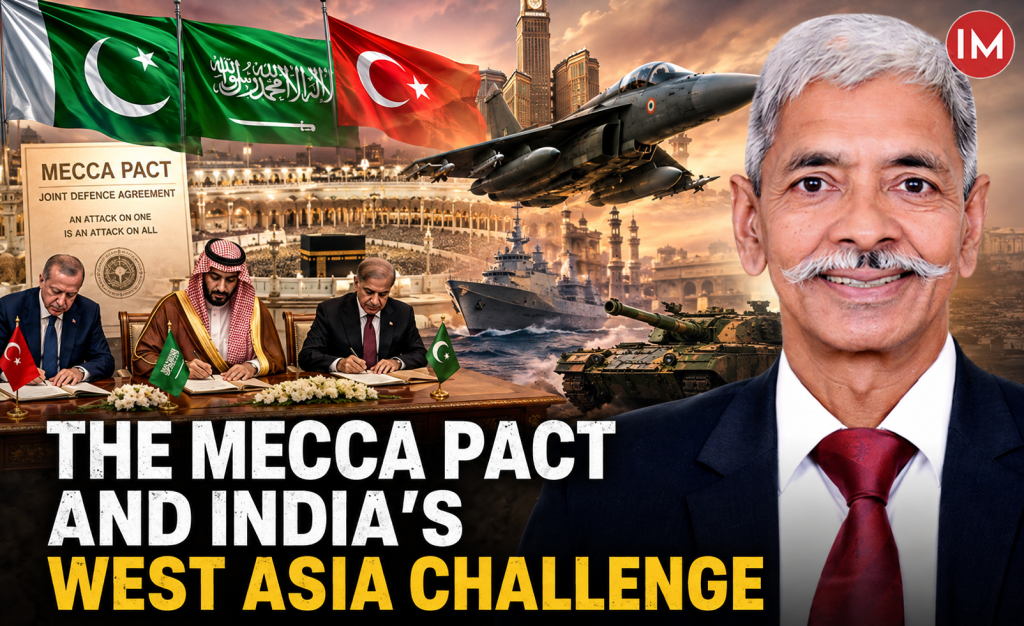
That is the real story behind the Mecca Joint Defence Agreement, signed on 7 August at Al-Safa Palace by Saudi Arabia, Turkiye and Pakistan, binding the three to treat an attack on one as an attack on all. Not the Pakistan angle everyone is fixated on. The initiative angle.
What Was Actually Signed
Strip away the noise and the text is straightforward: an armed attack on any of the three shall be regarded as an attack on all three. Turkish Foreign Minister Hakan Fidan has since said, on the record, that the commitment is “technically the same” as NATO’s Article 5. He should know that Turkiye has held NATO membership since 1952 and Fidan himself said the pact took nearly three years of quiet negotiation to finalise. A joint military-political committee is being set up. A secretariat will sit in Riyadh. And the door has been deliberately left open for more members, with Egypt named as a likely candidate.
Also Read – Atmanirbharta 2.0: India’s Real Defence Test Begins After the Factory Gate
This is not three governments issuing a joint statement for the cameras. It is the scaffolding of a functioning alliance, complete with the bureaucratic apparatus that turns a promise into an institution.
It also did not come from nowhere. Saudi Arabia and Pakistan signed a bilateral version of this same commitment back in September 2025, four months after the India-Pakistan military clash that May. What happened on 7 August was that bilateral arrangement growing a third leg and a governing structure. Anyone surprised by the trilateral pact was not paying attention to the bilateral one.
Resist The Urge to Make This About Pakistan Alone
Every instinct in the Indian strategic commentariat is going to reach for the Pakistan angle first, and it is not an unreasonable instinct. Pakistan remains the only nuclear-armed Muslim-majority state on earth, and its army chief was in Riyadh in the run-up to the signing. But that instinct, taken alone, misses the larger and more pertinent point.
This pact was signed in the shadow of a live war. Saudi Arabia has absorbed repeated missile and drone fire from Iran and Iran-aligned groups since the United States and Israel opened hostilities against Tehran in late February. Riyadh’s confidence in the American security umbrella has visibly cracked. Turkiye, watching Gaza and its own tensions with Israel, has its own reasons to hedge. This is, first and foremost, a Gulf hedge against Washington’s unreliability and Pakistan happened to be the most useful, most battle-tested, nuclear-capable partner willing to formalise that hedge.
That is a harder problem for India than a simple “Pakistan got a new friend” reading. It means West Asia’s security order is drifting from a set of American-anchored bilateral relationships toward a self-organising regional bloc, one that India was not consulted on, is not part of, and will now have to read from the outside.
On the nuclear question specifically, let me be precise rather than sensational. Saudi officials, when pressed last year on whether the bilateral pact extended Pakistan’s nuclear deterrent to Riyadh, gave a deliberately vague answer describing “a comprehensive defensive agreement- encompassing all military means.” No public text of either the 2025 or 2026 agreement confirms a formal nuclear commitment. Repeating that ambiguity as if it were confirmed fact does India’s strategic debate no favours. Flagging that the ambiguity has been allowed to persist across two successive agreements, deliberately, is a fair and useful observation. There is a difference, and Indian commentary should hold that line.
Why This Touches Every Indian Household, Not Just South Block
Here is the part that should worry ordinary Indians more than the defence-community chatter about warheads and squadrons. India still imports close to nine-tenths of its crude oil, and nearly half of that comes from the Middle East. Just over half of India’s total crude basket transits the Strait of Hormuz; a chokepoint that has already shown how fragile it can get this year.
Add close to ten million Indians working across the six Gulf states and remittances from that corridor making up nearly 38 per cent of everything India receives from its diaspora worldwide. A more tightly bound, more institutionalised Gulf security architecture is not a story confined to think-tank seminars. It runs through Indian refineries, Indian LPG cylinders, and the bank accounts of families in Kerala, Punjab and Uttar Pradesh who depend on a monthly wire transfer from Dubai or Riyadh.
The Governance Lesson New Delhi Keeps Skipping
In every corporate board now, there is a pattern that any independent director would recognise instantly. A company that runs entirely on the personal equation between two promoters, with no institutional process behind it, is one leadership change away from crisis. India’s West Asia strategy has run on almost exactly this model for two decades — real warmth at the top, most visibly the Modi-MBS relationship, standing in for deeper institutional depth.
That warmth delivered genuine gains. It did not stop Riyadh from signing first a bilateral, and now a trilateral, defence pact with Pakistan anyway. Personal rapport is an asset. It was never meant to be the entire strategy.
What New Delhi Should Actually Do
Nothing here calls for panic, and nothing here calls for a strongly worded statement either. It calls for structural work, most of which is already partially under way and simply needs acceleration.
Push crude and LPG diversification harder, building on the tilt toward American and non-Hormuz sources already visible this year. Deepen institutional not just ceremonial defence and energy dialogue mechanisms with the UAE and Qatar, both of which have kept India close through this period of regional flux. And build a standing, doctrine-level West Asia framework inside South Block that does not have to be reassembled from scratch every time a new bilateral pact catches New Delhi by surprise.
The three signatories at Al-Safa Palace insist their pact targets no one. India does not need to argue with that claim. It needs to make sure it is never again reading about the next one from a wire report instead of from inside the room.
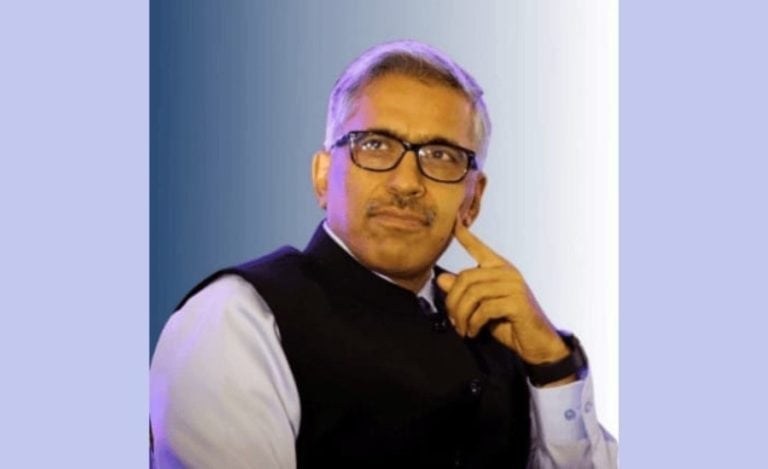
About the Author– Colonel M V Shashidhar (Retd) is an Independent Director, strategic governance commentator and leadership practitioner. He writes on geopolitics, corporate governance, sustainability and the intersection of national strategy and boardroom leadership.
Disclaimer—(The views and opinions expressed in this article are solely those of the author and do not necessarily reflect the views of Indian Masterminds. For feedback or queries, please write to [email protected].)
Also Read – When the Flood Recedes, the Learning Should Remain