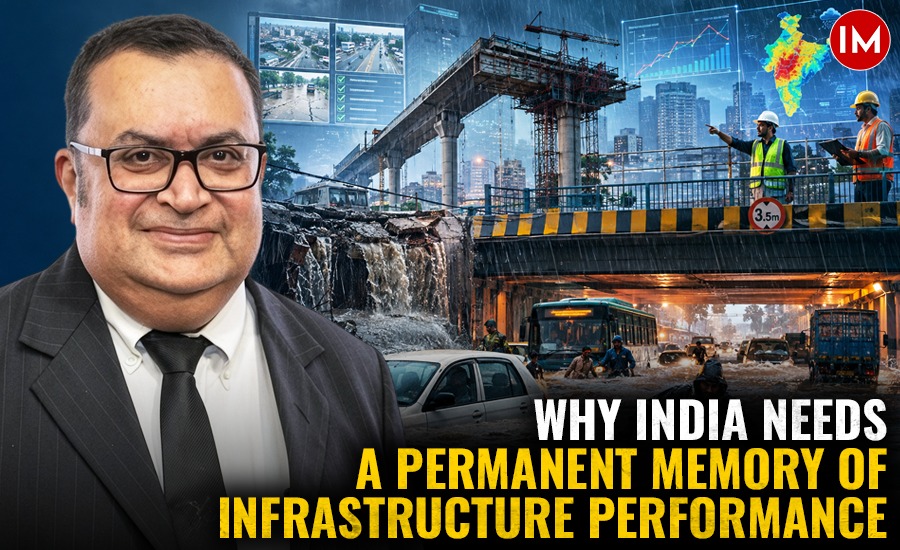
Across India, the monsoon produces a recurring sequence.
Rainfall intensifies. Roads waterlog. Underpasses close. Stormwater systems surcharge. Pumps are activated. Utilities are disrupted. Municipal teams respond. Engineers inspect damaged infrastructure. Repairs are commissioned.
Eventually, the water recedes. Traffic returns. The damaged road is reinstated. The pump is repaired. The culvert is cleared. Life moves on. But an important question remains: What happens to the knowledge created by the event?
India records enormous quantities of information around rainfall and disasters.
Meteorological agencies record rainfall. River authorities monitor water levels. Disaster-management systems issue warnings. Municipalities receive complaints. Road authorities record closures. Utilities record outages. Engineers document damage. Contractors record repairs. Insurers may record claims.
The problem is not necessarily the absence of data.
The problem is whether these separate records can eventually answer a much more useful question:
What happened to this particular physical asset during this particular event — and did we learn enough to make it perform better the next time?
That is where infrastructure resilience becomes a problem of institutional memory.
Also Read – Who Is Accountable When the Drain Fails?
THE PROBLEM — WE RECORD THE EVENT, BUT DO WE REMEMBER THE ASSET?
Consider a hypothetical urban catchment experiencing an extreme rainfall event.
The city may know how much rain fell. It may know which neighbourhoods flooded. It may know that roads were closed and pumping stations were activated. It may even know how much was subsequently spent on repairs.
But can the administration easily identify:
• Which individual manholes surcharged?
• Which pipe segments exceeded capacity?
• Which culverts became obstructed?
• Which pumps failed to start?
• Which roads remained operational?
• Which bridges required post-event inspection?
• Which infrastructure assets had failed during a previous event?
• Which had previously been upgraded?
And perhaps most importantly:
Did those earlier interventions improve their performance this time?
Without persistent identity, infrastructure knowledge is often assembled around projects, contracts, departments or incidents.
A culvert may appear in a road drawing under one number. The same culvert may appear differently in a GIS database. A maintenance contractor may use another reference. A flood-response report may describe it by location. A later capital-works project may assign yet another project number.
The physical asset remains the same. Its administrative identity does not necessarily remain continuous.
STHAVAR proposes to change that.
If every independently governable asset receives a permanent STHAVAR Ank, then every significant event affecting that asset can remain connected to it throughout its lifecycle.
The object does not need to be rediscovered every time something happens. It already has an identity. And therefore it can begin to acquire a memory.
THE COST — WHEN INSTITUTIONS FORGET, CITIES PAY TO LEARN THE SAME LESSON AGAIN
Infrastructure failure has an obvious cost. Road repairs cost money. Pump failures disrupt services. Flooding damages homes and businesses. Emergency response consumes public resources.
But there is another cost that receives less attention:
The cost of institutional forgetting.
A drain floods. It is cleared. A pump fails. It is repaired. A damaged road is reinstated. The expenditure is recorded. The contract is closed.
Yet if the reasons for the failure are not permanently associated with the asset itself, the next administration, consultant or contractor may have to reconstruct the same problem again.
The city may therefore pay repeatedly not only to repair the asset, but to rediscover why it is failing.
This is the difference between a maintenance history and a performance history.
A maintenance record might say:
Pump P-147 — repaired September 2026.
A performance record should be capable of saying much more: Pump P-147 experienced Event X. The rainfall conditions were recorded. The pump failed after a defined operating period. Inspection identified a particular cause. An intervention followed. During the next comparable event, the pump either failed again or performed successfully.
That sequence transforms an isolated repair into evidence.
Over time, the city begins to understand not merely what work has been undertaken, but whether the work actually improved infrastructure performance.
Public infrastructure should not be judged primarily by the volume of maintenance activity surrounding it. It should be judged by how reliably it performs when required.
THE SOLUTION — CONNECT ENVIRONMENT, EVENT, ASSET AND CONSEQUENCE
STHAVAR does not need to become another disaster-management platform. Nor should it duplicate meteorological or environmental systems.
The wider Saptarishi architecture allows the responsibilities to remain distinct.
Jamadagni Observes the Environment
Rainfall, river levels, terrain, catchment behaviour, flood susceptibility and other environmental conditions remain within authoritative environmental and geospatial systems.
Viśvāmitra Identifies the Significant Natural-Hazard Event
When a rainfall episode, flood, cyclone, earthquake, landslide or other natural hazard becomes significant enough to warrant persistent reference, it can receive a permanent Viśvāmitra Event Ank.
The event has an identity separate from the assets it affects.
STHAVAR Identifies the Physical Asset
The bridge, road, culvert, pumping station, manhole, building or utility component retains its permanent STHAVAR Ank.
STHAVAR Abhilekh Records What Happened
The asset’s federated lifecycle record can then retain authoritative references to consequences such as:
• exposed to
• damaged by
• service disrupted by
• inspected after
• repaired after
• restored after
• survived without material damage
The architecture can therefore be expressed simply:
Jamadagni observes the environment. Viśvāmitra identifies the event. STHAVAR identifies the asset. The Abhilekh remembers what happened.
No institution needs to surrender ownership of its authoritative information. STHAVAR only needs to preserve the connections between them.
FAILURE IS NOT THE ONLY THING WORTH REMEMBERING
There is an important bias in infrastructure management. Failure creates records. Success often does not.
When an underpass floods, there may be photographs, complaints, engineering reports and emergency works. When the neighbouring underpass remains operational under similar conditions, nothing may be recorded.
Yet the successful asset may contain the more valuable lesson.
Why did it perform? Was its drainage geometry better? Were pumps maintained more effectively? Was debris prevented from entering the system? Was the catchment smaller? Was preventive maintenance undertaken earlier? Did a previous intervention work?
A resilience system should remember what survived as carefully as it remembers what failed.
Imagine two comparable pumping stations experiencing the same major rainfall event. One fails. One remains operational.
If both carry permanent identities and their conditions, maintenance history and event performance are known, the city can compare them.
The question changes from “Why did Pump A fail?” to “What was different about Pump B that allowed it to succeed?”
That is the beginning of evidence-based resilience.
FROM EVENT RECORD TO LONGITUDINAL LEARNING
The real value appears when the record persists across multiple events.
Consider a hypothetical culvert:
2026: Heavy rainfall causes overtopping. Inspection identifies inadequate capacity and recurring debris accumulation.
2027: The culvert is enlarged and an upstream debris-control intervention is introduced.
2029: A comparable rainfall event occurs. The culvert remains operational.
2031: A more intense event occurs. The culvert performs within the revised design expectation.
This is no longer simply a sequence of maintenance records. It is evidence that an intervention worked.
Across thousands of infrastructure assets, the same principle could generate a national body of empirical knowledge.
Which drainage interventions actually reduce repeated flooding? Which road details survive extreme rainfall? Which retaining structures repeatedly require intervention? Which pump configurations remain reliable? Which materials deteriorate faster under particular environmental conditions? Which maintenance regimes produce the strongest resilience outcomes?
The knowledge loop becomes:
Event → Asset performance → Intervention → Next event → Validation → Better decision
Over time, this information can influence much more than maintenance. It can inform design standards; municipal engineering guidelines; capital investment priorities; procurement requirements; insurance and risk assessment; asset-renewal programmes; disaster preparedness; and future infrastructure design.
The result is an important shift:
A natural hazard stops being only a disruption and becomes a test from which the built environment can learn.
THE ABHILEKH SHOULD BE AN INDEX, NOT A WAREHOUSE
The solution does not require creating a giant database containing every engineering drawing, rainfall record, insurance document and inspection report in India.
That would introduce enormous questions around ownership, security, duplication and governance.
STHAVAR Abhilekh should instead operate as a federated lifecycle index.
It can record the permanent asset identity; the authoritative source of a record; the event connected to it; the nature of the consequence; the intervention undertaken; the provenance of the information; and where the authoritative evidence is held.
The principle is:
STHAVAR should know where the truth is held. It does not need to own all of the truth.
That allows municipal, environmental, financial, infrastructure and disaster-management institutions to remain responsible for their own records while still recognising the same physical asset.
Institutional memory therefore becomes persistent without requiring institutional centralisation.
EVERY MONSOON SHOULD MAKE THE NEXT ONE LESS SURPRISING
India cannot prevent every flood. No stormwater system can be designed for every conceivable rainfall event. No bridge, road, building or utility network can be made immune to all natural hazards.
Resilience should therefore not be defined as the impossible promise that infrastructure will never fail.
A more practical ambition is this:
Every significant event should leave the system better informed than it was before.
When a bridge performs well, remember why. When a pump fails, remember why. When a culvert is upgraded, test whether the intervention worked. When a road repeatedly floods, do not allow each occurrence to become a new investigation. When an asset survives a major event without damage, preserve that evidence too.
India is building infrastructure at extraordinary scale. At that scale, institutional memory becomes infrastructure in its own right.
The rainfall will stop. The flood will recede. The road will reopen. The pump will be repaired. The immediate crisis will eventually disappear from public attention.
The learning should not.
Because a country building for the next several decades cannot afford to let every monsoon become the first monsoon again.
About The Author – (Apurva Pathak is a New Zealand-based architect, design manager, and built-environment governance
practitioner with more than three decades of experience across India, the Gulf, Africa, Papua New Guinea, and New Zealand. He is the author of the Saptarishi Framework, a proposed seven-layer Digital Public Infrastructure architecture for India’s built environment, integrating BIM, GIS, land governance, municipal automation, digital twins, environmental intelligence, and resilience planning.)
Disclaimer—(The views and opinions expressed in this article are solely those of the author and do not necessarily reflect the views of Indian Masterminds. For feedback or queries, please write to [email protected].)
Also Read – Why India Needs a National Architecture & Construction Cloud