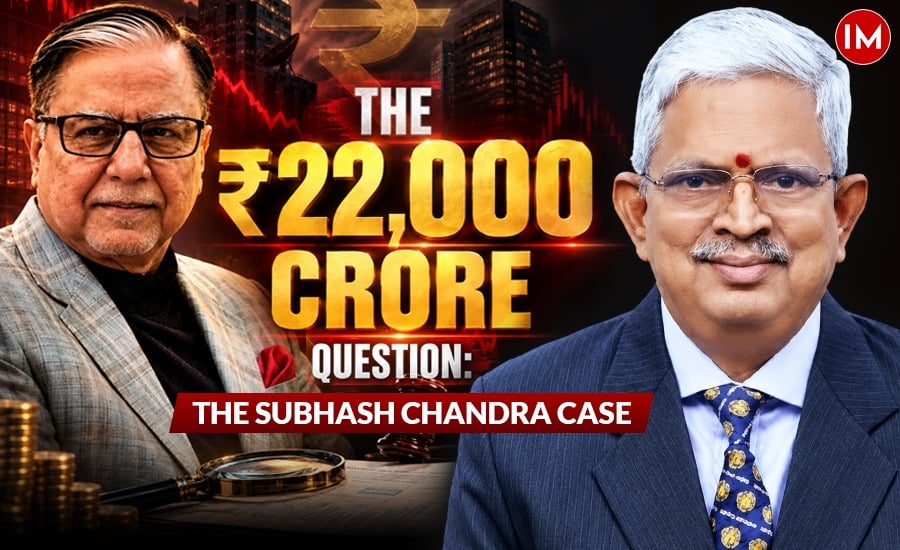
Few insolvency cases have generated as much noise in as little time as the Subhash Chandra repayment plan before the National Company Law Tribunal. The headline number—Rs 22,006.57 crore of admitted claims against a personal contribution of just Rs 6.5 crore—has triggered outrage, confusion and competing claims about what was actually recovered. But beneath the dramatic arithmetic lies a far more important question: did the tribunal merely follow the law, or did the process expose serious gaps in India’s personal insolvency framework? This first part examines the numbers, the NCLT’s reasoning, the creditors’ vote and the strongest arguments on both sides, while separating what is established from what remains unverified.
Every so often a tribunal order escapes the specialist journals and becomes folklore. The order pronounced on 25 August 2026 by Nilesh Sharma, Judicial Member of the National Company Law Tribunal (NCLT), sitting as the third member to break a deadlock, has managed it in under forty-eight hours. Its central number is irresistible: Rs 22,006.57 crore of admitted claims, Rs 6.25 crore for the creditors, Rs 25 lakh for process costs. Six and a half crore rupees in total. A recovery of about 0.03 per cent. A haircut of 99.97 per cent.
Also Read – When the Flood Recedes, the Learning Should Remain
Within a day the figure had been rendered into the shorthand that will outlive every paragraph of the order–“NCLT waives Rs 22,000 crore”–and Vijay Mallya, watching from London, had congratulated his “friend Subhash” on X, noting that banks and the government had acknowledged recovering Rs 14,100 crore from him against a judgment debt of Rs 6,203 crore, and signing off with the phrase that will do the rounds for months: “Indian Debt Resolution Justice, I presume.” Those recovery figures are Mallya’s own assertions and form no part of the tribunal’s reasoning; but the juxtaposition is precisely the sort of thing that erodes public faith in a statute faster than any judgment can rebuild it.
The shorthand is wrong, and the wrongness matters. The tribunal did not decide that Rs 22,000 crore should be forgiven. A statutory majority of creditors decided that, and the tribunal decided that it could not substitute its own commercial judgment for theirs. That is a materially different proposition, and everything interesting about this case lies in the gap between the two.
It is also, as it turns out, not the only number in the case. Within four days the same order had generated a figure for payments by the principal borrowers running into four digits of crores, a bank publicly claiming a recovery two orders of magnitude above the headline, and a counter-figure from the guarantor himself putting the relevant claims at a fifth of the reported total. None of these can be reconciled from the public record, because the order itself remains unpublished. Before anything can be said about what this case means, something has to be said about which number it actually is.
From a Rs 170-Crore Guarantee to a Rs 22,006-Crore File
The file did not begin as a leviathan. It began with a loan of Rs 170 crore advanced to Vivek Infracon, against which Subhash Chandra had signed a personal guarantee. When the loan soured, Indiabulls Housing Finance Limited–since renamed Sammaan Capital–moved the NCLT in 2022 under Section 95 of the Code (IBC), the provision that permits a creditor to initiate an insolvency resolution process against an individual.
There followed the sort of procedural detour that has become the Code’s signature. Chandra contested the tribunal’s authority to adjudicate individual insolvency at all. The matter travelled to the appellate tribunal (NCLAT), where it was closed on Indiabulls’ indication that a settlement had been reached. The settlement never materialised. In November 2023 the Supreme Court, dismissing 384 writ petitions in Dilip B. Jiwrajka v. Union of India, upheld the constitutional validity of Sections 95 to 100 of the IBC and confirmed that the resolution professional’s function at the pre-admission stage is facilitative rather than adjudicatory. The proceedings against Chandra were revived in February 2024 and the petition was admitted that April.
Between the Rs 170-crore trigger and the Rs 22,006.57-crore file lies the entire logic of the personal guarantee. Chandra did not borrow Rs 22,000 crore in his own name. He stood surety, repeatedly, across a sprawling group, and every creditor holding such a surety filed in the personal insolvency once the door was opened. Chandra’s office has since added a detail that changes the complexion of the file considerably: the total value of guarantees he signed was around Rs 22,000 crore, and most of them, it says, were issued after 24 January 2019–that is, after the group had already defaulted in the financial system. If that is right, a substantial part of the paper now being enforced was taken from a man whose distress was public knowledge at the moment he signed. The guarantee, in Indian lending practice, has always been less a security than a signal–a promoter’s statement that he believes in his own project. In this case the signal was cashed in and found to be worth, at present valuation, a little over Rs 31 crore of personal estate against which the objectors set net-worth certificates that they said showed Rs 45,888 crore in 2017 and Rs 40,562 crore in 2018.
The Bench That Could Not Agree
The repayment plan, prepared by the debtor in consultation with the resolution professional under Section 105 of IBC, was put to the creditors and carried with 80.814 per cent of voting share– comfortably above the threshold of more than three-fourths in value prescribed by Section 111 of the IBC. That should have made approval a formality. It did not.
The original division bench split. Judicial Member Ashok Kumar Bhardwaj favoured approval. Technical Member Reena Sinha Puri did not, finding what has been described in reports of the proceedings as serious legal and procedural defects in the proposal. A division of opinion on a point of this magnitude is itself instructive: it means that two members of the same bench, reading the same record, could not agree whether the IBC permitted the outcome. The president of the tribunal thereupon nominated Nilesh Sharma as the third member, and it is his opinion, running to a reported 144 pages, that has now carried the day.
The mechanism deserves a moment’s attention because it is often misdescribed. The third member does not sit in appeal. He hears only the points of difference and answers them, whereupon the matter returns to the original division bench, which must pass the formal order in accordance with the majority view under Section 419(5) of the Companies Act, 2013. As of this writing that formal order has not issued. The plan is therefore approved in substance and awaiting its instrument–a distinction that will matter to anyone drafting an appeal to the NCLAT.
What the Third Member Actually Decided
If we strip away the headline, the order does three things.
First, it declines to treat the size of the haircut as, by itself, a ground for rejection. Section 114 requires the adjudicating authority to approve or reject the repayment plan on the basis of the resolution professional’s report of the creditors’ meeting; it prescribes no floor, no minimum percentage, no fairness ratio. The third member held that the tribunal could not displace the commercial decision of a statutory majority with its own view of what an acceptable settlement looks like, and that on the valuation material before it, rejection was unlikely to leave dissenting creditors better off–rejection under Section 115(2) opening the door to bankruptcy proceedings, from which the realisable estate would be no larger and quite possibly smaller.
Second, it found a real defect in the claims process and treated it as curable rather than fatal. Claims lodged by one Anil Kumar on behalf of 960 individuals, and by one Sunil Jain on behalf of 300 more, had been admitted by the resolution professional without supporting documents. Sharma directed their exclusion and the preparation of a revised creditor list, characterising the admission as a lapse by the resolution professional but not one grave enough to vitiate the plan. The Rs 6.25 crore pool stays; the denominator changes; individual entitlements shift.
Third, it refused to disenfranchise five entities whose votes the objectors sought to exclude–Veena Investments Private Limited, Direct Media Distribution Ventures Private Limited, World Crest Advisors LLP, Lemonade Capital Advisors LLP and Corpcall Capital Advisors LLP–holding that the statutory definition of “associate” in Section 79(2)(g) could not be stretched to cover mere allegations of family, business or commercial proximity. Since the plan carried with 80.814 per cent and the objectors together commanded under twenty, this holding was load-bearing.
It is worth recording what the order did not do. It did not order a forensic audit. Confronted with the gap between net-worth certificates in the tens of thousands of crores and a present estate of some Rs 31.79 crore, the third member held that the discrepancy alone established neither concealment nor a mandatory obligation to investigate before considering the plan. That single holding is where the legal defensibility of the order and its public credibility part company.
Which Number Is the Real One?
Before the argument can proceed, the arithmetic has to be pinned down, and it will not stay still. Five figures are now in circulation for the same transaction, and the gaps between them are not rhetorical.
The first is Rs 22,006.57 crore, the admitted claims. Nobody disputes that this is what the resolution professional admitted, but the third member has himself directed that claims lodged for 1,260 individuals be excluded and the creditor list revised. The denominator is therefore already known to be wrong, and is being recomputed downward by an amount nobody outside the tribunal can presently state.
The second is Rs 6.25 crore for creditors and Rs 25 lakh for process costs–Chandra’s personal contribution, drawn from an estate he has disclosed at Rs 31.79 crore. This figure is not in dispute, and it is the one that generates the 0.03 per cent and the 99.97 per cent that have circled the world.
The third is Rs 1,494 crore, reported as the payments by the principal borrowers that the repayment plan itself envisages, over and above Chandra’s personal contribution. If that is accurate, then every account of this case–including the first version of this note–has been comparing the wrong things. The consideration moving under the plan would not be Rs 6.5 crore but something close to Rs 1,500 crore, and effective recovery against admitted claims would be nearer seven per cent than three basis points. That is still a severe haircut. It is not a scandalous one, and it is emphatically not what the headlines have said. The figure is attributed to unnamed sources in a single agency report and appears nowhere else; until the order is published it must be treated as unverified. But its mere plausibility is enough to require every confident assertion about 99.97 per cent, this note’s included, to be qualified.
The fourth is 3.2 per cent–HDFC Bank’s own public statement of what it stands to recover on the strength of the 25 August order, which it opposed and is now considering appealing. A bank that voted against the plan has no incentive to overstate its recovery, and 3.2 per cent is a hundred times the headline. Either distribution under the plan is radically unequal between classes of creditor, or HDFC is counting recoveries from the principal borrowers within its figure. Both readings are consistent with the Rs 1,494 crore report; neither is consistent with the story the country has been told.
The fifth is Rs 3,992 crore, Chandra’s own figure for what he says the relevant claims actually amount to, as against the Rs 22,000 crore being reported. He has not explained the basis on which he arrives at it, and a guarantor’s characterisation of the claims admitted against him is not evidence of their quantum. But if 1,260 claims are to be struck out and a fraction of the admitted book is duplicative across co-guarantees, the gap between his number and the tribunal’s is at least a question rather than an evasion.
Where does that leave the analysis? On the most conservative reading available, the personal contribution is a rounding error against the personal exposure, and that much is certain. Whether the plan as a whole is a rounding error is not presently knowable from the public record, and anyone who says otherwise is guessing. The critique that survives either reading is procedural rather than arithmetical: a claims roll the tribunal has itself found defective, a majority computed on that roll, an associates test too narrow to reach the entities the objectors named, and–above all–no forensic examination of how a disclosed estate came to be worth Rs 31.79 crore. Those objections do not soften if the recovery turns out to be seven per cent. They are about how the answer was arrived at, not what it was.
The Case for the Order
It would be lazy to treat this as an indefensible decision, and the strongest version of the case for it should be stated plainly.
Let us begin with the statute. Part III of the Code (IBC) is not a recovery mechanism. It is a rehabilitation framework, built on the premise–old as the Statute of Anne and refined in every modern insolvency system–that an insolvent individual should be able to offer what he has, be discharged, and re-enter economic life. Section 111 fixes a three-fourths threshold precisely so that a minority cannot hold the process hostage. Section 115 makes an approved plan binding on dissenting and abstaining creditors alike, for the same reason. To read into Section 114 an unwritten requirement that recovery must reach some judicially satisfying percentage would be to legislate from the bench in a statute that has already told the bench where its role ends.
Next, the counterfactual. What is the alternative to Rs 6.25 crore? Rejection leads to bankruptcy under Chapter IV, a bankruptcy trustee, a further round of realisation from the same estate, further costs, further years. If the estate really is worth about Rs 31 crore, and if secured and preferential claims stand in front, the dissenting creditors are not being deprived of a better bargain; they are being deprived of a longer one. The tribunal’s conclusion that rejection would not improve their position is not a rhetorical flourish–it is the statutory best-interests test doing its work.
Third, the commercial-wisdom doctrine. Whatever one thinks of it, Indian insolvency jurisprudence has spent a decade insisting that tribunals must not second-guess creditors’ commercial judgment. The Supreme Court’s extraordinary sequence in the Bhushan Power matter–rejecting the JSW plan and directing liquidation in May 2025, recalling that judgment in July, and on rehearing restoring the plan –was in substance a reaffirmation of exactly that principle, delivered at some cost to the Court’s own consistency. A third member who had rejected a plan carried by 80.814 per cent, on the ground that the payout offended his sense of proportion, would have been reversed on appeal and would have deserved to be.
Fourth, and least comfortable for the critics: the creditors voted for this. Not one or two, but institutions holding four-fifths of the value on the table. Whatever calculation led them there–the futility of chasing a depleted estate, the wish to close a provision, the desire to preserve claims against principal debtors that survive untouched–it was theirs to make. If the outcome is scandalous, the scandal begins in the credit committees, not in Court No. VI.
The Case Against the Order
And yet. Four objections survive the steel-manning, and they are not small.
The first is the forensic hole. A tribunal presented with a documented collapse from tens of thousands of crores to Rs 31.79 crore had before it the single most probative question in the entire file: where did it go? And here the IBC plays a trick that deserves more attention than it gets. Its avoidance armoury for individuals–Section 164 on undervalued transactions, Section 164A on transactions defrauding creditors, Section 165 on preferences, Section 167 on extortionate credit–sits in Chapter V of Part III and vests in the bankruptcy trustee. It becomes available only if the repayment plan fails and bankruptcy follows. Approve the plan, and the look-back never happens. That is not a drafting nicety; it is the whole game. A guarantor whose estate has thinned inexplicably has every incentive to procure approval of a modest plan precisely in order to foreclose the one inquiry capable of unwinding it. To hold that the discrepancy “alone” does not compel investigation is technically unimpeachable and practically an abdication, because the discrepancy is never going to arrive at the tribunal accompanied by a confession. If a fall of that magnitude does not trigger the inquiry, it is difficult to conceive of the fall that would.
The second is the associates test. Section 79(2)(g) of the IBC is narrowly drawn, and the third member is right that it cannot be enlarged by allegation. But an insolvency regime in which relatedness must be proved to the standard of a definition, while the voting occurs on the strength of the unexamined list, has the burden the wrong way round. In corporate insolvency, Section 21(2) excludes related parties from the committee of creditors precisely because the risk of a debtor voting on his own settlement is structural rather than exceptional. Part III has no equivalent muscle. That is a legislative gap, not a judicial error–but it is a gap through which a great deal can walk.
The third is the quality of the claims process. Twelve hundred and sixty individual claims admitted without supporting documents is not a clerical slip; it is a failure of the very function that gives the resolution professional his standing in the proceeding. If the list was that porous on the way in, the confidence one can place in the voting percentages computed from it is correspondingly reduced. To call this a lapse and move on is to treat the integrity of the electoral roll as severable from the legitimacy of the election.
The fourth is the character of the consideration itself. Objecting creditors pointed out that the Rs 6.5 crore had been described as indicative rather than fixed–a point that appears in only one detailed account of the proceedings and should be treated as unverified until the order is published. If accurate, it means a binding statutory discharge has been erected on a number that is not yet a number.
Underneath all four sits the moral-hazard argument, which is not a legal objection but is the one the country will actually make. A personal guarantee is the last line of defence in Indian corporate lending. Its entire value lies in the guarantor’s belief that it will be enforced against him personally. An order which converts that guarantee into a discharge purchasable at a fraction of one per cent of the guaranteed exposure does not merely settle one file; it re-prices every promoter guarantee on every bank’s books.
The Guarantor’s Brief, Tested
Chandra has not stayed silent, and his account deserves better than either the dismissal it has received in the coverage or the polite recital it received in the first version of this note. He makes three claims. Each should be tested rather than repeated.
The first is that he never borrowed a rupee in his personal capacity, and that the admitted claims arise entirely from guarantees furnished for borrowings by Essel and Zee-linked companies. This is true in form and thin in substance. Section 128 of the Contract Act makes a surety’s liability co-extensive with the principal debtor’s; the obligation is independent, not derivative. And a promoter-guarantor is not a stranger standing surety for a friend–he is the beneficial owner of the borrowing entities, and the guarantee was the price at which the credit was advanced to businesses whose equity value was his. Nor does he dispute that Rs 22,006.57 crore stands admitted against him personally; indeed his own office puts the aggregate value of guarantees he signed at around Rs 22,000 crore. The distinction between borrower and guarantor matters for how the headline should be written. It does not reduce what he undertook.
The second is that group borrowings stood at about Rs 45,000 crore on 24 January 2019 and that roughly Rs 43,000 crore has since been repaid. Here the account does not hold together. If Rs 43,000 crore of Rs 45,000 crore has been repaid, the residue is some Rs 2,000 crore–yet the admitted claims against him are Rs 22,006.57 crore, and even his own revised figure is Rs 3,992 crore. Neither fits. The reconciliation, oddly enough, lies in his own statement: if most of the guarantees were executed after 24 January 2019, then the Rs 43,000 crore repaid belongs to the pre-default stock while the guarantee liability is largely a subsequent restructuring layer. The two figures are not numerator and denominator of the same fraction, and presenting them as a ninety-six per cent repayment record is misleading even if each number is individually accurate. There is a second slippage in the word “repaid.” The group deleveraged substantially by selling assets and by settling with lenders–the reported position in August 2021 was a settlement with forty-three lenders, which is not the same as payment in full. None of this is dishonest. All of it is doing more work in his statement than the underlying facts will bear.
And yet the same fact cuts hard in his favour, and the point deserves to be made bluntly because nobody making it has an interest in doing so. If the bulk of these guarantees were taken after the group had publicly defaulted–after the January 2019 crash, after the open letter of apology to lenders–then the institutions that took them knew, or had every means of knowing, that the man signing was worth a small fraction of what he was guaranteeing. Paper of that kind is not security. It is ritual: a comfort document that permits a restructuring to be booked and a provision to be deferred. The lenders now protesting a 99.97 per cent haircut accepted instruments they had no rational basis for valuing at par on the day they accepted them.
The third claim is the net worth: Rs 31.79 crore as assessed in 2024, including a residential property valued at about Rs 25 crore. Several cautions attach. It is self-declared to the resolution professional, unaccompanied by any independent valuation commissioned by creditors–precisely the gap this note identifies elsewhere. A personal net-worth statement captures assets held in one’s own name, and promoter wealth in India habitually sits in family trusts, Hindu undivided families, private investment vehicles and the names of relatives; the five entities whose votes the objectors sought to exclude are exactly that species, and the tribunal held only that they were not proved to be associates, not that they were unconnected in fact. A declared estate is a floor, not a ceiling.
But his methodological objection to the Rs 45,888 crore figure is probably right, and it is the strongest thing he has said. He points to his own declaration of total assets at Rs 39.08 crore in the 2016 affidavit filed as a member of the Rajya Sabha–a sworn statement to Parliament, made under penalty, one year before the certificate that valued him at Rs 45,888 crore. Those two documents cannot both describe the same man’s personal estate. If the certificate aggregated the market capitalisation of every listed group company and attributed it to the guarantor, then the celebrated collapse from Rs 45,888 crore to Rs 31.79 crore never occurred, because the larger figure was never his to lose.
Which turns his sharpest question on his lenders rather than on himself: how, he asks, could a bank accept a net worth of Rs 45,888 crore in 2017? It is the best question in the affair and nobody has answered it. There is a counter, and it is not trivial: a net-worth certificate of that kind is ordinarily procured by or for the borrower to induce credit, and if his own side furnished the arithmetic he cannot disown the methodology while keeping the loan. Who commissioned that certificate, and on whose instructions, is answerable from the file. Nobody has asked.
The net of it: his first claim is accurate and immaterial; his second is unreconciled and, as framed, misleading; his third is probably true and, if true, indicts the underwriting more severely than the borrower. And on the single step that would settle all three at once–an independent examination of his estate and its disposals–he and his fiercest critics ought to be on the same side. He is the only person in this proceeding who can convert an assertion into an acquittal, and the order as it stands has denied him the chance.
What Part III Was Built For, and What It Is Being Asked to Do
The deeper trouble is architectural. Part III of the Code (IBC) was drafted for individuals and partnership firms–the small trader, the failed proprietor, the guarantor of a modest advance. Chapter III of that Part gives the debtor the pen: he prepares the repayment plan, the resolution professional assists, the creditors vote, the tribunal ratifies. It is a consensual, low-friction, low-cost mechanism, and for its intended constituency it is the right design.
It was never designed to adjudicate the estate of a man who has guaranteed Rs 22,000 crore across a conglomerate. For that task it lacks almost everything corporate insolvency has acquired: no committee of creditors with statutory powers, no related-party exclusion from voting, no mandatory transaction audit, no independent valuation of the debtor’s estate by registered valuers appointed on the creditors’ motion, no Section 29A-style ineligibility, no meaningful discovery. The debtor discloses; the professional collates; the majority votes; the tribunal ratifies. Applied to a large estate, that is not a resolution framework. It is an honour system with a gavel.
The numbers tell the same story. As of March 2024, creditors had recovered 2.16 per cent—Rs 102.78 crore in absolute terms–of admitted claims against personal guarantors; of 383 admitted processes, 124 had closed, of which 86 closed because no repayment plan was submitted or the plan was rejected, and just 26 yielded an approved plan. Read against that baseline, the Chandra order is not an aberration. It is the mode of the distribution, dressed in a headline.
Nor is the corporate side reassuring. ICRA’s assessment marking the Code’s tenth year found recoveries falling to about 23 per cent of admitted claims in 2025-26 from 46 per cent the year before, with average haircuts of 68 per cent, an average resolution timeline of 744 days against a statutory 330, and 78 per cent of ongoing corporate insolvency processes past the 270-day mark as on 31 March 2026. Realisation in liquidation touched 3.6 per cent. The regulator’s own newsletter for the period to September 2025 records realisation of Rs 3.99 lakh crore against admitted claims of Rs 12.31 lakh crore–a haircut of about 67 per cent. The Code’s genuine triumph, and it is a real one, lies elsewhere: some 42,402 matters have been disposed of at the tribunal since inception, of which roughly 83 per cent, carrying underlying defaults of about Rs 16 lakh crore, were settled before admission. The IBC works best as a threat. Its difficulty is what happens when the threat has to be executed.
The Subhash Chandra case is therefore about much more than a 99.97 per cent haircut. It raises questions about creditor voting, claims verification, asset disclosure and the limits of the IBC itself. This is only the first part of the analysis.
(Part 2 will follow soon, examining the wider implications for lenders, promoters, personal guarantees and India’s insolvency regime.)
About The Author– Mr. P Sesh Kumar is a retired 1982-batch officer of the Indian Audit and Accounts Service (IA&AS) who served as Director General of Audit at the Comptroller & Auditor General of India.
Disclaimer—(The views and opinions expressed in this article are solely those of the author and do not necessarily reflect the views of Indian Masterminds. For feedback or queries, please write to [email protected].)
Also Read – Beyond Avlokan: Who Will Audit India’s International Tax Administration? (Part-2)