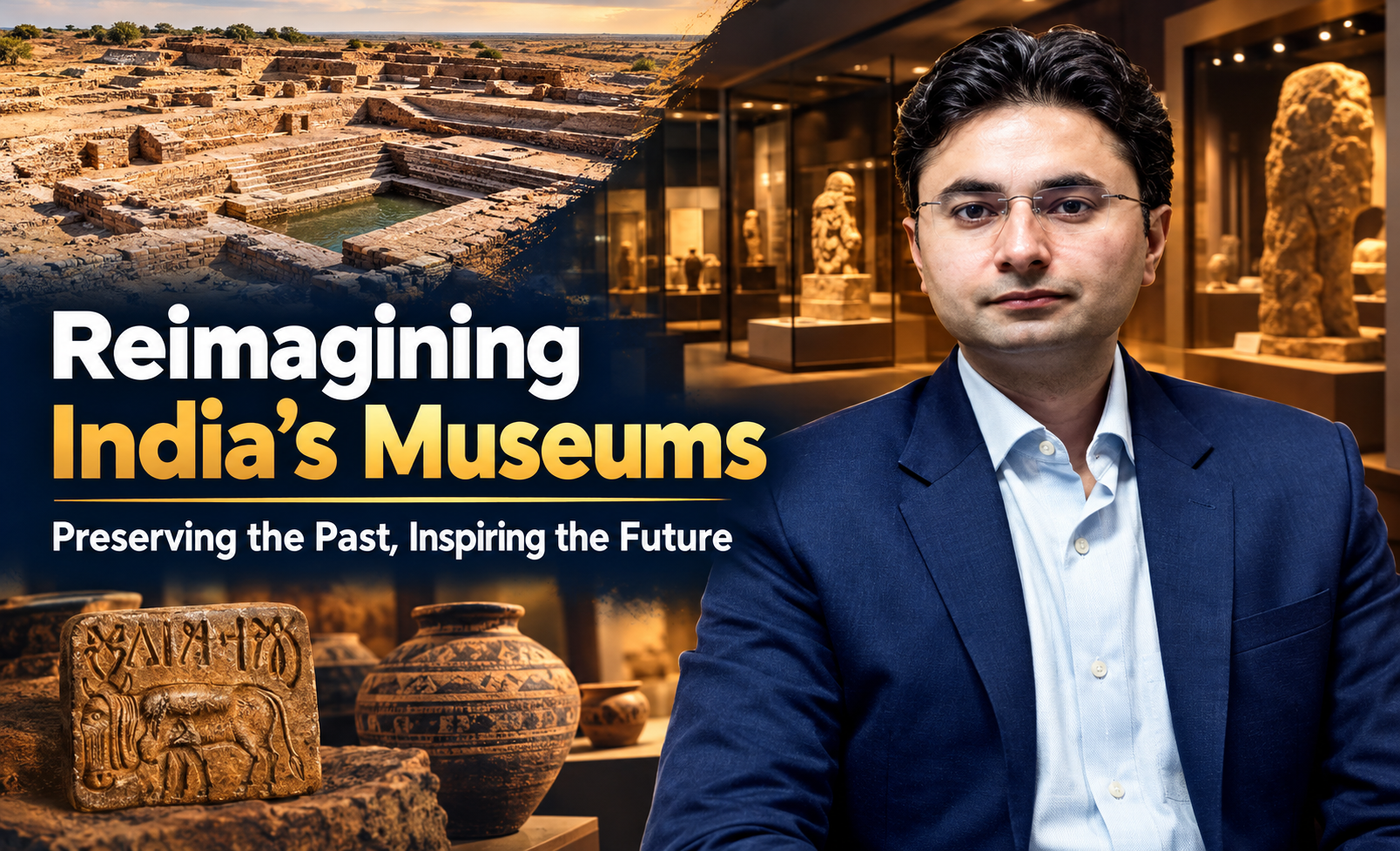
What if a visit to a museum could transport a child thousands of years into the past, revealing how ancient Indians built cities, managed water, traded goods and developed sophisticated systems of living? What if museums were not merely places to see old objects but spaces where India’s civilisational story came alive through technology, interactive experiences and engaging storytelling?
This is the vision behind India’s evolving approach to museums and heritage tourism. From developing world-class museums at historically significant locations such as Dholavira to improving facilities around protected monuments, the focus is shifting towards making the country’s rich cultural inheritance more accessible, engaging and relevant to modern audiences.
For Inderjeet Singh, a 2010-batch IAS officer currently posted as Joint Secretary in the Ministry of Culture, Government of India, this transformation reflects a larger question about governance: how can public institutions move beyond conventional approaches and use innovation to create greater value for society?
The answer lies in reimagining how people experience history, combining cultural preservation with technology, better public facilities and a willingness to experiment. While museums and monuments remain custodians of India’s past, their future will increasingly depend on how effectively they connect that past with younger generations and visitors from around the world.
MUSEUMS AS WINDOWS INTO INDIA’S CIVILISATION
“Museums have an important role in preserving historical objects, but their potential extends far beyond displaying artefacts. They can help people understand how civilisations evolved, how communities organised their lives and how knowledge, technology and cultural practices developed over centurie”, Mr. Singh said during a conversation with Indian Masterminds
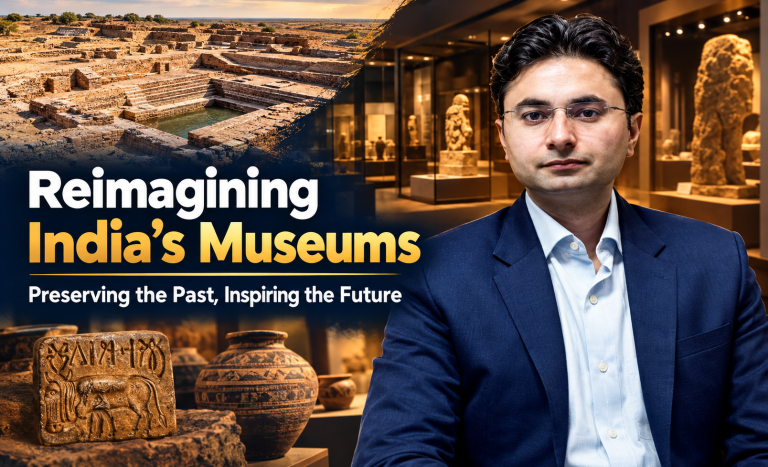
The proposed Desh… museums initiative, announced in the Union Budget, reflects this broader ambition. It envisages the development of museums across the country at locations associated with India’s civilisational heritage. Dholavira in Gujarat, an important site of the Indus Valley Civilisation, is among the locations highlighted in this context.
Dholavira offers a remarkable opportunity to tell the story of an ancient urban civilisation through its archaeological remains. Its planned streets, sophisticated water-management systems and evidence of organised settlement can help visitors understand the ingenuity of communities that lived thousands of years ago.
Also Read – Inside the Journey of Praveen Sood, the IPS Officer Leading the CBI
The challenge is to translate such historical evidence into experiences that visitors can easily understand and remember. Instead of limiting the presentation to information panels and exhibits, museums can use immersive displays, digital storytelling and interactive technologies to explain how people lived and how their societies functioned.
For children, this could make history more engaging. For researchers, it could offer new ways to explore archaeological evidence. For international visitors, it could provide a deeper understanding of India’s civilisational achievements.
The objective is to create world-class museums that do not simply preserve the past but communicate its significance to a wider audience. By connecting historical objects with the stories behind them, these institutions can make India’s cultural heritage more accessible and meaningful.
MAKING HISTORY RELEVANT TO YOUNGER GENERATIONS
One of the biggest challenges facing cultural institutions is attracting younger audiences who increasingly consume information through digital platforms. Traditional museum displays remain valuable, but there is considerable scope to make visits more interactive and participatory.
A museum can become a place where visitors do more than observe. Through carefully designed digital experiences, they can explore ancient settlements, understand historical technologies and discover how everyday life differed across periods and regions.
Such experiences can also help bridge the gap between historical knowledge and contemporary questions. An ancient water-management system, for instance, can prompt discussions about urban planning, sustainability and the management of natural resources today. Similarly, archaeological evidence of trade and settlement can help explain the development of cities and economic networks.
The proposed museums can therefore serve as educational spaces that connect India’s past with its present. Their success will depend not only on the quality of their collections but also on how effectively they communicate complex historical ideas to visitors of different ages and backgrounds.
Technology can support this effort through interactive displays, virtual reconstructions and multilingual interpretation. However, the purpose is not to replace the historical objects themselves. It is to help visitors understand their context and appreciate the societies that produced them.
TURNING HERITAGE SITES INTO LIVING EXPERIENCES
The effort to improve India’s cultural experiences extends beyond museums to monuments protected by the Archaeological Survey of India (ASI). These sites preserve important chapters of the country’s architectural, political and social history, but the overall visitor experience also influences how people engage with them.
One initiative involves encouraging public-private partnerships to develop facilities around historical monuments. Better visitor amenities, including suitable restaurants and other services, can make these destinations more comfortable for families and tourists.
The idea is to move beyond the model in which people visit a monument briefly before leaving. With appropriate facilities, visitors may be encouraged to spend more time exploring the site, learning about its history and experiencing the surrounding area.
The approach began in Delhi and is now being expanded beyond the capital. It reflects an understanding that heritage tourism requires both conservation and thoughtful visitor management.
Such development must, however, respect the historical and architectural character of protected sites. Commercial facilities should complement the heritage experience rather than overshadow it. When planned carefully, public-private partnerships can help improve amenities while allowing government institutions to focus on conservation and public access.
The broader objective is to make heritage destinations more welcoming without compromising their historical significance. A well-designed visitor experience can strengthen public interest in monuments and encourage people to develop a deeper connection with India’s cultural inheritance.
TECHNOLOGY AS A DRIVER OF CULTURAL TRANSFORMATION
Underlying these initiatives is a wider philosophy about the role of technology in public administration. Technology is not simply a means of digitising existing systems; it can also help institutions rethink how they deliver services and engage with the public.
In the cultural sector, this approach can connect museums, monuments, historical records and educational resources with audiences who might otherwise have limited access to them. Digital platforms can make information available across geographical boundaries, while interactive tools can help visitors understand complex subjects more easily.
The same thinking is reflected in the Gyan Bharatam Mission and efforts to make ancient manuscripts more accessible through digitisation and artificial intelligence. Although these initiatives address a different aspect of cultural preservation, they share a common objective with the museum programme: making India’s knowledge and heritage easier to discover, understand and experience.
For Singh, this broader approach to innovation highlights the importance of looking beyond routine administrative processes. An initiative that begins with a conventional objective can often create greater public value when institutions explore new technologies and methods of delivery.
However, innovation also involves uncertainty. New approaches may not always produce immediate results, and experimenting with unfamiliar systems can expose officials to criticism. Yet avoiding every risk can leave institutions dependent on established methods, even when better alternatives are possible.
The challenge is to use technology purposefully, ensuring that it improves public access, strengthens institutional capacity and addresses genuine needs.
BREAKING THE CULTURE OF BUSINESS AS USUAL
Technological solutions can succeed only when they are supported by a corresponding change in administrative thinking. Government systems need rules and procedures to ensure accountability, but following established processes without examining their outcomes can limit innovation.
Singh’s approach emphasises that public service must extend beyond completing officially assigned tasks. Bureaucrats must also recognise their responsibility as members of society who can identify problems and contribute to their resolution.
A bureaucrat is first a member of society and then a public servant. This principle places social responsibility at the centre of governance. It suggests that the motivation to address public problems should not depend entirely on official instructions, financial incentives or the creation of a new government scheme.
The Udaan programme, discussed in this context, focused on children in the six-to-fourteen age group and sought to address issues related to education. The initiative was described as an effort undertaken out of personal responsibility rather than merely as a formally assigned task.
Such examples illustrate how public service can move beyond administrative boundaries. Whether the challenge concerns education, cultural preservation or access to public facilities, meaningful change often begins when officials take ownership of a problem and explore ways to address it.
CHANGE MUST BECOME PART OF GOVERNANCE
For reform to become sustainable, it cannot depend solely on external pressure or individual instructions. Change must become part of the institutional mindset, encouraging public servants to question existing practices, experiment with new approaches and continually assess their results.
This is particularly important in cultural administration, where India’s heritage is spread across diverse geographical locations and historical periods. A single model may not work equally well for every museum or monument. Institutions must adapt their approaches to the significance of each site, the needs of visitors and the practical requirements of conservation.
Technology can support this process, but it cannot replace careful planning, professional expertise or public accountability. The objective should be to combine technological capability with sound institutional judgement.
The same principle applies to social initiatives. Identifying a problem is only the beginning; effective implementation requires sustained effort, collaboration and a willingness to improve the approach when circumstances change.
A culture of continuous improvement can help public institutions become more responsive and innovative. It also encourages officials to view governance not merely as the implementation of existing policies, but as an ongoing effort to find better ways of serving society.
TECHNOLOGY AS THE GREAT EQUALISER
Perhaps the most important opportunity offered by technology is its potential to widen access to knowledge. A child from a wealthy family may have greater opportunities to visit museums, access educational resources and travel to historical destinations than a child from a modest background.
Digital interpretation, virtual experiences and accessible educational content can help narrow some of these differences. They can bring aspects of India’s cultural heritage closer to people who may not have the resources or opportunity to visit every important site.
However, digital solutions must be designed with inclusion in mind. Language barriers, limited connectivity and differences in digital literacy can prevent some communities from benefiting fully. Technology can become an equaliser only when institutions make deliberate efforts to reach those who are otherwise excluded.
Museums can play an important role in this process by making history accessible to diverse audiences. When supported by thoughtful interpretation and educational programmes, they can become spaces where people from different backgrounds encounter a shared civilisational heritage.
The objective is not simply to attract more visitors, but to ensure that the knowledge preserved by cultural institutions reaches a wider section of society.
BUILDING A NEW MODEL OF PUBLIC SERVICE
The proposed museums, improved facilities at historical monuments, technology-enabled cultural initiatives and efforts to make India’s knowledge systems more accessible may appear to be separate projects. Yet, they share a common philosophy: preserve what the country has inherited, use innovation to make it accessible and ensure that public institutions deliver meaningful value to society.
For Singh, the broader challenge is to connect institutional responsibility with a willingness to change. Cultural preservation cannot remain limited to protecting objects and structures. It must also involve helping people understand their significance and ensuring that future generations can engage with them.
India’s civilisational history offers lessons in urban planning, architecture, water management, trade and social organisation. Museums can bring these stories to life, helping visitors understand not only what earlier generations created but also how their achievements continue to shape the present.
Ultimately, the success of this approach will depend on the ability of public institutions to combine conservation, accessibility, technology and public engagement. The aim is not to modernise heritage at the cost of its authenticity, but to find better ways of communicating its enduring value.
The deeper message is that India’s past must not remain confined to museum galleries or historical records. It must be made accessible, understood and experienced by the people it belongs to. By reimagining museums as spaces of discovery and learning, and by encouraging a more innovative approach to governance, India can preserve its civilisational legacy while making it relevant to generations yet to come.
Also Read – From Manuscripts to AI: How Technology Is Opening India’s Knowledge Heritage to the World