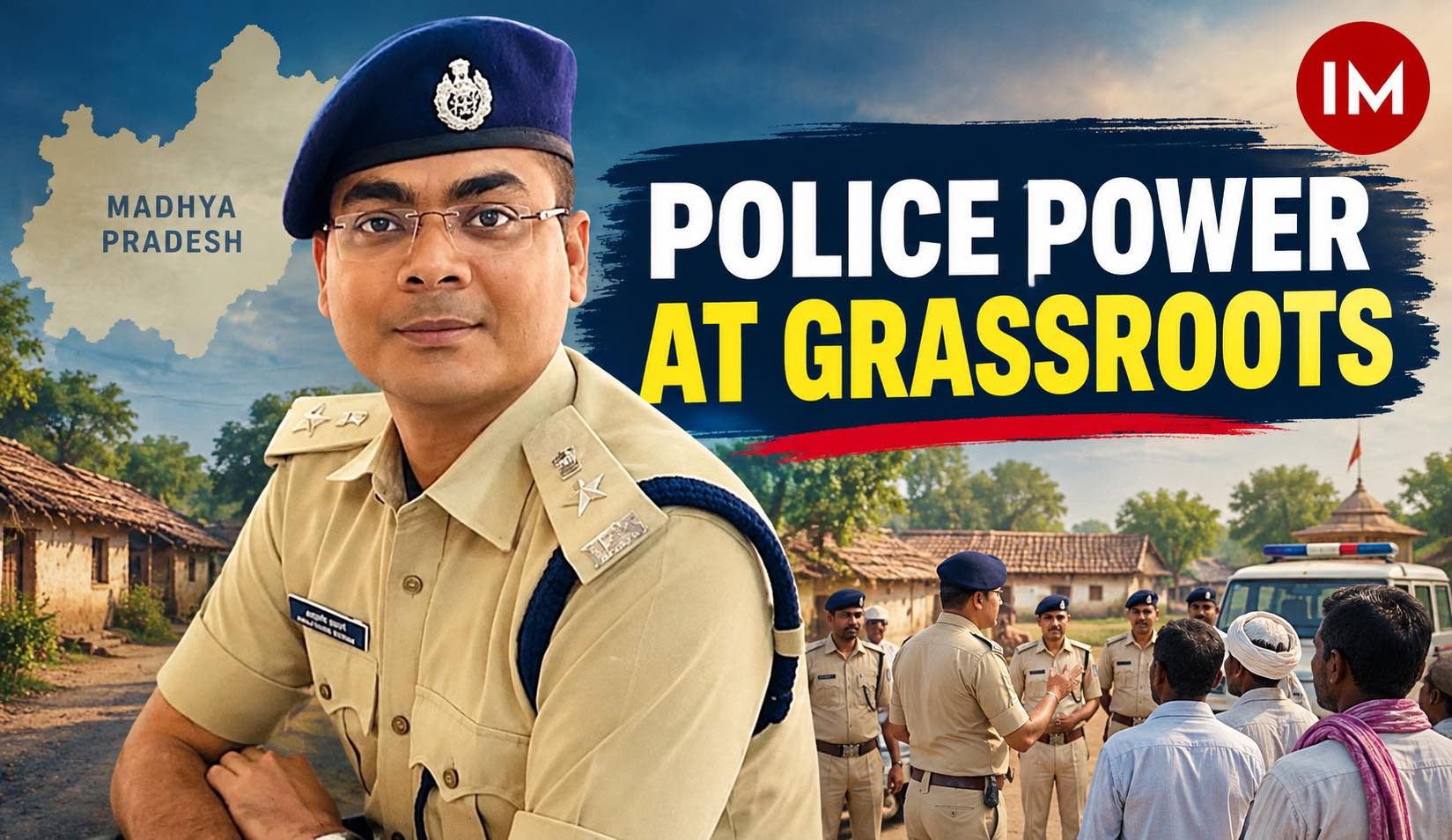
At a time when effective policing depends as much on timely local intelligence as on swift action, Burhanpur Police is turning to a time-tested institution to strengthen security from the grassroots. Under the leadership of 2015 batch IPS officer of MP cadre, Mr Ashutosh Bagri, the district is reviving the traditional role of Gram Kotwars, training them to become an active link between villages and the police.
By combining a legacy of community-level vigilance with structured training in discipline, intelligence gathering and crime prevention, the initiative seeks to build a stronger village-level security network without imposing an additional financial burden on the government. The idea is simple yet significant: instead of creating an entirely new system, make better use of an existing one that has served village administration for generations.
Indian Masterminds interacted with Mr Bagri, Burhanpur Superintendent of Police, Madhya Pradesh, to understand the idea behind this initiative, how Gram Kotwars are being trained and integrated into the police network, and how this traditional system is helping strengthen village-level intelligence, crime prevention and law-and-order management in Burhanpur.
How It Started: Reviving a Forgotten Link
Gram Kotwars have traditionally served as a vital link between villages, the revenue administration and the police. Their responsibilities included reporting suspicious activities, informing authorities about criminals and strangers, and assisting in maintaining law and order. Their role dates back to the pre-Independence period and has roots in India’s older administrative systems.
However, over time, the system gradually lost some of its effectiveness. Training became less frequent, and Kotwars were not always adequately integrated into the functioning of the police. Although they continued to be present in villages, their potential as a reliable source of local intelligence remained underutilised.
Recognising this gap, Mr Bagri initiated a programme to revive their role through structured training and closer coordination with the police.
Read Also: Project Cheetah’s Untold Story: The Negotiations, Challenges and Diplomacy Behind the Mission
Explaining the reasoning behind the initiative, IPS Bagri said, “The biggest advantage is that these people have been living in their villages for a long time. Their position and responsibilities are already recognised under the law. Providing information about criminals, suspicious persons and incidents affecting law and order was fundamentally part of their role.”
Rather than introducing a completely new arrangement, the initiative focuses on strengthening an existing institution and making it more effective in today’s policing environment.
Seven-Day Training: Building Discipline and Confidence
A key component of the initiative is a seven-day special training programme designed to prepare Gram Kotwars for a more active role in village-level security.
The training is conducted at the police lines, with personnel from the Special Armed Force (SAF) assisting in the process. The objective is not merely to familiarise Kotwars with their responsibilities but also to instil discipline, improve their presentation and help them function confidently as representatives of the police in their respective villages.
The programme includes drill commands, saluting protocols, marching, morning physical training and yoga. Kotwars are also taught the correct way to wear and maintain their uniforms, including their belts, badges, lanyards and boots.
According to Bagri, some Kotwars had never received proper guidance on wearing their uniforms or maintaining the standards expected of personnel associated with policing. The training therefore addresses both practical requirements and the dignity attached to their responsibilities.
“We are trying to revive their role by giving them training so that village-level policing, intelligence collection, law and order, and crime prevention can be strengthened,” IPS Bagri explained.
The emphasis on discipline is intended to build confidence among the Kotwars while also helping villagers recognise their role as an important link in the local security system.
Implementation: Connecting Every Village to the Police
The most significant aspect of the initiative is the integration of Gram Kotwars into the police’s information network.
With a Kotwar present in every village, the police have an existing local contact who can report developments without waiting for information to travel through several administrative layers. To facilitate communication, Burhanpur Police has created a WhatsApp group connecting the Kotwars with the police network.
This arrangement allows information about suspicious activities, potential disputes and other developments in villages to reach police personnel more quickly.
The training also goes beyond routine reporting. Kotwars are being encouraged to develop their ability to gather human intelligence by drawing on their familiarity with local communities, people and village-level dynamics.
Their long-standing presence gives them an advantage: they often understand local relationships, know the people living in their villages and are better positioned to notice unusual developments.
IPS Bagri believes this local knowledge can significantly improve the reach of the police.
“If there is a Kotwar in every village and that person is connected to the police, information can reach us immediately whenever something happens. This strengthens our information network and allows us to respond more effectively,” he said.
The system also helps police obtain information about wanted or absconding criminals and trace individuals who may otherwise be difficult to locate through conventional channels.
A Force Multiplier During Law-and-Order Situations
The initiative assumes particular importance during public gatherings, processions and sensitive law-and-order situations, when police personnel must monitor several locations simultaneously.
Burhanpur is a communally sensitive district where festivals such as Ganesh Utsav, Muharram and Eid require careful planning and coordination. During these occasions, local developments need to be monitored closely to identify possible disputes before they escalate.
Kotwars, given their familiarity with village conditions, can help the police assess the situation ahead of processions, identify emerging tensions and communicate concerns in time for preventive action.
They can also support police personnel during law-and-order deployments, helping improve coordination and the availability of local information.
Explaining the operational advantage, Bagri said that when one police officer is supported by three Kotwars, the officer’s effectiveness can increase considerably because more people are available to observe developments and communicate information.
In this sense, the Kotwars act as a force multiplier. They do not replace trained police personnel but extend their reach, particularly in areas where a limited number of officers must oversee several villages or respond to multiple developments.
Rights, Recognition and Dignity for Kotwars
The initiative is also intended to benefit the Kotwars themselves. Along with training, they are being made aware of their rights, responsibilities and the proper scope of their work.
Bagri pointed out that when Kotwars were not adequately connected with the police, they sometimes lacked the recognition and confidence associated with their responsibilities. Reconnecting them with the police network and helping them understand their role can improve both their standing and their willingness to contribute.
“When they understand their responsibilities and perform their work with confidence, their reputation in the village and society also improves,” he said.
The programme therefore combines operational objectives with a focus on institutional dignity. By equipping Kotwars with uniforms, discipline and a clearer understanding of their duties, the police are seeking to make them more effective and respected members of the village-level administrative structure.
Their existing compensation arrangements remain unchanged. According to the information provided by the police, Kotwars receive an honorarium of around ₹8,000 per month or, in some cases, agricultural land known as Seva Bhumi as compensation for their service.
The initiative does not introduce a separate payment structure for their expanded involvement.
Impact: Better Intelligence Without Additional Expenditure
One of the key features of Burhanpur’s model is that it seeks to strengthen policing without requiring the recruitment of additional personnel or creating a new financial commitment.
The Kotwars are already part of the village administrative system. By providing training and establishing regular communication with the police, the district is making greater use of existing human resources.
The expected benefits include quicker access to village-level information, improved intelligence gathering, assistance in tracing criminals, better preventive policing and additional support during sensitive law-and-order situations.
The programme also brings the police closer to communities by creating a recognised point of contact in each village. This can help reduce the gap between local developments and the authorities responsible for responding to them.
IPS Bagri’s approach is based on the belief that policing becomes more effective when the administration makes full use of the resources already available to it.
He explained the idea through a simple analogy: an existing system may appear ineffective when it is neglected, but once it is cleaned, maintained and put to proper use, its value becomes visible again.
That is the principle behind the revival of Gram Kotwars in Burhanpur.
An Old Institution for Modern Policing
The Gram Kotwar initiative demonstrates how traditional administrative arrangements can be adapted to meet contemporary security needs. By combining structured training, digital communication and a renewed understanding of responsibilities, Burhanpur Police is seeking to strengthen its grassroots intelligence network through an institution that already exists.
The programme’s significance lies not in creating another layer of policing, but in making an overlooked resource more effective. Its long-term success will depend on sustained coordination, continued guidance and the ability to translate local information into timely preventive action.
Under Ashutosh Bagri’s leadership, the effort offers a practical example of how community familiarity and administrative experience can complement professional policing. By bringing the Kotwars back into a more active role, Burhanpur is working towards a system in which every village has a stronger connection with the police—and where information from the grassroots can help prevent problems before they become larger challenges.