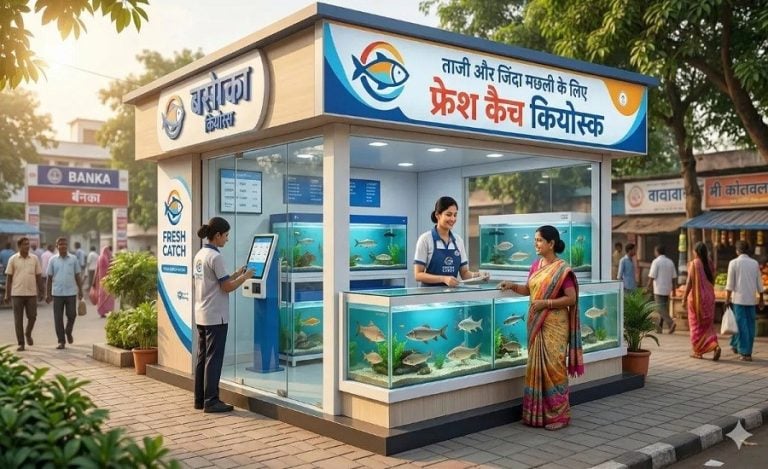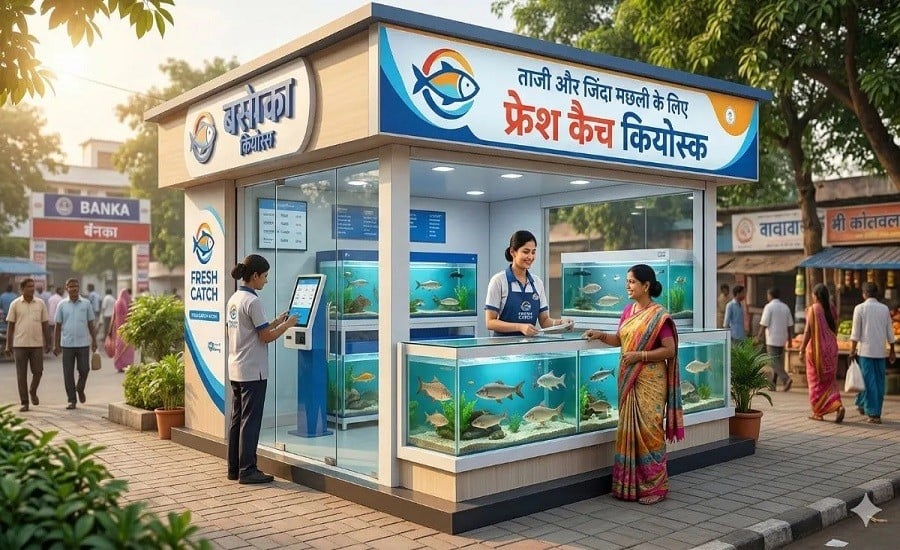
Patna: The Bihar government is planning to establish 100 Fresh Catch Kiosks across the state on the lines of Sudha milk outlets to provide consumers with fresh fish in hygienic conditions and create an organised marketplace for fish farmers. The initiative will be implemented in two phases, with 30 kiosks in the first phase and 70 in the second.
Construction of the first 30 kiosks is underway, and their inauguration is expected soon. Equipped with modern facilities such as cold-chain systems, deep freezers, display counters and digital payment options, the kiosks aim to improve fish storage, quality and retail sales across urban areas.
Bihar Fresh Catch Kiosk Scheme Under Saat Nischay-3
The initiative has been proposed under the state’s Saat Nischay-3 programme, with an estimated maximum expenditure of ₹10.56 crore.
The scheme will be implemented through the Directorate of Fisheries under the Department of Dairy, Fisheries and Animal Resources, in collaboration with the Bihar Aquaculture Infrastructure and Development Corporation Limited (BAIDCL).
Government land, municipal land or land provided by district administrations will be used to establish the kiosks.
The project aims to modernise fish retailing by creating organised sales centres that offer consumers access to fresh fish while providing fish farmers with better market access.
Read also: Bihar Partners with Google for Free AI Training Across 84 Government Technical Institutions
First Phase to Cover Major Cities Across Bihar
The first phase of the scheme will cover major urban centres across Bihar. Locations identified for the initial kiosks include:
- Patna
- Gaya
- Muzaffarpur
- Bhagalpur
- Purnia
- Darbhanga
- Begusarai
- Motihari
- Bettiah
- Hajipur
- Kishanganj
- Katihar
- Munger
The first 30 kiosks are being developed as part of the initial rollout. A further 70 kiosks are planned in the second phase, taking the total number to 100 across the state.
Fresh Catch Kiosks to Have Modern Storage and Hygiene Facilities
The Fresh Catch Kiosks will be equipped with infrastructure designed to maintain fish freshness, quality and hygiene throughout storage and sale.
The proposed facilities include:
- Cold-chain systems and deep freezers for safe storage and preservation of fish.
- Display counters for organised retail sales.
- Clean water and drainage systems to maintain hygiene.
- Electricity and backup facilities to support uninterrupted operations.
- Digital payment options for convenient transactions.
- Waste management systems to ensure cleaner sales premises.
The government also plans to develop a strong supply chain linking local fish producers with kiosk operators to ensure a regular supply of fresh fish.
Government to Bear Up to 80% of Kiosk Construction Cost
Under the scheme, the prescribed unit cost of constructing one kiosk is ₹11 lakh. Taking potential price increases into account, the maximum estimated cost per kiosk has been set at ₹13.20 lakh.
The government will bear up to 80% of the prescribed unit cost or the actual construction cost, whichever is lower.
Construction agencies or contractors will be selected through a tendering process. Operators will also be selected according to prescribed rules and conditions.
The selected operators will be responsible for the regular operation and maintenance of the kiosks.
Scheme to Provide Better Market Access to Fish Farmers
The Fresh Catch Kiosk initiative is expected to create a more organised marketing system for fish farmers and strengthen the supply chain connecting producers with urban consumers.
The Directorate of Fisheries and BAIDCL will work towards ensuring a regular supply of fish through a structured distribution network. This will help fish farmers, Fish Farmer Producer Organisations (FFPOs) and fisheries cooperative societies access organised retail markets for their products.
The scheme also includes training and capacity-building programmes for kiosk operators to improve their operational skills and ensure better management of the sales centres.
Initiative Aims to Improve Fish Quality and Create Employment
Fish sales in several urban areas of Bihar currently take place through traditional and unorganised channels, creating challenges related to storage, hygiene and quality control.
The proposed kiosks aim to address these issues by providing dedicated retail infrastructure and improved storage facilities. A structured supply chain is also expected to help reduce handling-related quality concerns and maintain fish freshness.
By expanding organised fish retailing, the initiative aims to benefit consumers, improve market access for fish farmers and create employment opportunities through kiosk operations and related supply-chain activities.