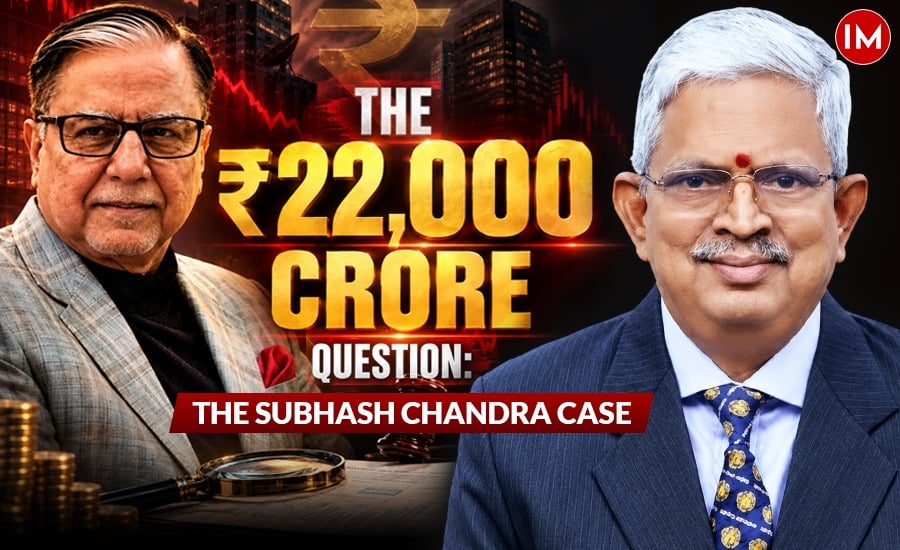
A personal guarantee is supposed to do something deceptively simple: make the promoter stand behind the debt of the company he controls. Indian law has spent the past decade making that promise increasingly difficult to escape. Yet the Subhash Chandra case presents an unsettling paradox. The guarantee remains legally enforceable, but the recovery it produces can be almost negligible. When ₹22,006.57 crore of admitted claims can stand against a personal contribution of only ₹6.25 crore, the question is no longer merely whether the law permits such an outcome.
It is whether the insolvency framework is equipped to distinguish a genuine business failure from an unexplained depletion of personal wealth. The comparison with Anil Ambani’s prolonged insolvency and regulatory proceedings makes that gap sharper. One case shows what happens when forensic and criminal machinery surrounds a promoter; the other shows what happens when it does not. Together, they expose a structural weakness in India’s personal-guarantee regime.
The Guarantee: An Instrument Made Unbreakable and Worthless
To understand what has actually been extinguished here, one has to go back past the IBC to the law of suretyship. A contract of guarantee under Section 126 of the Indian Contract Act, 1872 is a promise to perform the promise of a third person on his default, and Section 128 makes the surety’s liability co-extensive with that of the principal debtor unless the contract provides otherwise.
Co-extensive, note, not derivative: the obligation is independent, and the Supreme Court reaffirmed as recently as 2024 that the liability is parallel rather than shared, so that a creditor may proceed against principal and surety together or against either alone, and part-payment from the surety does not extinguish the balance owed by the principal. In Indian corporate lending this ancient instrument does a very modern job. It is the device by which a bank converts an arm’s-length exposure to a limited-liability company into a claim on the human being who controls it–which is to say, the device by which the corporate veil is pierced by consent rather than by litigation.
For a decade the law has moved relentlessly in one direction: to make that instrument harder and harder to escape. In State Bank of India v. V. Ramakrishnan the Supreme Court held that the moratorium under Section 14 protects the corporate debtor and casts no shadow of protection over its guarantors. The notification of 15 November 2019 switched on Part III for personal guarantors to corporate debtors, and in Lalit Kumar Jain v. Union of India the Court upheld it while delivering the commercially decisive holding that approval of a resolution plan for the corporate debtor does not, of itself, discharge the guarantor–the guarantee being an independent obligation that survives the company’s clean slate. Dilip B. Jiwrajka closed the constitutional route in 2023.
The Amendment Act of 2026 has now stripped the guarantor of the automatic interim moratorium and, through Section 28A, opened a path by which security over a guarantor’s asset can be realised inside the corporate debtor’s own process. One by one, Parliament and the Court, acting in concert, have closed every door a guarantor once had.
And the recovery rate is 2.16 per cent. That is the paradox at the centre of this subject, and the Chandra order is simply its most legible expression. India has spent ten years building an instrument that is legally invulnerable and economically worthless–perfect enforceability married to negligible recoverability. The guarantee cannot be escaped; it also cannot be collected. A bank that prices a promoter’s signature as security is pricing a right of action, not an asset, and the difference between the two is the entire distance between Rs 22,006.57 crore and Rs 6.25 crore.
Nowhere is that distance better illuminated than by setting the Chandra file beside the one belonging to the other great personal-guarantee saga of the decade. On 23 September 2016 Anil Ambani executed a personal guarantee in favour of the State Bank of India (SBI) covering credit facilities of Rs 565 crore to Reliance Communications and Rs 635 crore to Reliance Infratel. The bank invoked it on 31 January 2019 with a demand for Rs 692.19 crore, went first to the Debt Recovery Tribunal, and then filed under Section 95 before the Mumbai bench of the NCLT on 12 March 2020, claiming a default of Rs 853.25 crore.
On 20 August 2020 the tribunal appointed a resolution professional. Within weeks Ambani was before the Delhi High Court challenging the constitutional validity of the personal-guarantee provisions themselves, and a division bench stayed the proceedings while restraining him from alienating his personal assets; the Supreme Court declined to disturb that stay.
The petitions were then transferred, absorbed into Lalit Kumar Jain, and after that into the Jiwrajka batch. The constitutional challenge failed. And then–this is the number worth pausing on–the petition was finally admitted on 11 June 2026, six years and three months after it was filed, the tribunal holding expressly that the personal guarantee was not discharged by the approved resolution plan for Reliance Communications. An appeal to the appellate tribunal followed within a fortnight.
Running alongside that glacial insolvency is a second proceeding of an entirely different temperature. A forensic audit by BDO India in October 2020 flagged alleged irregularities of some Rs 31,580 crore across group entities; public-sector banks moved to classify the accounts, and Ambani’s, as fraudulent; a single judge of the Bombay High Court stayed them in December 2025 and a division bench quashed that stay in February 2026 in terms rarely used about a fellow judge, calling it illegal and perverse; the Supreme Court in April 2026 declined to interfere, leaving him to pursue the challenge below.
The Enforcement Directorate has provisionally attached properties under the Prevention of Money Laundering Act running to some Rs 7,500 crore in October 2025–forty-two properties including the family home at Pali Hill–and a further Rs 1,452 crore the following month, against group borrowings whose outstandings it puts at Rs 40,185 crore.
The Supreme Court, sitting under the Chief Justice, directed the constitution of a Special Investigation Team in February 2026, expressed open displeasure at what it called the reluctance of the CBI and the ED in March, declined to order an arrest in May, and –on a submission that Reliance Communications, carrying debts of about Rs 47,000 crore, had been sold for roughly Rs 430 crore–observed from the bench that the IBC was being misused like anything.
All of this is allegation, submission and investigation rather than adjudicated finding; Ambani has denied the charges throughout, and in a related matter has maintained that he furnished no personal guarantee at all to the Chinese lenders whom an English court ordered him to pay some 717 million dollars.
Now, let us set the two files side by side, because the comparison is more instructive than either alone. Two promoters. The same instrument. The same Part III. Chandra’s proceeding was filed in 2022, admitted in 2024, and has produced an approved repayment plan in 2026 discharging his personal liability for Rs 22,006.57 crore of admitted claims against a personal contribution of Rs 6.25 crore, with no forensic examination ordered and an unexplained collapse in disclosed net worth left unexplained.
Ambani’s proceeding was filed in 2020 and reached admission only in 2026, but his affairs have been forensically audited, his accounts classified as fraud, his estate frozen under a different statute, and his conduct placed under the continuous supervision of the Supreme Court. One guarantor’s estate has been examined exhaustively; the other’s has been accepted as stated.
The variable that separates them is not the Insolvency and Bankruptcy Code (IBC). It is the presence or absence of a criminal and regulatory overlay. This is, I think, the single most important thing the Chandra order teaches, and it is not about Chandra at all: the IBC has quietly outsourced its forensic function to the Enforcement Directorate. Part III possesses no investigative capacity of its own before bankruptcy – no avoidance powers in the hands of the resolution professional, no mandatory transaction audit, no compulsion to reconcile a disclosed estate against a documented past.
So the only guarantors whose affairs are actually examined are the ones who happen to have attracted a criminal complaint. Whether a promoter’s estate is interrogated therefore depends not on whether it shrank inexplicably, but on whether somebody filed a first information report. That is a lottery dressed as a system, and it is why an honest guarantor and a concealing one look identical on the face of a repayment plan.
Worse, the substitute machinery works against the very creditors it appears to vindicate. An attachment under the money-laundering statute freezes precisely the assets from which lenders would otherwise recover; the Supreme Court was told in as many words that attaching utility and metro infrastructure holdings could damage operations, financing arrangements and the interests of thousands of shareholders. This is the same tension that ran through the Bhushan Power litigation from beginning to end.
Where forensic scrutiny exists, recovery is impeded. Where recovery is procedurally easy, scrutiny is absent. Neither branch of the system produces both, and no promoter, however honest or however culpable, currently faces a forum that does.
It would be both unfair and analytically lazy to equate the two men, and nothing in this comparison should be read as doing so. Chandra faces no fraud classification, no attachment, no criminal proceeding; he liquidated a media empire to repay lenders, and says that some Rs 43,000 crore of a Rs 45,000 crore group exposure has been returned–a claim tested earlier in this note and found true in parts and unreconciled in others. Ambani denies everything alleged against him and is entitled to be presumed innocent of all of it.
The point of placing the files together is precisely the reverse of equating them: it is that the Code (IBC), left to its own resources, cannot tell an honest failure from a concealed estate, and should never have been designed on the assumption that some other agency would do the telling for it. Give the resolution professional the avoidance powers now locked behind a bankruptcy order, attach an arithmetic trigger to any large unexplained decline in a guarantor’s disclosed worth, and the Code would be able to answer for itself the one question that presently only a criminal investigation can reach.
For lenders, meanwhile, the operational lesson from these two files is identical and unwelcome. A promoter’s signature is worth the security standing behind it and the forensic capacity available to trace it–nothing more. Ambani’s guarantee has been enforceable, in law, at every stage since 2018, and it has yielded nothing in six years. Chandra’s has been enforced to the letter of Part III and yielded three paise in the hundred. Every risk committee that treats a personal guarantee as credit enhancement is recording an asset that the last decade of Indian insolvency has comprehensively shown to be a receivable of last resort, contingent on an investigation that may never be opened.
The Company This Order Keeps
The Chandra order is spectacular, but it is not without relatives, and the family resemblance is unflattering.
In Videocon, the Mumbai bench approved Twin Star Technologies’ consolidated offer of Rs 2,962 crore against admitted claims of Rs 64,838 crore–a haircut of 95.85 per cent overall and 99.28 per cent for operational creditors–while itself observing, in the order approving it, that the resolution applicant was paying almost nothing and that operational creditors, many of them micro and small enterprises, might themselves be pushed into insolvency by the outcome. The appellate tribunal subsequently stayed it. A tribunal that can diagnose the disease with that precision and still administer the treatment is describing a jurisdictional problem, not a factual one.
In Aircel, lenders accepted roughly Rs 150 crore against dues of about Rs 20,000 crore–a 99 per cent haircut arrived at by the committee of creditors itself, with no bench to blame. In Bhushan Power and Steel, the Supreme Court rejected an implemented plan and ordered liquidation in May 2025, recalled that judgment on 31 July, and after rehearing left the JSW acquisition standing–an eight-year, three-forum, two-judgment journey that ended approximately where it began, having in the interim made every resolution applicant in the country wonder whether an approved and executed plan is ever final. Jaiprakash Associates carries admitted claims north of Rs 59,000 crore against offers implying haircuts of up to 79 per cent.41 And personal-guarantor claims themselves rose some 80 per cent in 2024-25 as lenders, belatedly, began to invoke the instrument in earnest.
The pattern across all of these is the same. The Code’s substantive design is sound. Its outcomes are being determined not by that design but by delay, by institutional thinness at the tribunals, by the asymmetry of information between a promoter and everyone else, and by the fact that value in a stressed asset evaporates at a rate no statutory timeline has yet managed to outrun.
Merits, Demerits, and the Ledger of Consequences
Let us now attempt to set on one side of the ledger what this order genuinely achieves. It closes a file that had run four years. It applies the statute as written rather than as one might wish it written. It corrects, rather than ignores, a demonstrable defect in the claims list, and in doing so redistributes the pool toward creditors with documented claims. It preserves the creditors’ remedies against the principal debtors, which are untouched. It respects the settled principle that tribunals do not second-guess commercial majorities–a principle whose abandonment, as the Bhushan Power episode demonstrated, costs the system more than its observance.
Now, let us set the ledger on the other side and see what it costs. It permits a statutory discharge of a personal guarantee at a fraction of one per cent of admitted claims–and, on the personal contribution alone, at three paise in the hundred–without any forensic examination of an unexplained collapse in the guarantor’s estate. It accepts a voting outcome computed from a list the order itself finds to have been improperly compiled. It applies an associates test so narrow that the burden of proving relatedness falls on parties with no discovery powers. It hands every promoter in the country a template and every credit committee a precedent. And it does all of this in a case with a household name attached, which means the reputational cost will be borne not by the bench but by the Code.
The net of the ledger, in my view, is this: the order is very probably right in law and very probably indefensible as policy, and the fact that both propositions can be true at once is the finding that should concern Parliament rather than the appellate tribunal.
Lessons
Four lessons present themselves, and none of them is about Subhash Chandra.
The first is that a threshold without a floor is an invitation. Section 111 of the IBC tells creditors how many of them must agree; nothing tells them what they must agree to. In an environment where a public-sector lender’s incentive is frequently to close a provision rather than to maximise a recovery, and where the officer signing the vote will have moved on long before anyone audits it, the absence of a minimum-consideration test or a mandatory best-interests certification is not a neutral silence. It is a structural bias toward the smallest number that will clear the room.
The second is that verification is not administration. The claims process is where a creditors’ vote acquires its legitimacy, and treating its failure as a curable lapse rather than as a defect going to the root inverts the relationship between the two. If 1,260 undocumented claims can be admitted and the vote computed on that basis still stand, the incentive to compile the list carefully disappears.
The third is that the personal guarantee, as an instrument of Indian credit, is now demonstrably weaker than the balance sheets that rely on it. Banks price guarantees as though they will be enforced. This order, and the 2.16 per cent recovery rate behind it, say otherwise. Somebody in every risk committee in the country should be rewriting an assumption this week.
The fourth, and the least discussed, is that the audit gap in insolvency is now systemic. There is no independent examination—say, by the Comptroller and Auditor General (CAG is not empowered to do so in the existing scheme of things) over public-sector lenders’ conduct in creditor committees, by the regulator over resolution professionals’ claim verification, or by anyone at all over the quality of the valuations on which best-interests findings rest. Every large haircut in this decade has been ratified on the strength of a valuation that no external party has ever tested. A country that would not accept an unaudited government expenditure of Rs 6.5 crore is accepting unaudited write-offs of Rs 22,000 crore.
The Way Out for the Parties
Before either side reaches for a remedy, one procedural fact deserves to be held steadily in view: this is not yet an order. The third member has answered the points of difference; the matter returns to the original division bench, which must still pass the formal order in accordance with the majority under Section 419(5) of the Companies Act, 2013. Until it does, the file is open, the revised creditor list is still being prepared, and the distribution is still being recomputed. That is a narrow window, but it is a window.
For the dissenting creditors, the temptation will be to appeal on the number, and the number is the one ground on which they will certainly lose. No bench is going to hold that 0.03 per cent is too little when the statute prescribes no floor and the Supreme Court has spent a decade instructing tribunals not to price settlements. The stronger card lies elsewhere, and the third member handed it to them himself. He found that claims lodged on behalf of 1,260 individuals had been admitted without supporting documents.
The question that follows is arithmetical rather than discretionary: were those claims also voted, and if the defective admissions are stripped out of the numerator and the denominator alike, does 80.814 per cent survive? A majority is a computation, not an intuition. If the roll was defective, the computation performed on it is defective too, and that is a defect going to the constitution of the majority rather than to the wisdom of its decision–which is precisely the distinction an appellate bench can act upon without trespassing on commercial judgment.
It should be raised before the division bench passes its order, and pressed in appeal to the appellate tribunal, the route by which personal-guarantor matters have in practice travelled. There is no shortage of appellants: LIC Housing Finance, HDFC Bank, Axis Bank, Canara Bank, RBL Bank and Union Bank all opposed the plan, and HDFC Bank has said publicly that it is exploring an appeal.
Two parallel tracks matter more than the appeal and are being almost entirely ignored in the coverage. The first is that the discharge of a surety leaves the principal debtors exactly where they were; every rupee of the underlying corporate borrowing remains recoverable from the companies that borrowed it, through the corporate insolvency process, through SARFAESI, through the debt recovery tribunals.
The Rs 22,006.57 crore has not been extinguished. One route to one pocket has been closed. The second is newer and sharper: Section 28A, inserted by the 2026 amendment, now permits a creditor holding a security interest over a guarantor’s asset, and having taken possession under SARFAESI or any other law, to transfer that asset as part of the corporate debtor’s own resolution process with the approval of the committee of creditors.
A lender that has been treating the personal guarantee as a claim to be filed in the guarantor’s insolvency has been fighting on the wrong ground; the guarantee’s real value now lies in the security behind it, realised through the corporate process. And a complaint to the regulator over the claim verification costs a stamp, builds a record, and is the only mechanism by which the admission of 1,260 undocumented claims will ever have a consequence for anybody.
For Chandra, the counter-intuitive truth is that his interest and his critics’ converge. His discharge is conditional, not absolute: Section 118 of the IBC provides for a repayment plan coming to an end prematurely, and the discharge order under Section 119 follows completion rather than approval.A plan that fails in performance reopens the file, and it reopens it into bankruptcy, where the avoidance look-back that approval currently forecloses becomes available to a trustee. Strict performance is therefore not merely good faith; it is self-preservation.
Beyond that, his press statement makes a serious methodological objection–that the Rs 45,888 crore figure is the aggregate market capitalisation of listed group companies wrongly attributed to him personally–and an assertion, however plausible, cannot acquit anybody. An independently certified statement of his estate and its disposals over the look-back period, volunteered rather than compelled, would either vindicate him completely or settle the matter the other way. Without it he carries the insinuation permanently, at a cost far exceeding Rs 6.5 crore, and the country carries the impression that the IBC is a door marked exit.
Can the Statute Be Set Right?
The Insolvency and Bankruptcy Code (Amendment) Act, 2026–Act No. 6 of 2026, which received assent on 6 April 2026–is the most substantial overhaul of the framework since enactment. It introduces a creditor-initiated insolvency resolution process on a debtor-in-possession model, an enabling framework for group insolvency where corporate debtors are interconnected by control or 26 per cent voting rights, a rule-making power for cross-border insolvency broadly aligned with UNCITRAL principles, mandatory admission where default is established, a two-year look-back for avoidance transactions, and a codification of the clean-slate principle.
Nor has Part III been left entirely alone, and it is only fair to record what has already been done. The Act inserts Section 96(4), which strips personal guarantors to corporate debtors of the automatic interim moratorium–an answer to the well-documented tactic of filing a personal insolvency in order to freeze recovery against personal assets while the corporate process ground on. It came into force on 26 May 2026, and the Bombay High Court has since held that it reaches proceedings already pending, operating retroactively rather than retrospectively.
The regulator has moved in step: the Personal Guarantor insolvency regulations were overhauled with effect from 2 June 2026, inserting a new Regulation 6A that mandates detailed asset disclosure by the debtor, a new Regulation 11A to coordinate asset transfers under Section 28A, and a tightened Regulation 17B for the depressingly common case–143 of 664–in which no repayment plan is submitted at all.46 A discussion paper of July 2026 proposes to go further on valuation, requiring creditor approval for the appointment of valuers.
So the answer to whether the statute can be set right is yes, and a good deal of the work has begun. But none of it reaches the defect this order exposes, because every one of those repairs addresses the guarantor who delays or discloses too little, and none addresses the guarantor who complies fully and still walks away at three paise in the hundred.
For that, three further repairs sit squarely within the regulator’s existing rule-making power and require no return to Parliament. The first is a documentary-sufficiency standard for the admission of claims, with the admission of undocumented claims treated as a reportable contravention rather than an incident–an obligation that bites on the resolution professional, whose entire standing in the proceeding derives from the verification function.
The second is a prohibition on repayment plans that state their consideration as indicative rather than fixed; a binding statutory discharge should not be erected on a number that is still a range. The third, and the most consequential, is a requirement that a written best-interests comparison–plan against bankruptcy, on an independently valued estate be placed before the creditors before they vote, rather than reconstructed by a tribunal from the record afterwards. That is a floor on process, not on outcome. It leaves commercial wisdom entirely intact while making it, for the first time, examinable.
Two repairs do need amendment. Part III requires a related-party voting exclusion with the reach that Section 21(2) has in corporate insolvency, and it requires the burden to sit where the information sits–on the entity claiming to vote, to establish that it is unconnected to the debtor, rather than on an objecting creditor with no powers of discovery to prove that it is. The third member was right that Section 79(2)(g) cannot be enlarged by allegation; the answer is to enlarge it by statute, or to convert it into a rebuttable presumption.
The second amendment is the structural one. The Code’s avoidance armoury for individuals vests in the bankruptcy trustee and becomes available only after the plan has failed, which means that approving a repayment plan extinguishes the very inquiry that might have justified rejecting it. Making Sections 164, 164A, 165 and 167 exercisable by the resolution professional with the leave of the adjudicating authority during the resolution stage is a modest drafting change with disproportionate effect: it would mean that a guarantor cannot buy immunity from the look-back by getting a small plan approved.
The cleanest single borrowing, though, is English and it is nearly a hundred years old in spirit. Section 262 of the Insolvency Act, 1986 permits a creditor to challenge an approved individual voluntary arrangement on two grounds that Section 114 of our Code lacks altogether: that the arrangement unfairly prejudices the interests of a creditor, and that there has been material irregularity at or in relation to the creditors’ meeting. On either ground the court may revoke or suspend the approval, or direct that a fresh meeting be summoned. The English courts have applied that provision to precisely the mischief in issue here–in one reported case, an insolvency practitioner admitted an objecting creditor’s claim at a nominal GBP 1 for voting purposes, and the arrangement, which would have failed had the claim been admitted at full value, was challenged as a material irregularity.
Substitute 1,260 undocumented claims for the nominal pound and the parallel writes itself. An unfair-prejudice and material-irregularity gateway in Part III would give an Indian bench something to weigh the votes against without asking it to second-guess a single commercial judgment. It is one clause. It is the fix.
To all of this one must add the institutional obvious, which no amount of drafting will cure. An average resolution timeline of 744 days against a statutory 330, and 78 per cent of live cases past the 270-day mark, is not a jurisprudential problem. It is a staffing problem, diagnosed in every review of the Code since 2019 and solved in none. A tribunal that must borrow a third member to break a deadlock, months after the deadlock arose, is not a tribunal that will deliver time-bound insolvency however elegantly its statute is redrafted.
And one recommendation belongs to the auditor rather than the draftsman: where a public-sector bank or a government-owned financial institution votes for a settlement involving a haircut above a prescribed threshold, that vote should be capable of independent examination–not to second-guess the commercial call, but to establish that a commercial call was in fact made, on a record, by someone answerable for it. A country that would not tolerate an unaudited government payment of Rs 6.5 crore is presently tolerating unaudited write-offs of Rs 22,000 crore.
The Last Word
There is a particular pathos in the fact that the man at the centre of this order built his fortune by persuading a nation to believe what appeared on a screen. Whatever the appellate tribunal makes of the objections–and LIC Housing Finance, which stands to receive about Rs 38.09 lakh against an admitted claim of Rs 1,322.39 crore, has every incentive to take them there–the wider damage is already done, and it was not done by Nilesh Sharma.
It was done by a statute that told a tribunal to count votes and gave it nothing to weigh them against; by a claims process that admitted 1260 creditors nobody had verified; by an absence of any obligation to ask where Rs 40,000 crore went; and by a decade of collective agreement that the commercial wisdom of creditors is a thing so sacred that no one need ever check whether wisdom was in fact exercised.
The IBC turned ten in May 2026. It has changed Indian corporate behaviour more profoundly than any commercial statute since the abolition of licensing, and four-fifths of the defaults it touches are now settled before a tribunal ever admits them. That is an extraordinary achievement and it should not be swallowed by a single order. But a law’s tenth birthday is a reasonable moment to ask what it has become when the threat fails and the machinery must actually run. Three paise in the hundred, or something appreciably more–the country still cannot say which, because the order remains unpublished and its arithmetic is being reconstructed from press briefings.
That uncertainty is the more damning fact. A republic that would not tolerate an unaudited government payment of Rs 6.5 crore has watched Rs 22,006.57 crore of admitted claims settled on terms it cannot read, ratified by a majority it cannot verify, over an estate nobody was required to examine. Whatever that is, it is not resolution.
The lesson from these cases extends well beyond two promoters. A personal guarantee is only as valuable as the assets behind it and the system’s ability to trace them. If India wants guarantees to remain credible instruments of credit, insolvency law must combine enforceability with verification, accountability and timely forensic scrutiny. Otherwise, legal strength will continue to mask economic weakness.