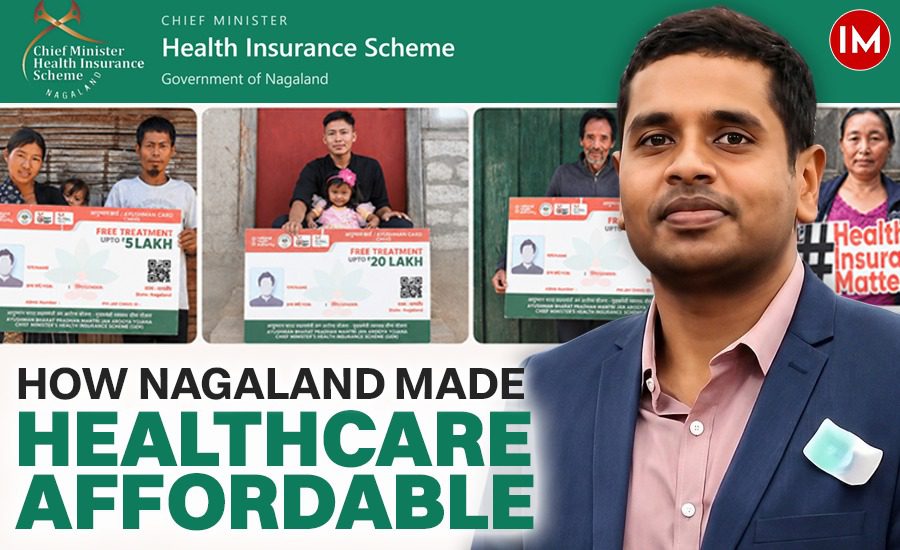
A serious illness can change a family’s life overnight. Beyond the emotional strain, hospital bills often become an even bigger challenge, forcing many households to borrow money, sell assets or delay treatment altogether. While government health insurance schemes have expanded significantly over the years, thousands of families still remain outside the safety net.
Nagaland decided to address this gap with a state-led solution. The Chief Minister’s Health Insurance Scheme (CMHIS) was introduced to ensure that every eligible resident could access cashless hospital treatment without worrying about the financial burden. Today, the scheme works alongside Ayushman Bharat-Pradhan Mantri Jan Arogya Yojana (AB PM-JAY), creating one of the country’s more comprehensive state health protection models.
Leading this transformation is IAS K. Thavaseelan, a 2012-batch Nagaland cadre officer and commissioner & secretary, Department of Rural Development. Closely associated with the implementation and expansion of CMHIS, he believes healthcare should never become a privilege determined by one’s income or location.
“The vision behind CMHIS was simple—to ensure that every eligible citizen of Nagaland has access to quality healthcare without facing financial hardship because of hospitalisation expenses,” IAS K Thavaseelan shared in an exclusive conversation with Indian Masterminds.
The result is a healthcare model that combines insurance coverage, technology and administrative reforms to make medical treatment more accessible across the state.
Filling the Gap Left by Existing Schemes
Ayushman Bharat PM-JAY already provides health insurance to economically vulnerable families identified under national criteria. However, many government employees, pensioners and indigenous inhabitants who did not fall within those categories remained uncovered.
Rather than creating a parallel system, Nagaland chose to integrate its own insurance programme with the national platform.
According to Mr Thavaseelan, this convergence has made healthcare delivery more efficient while expanding coverage to nearly every eligible resident.
“CMHIS complements PM-JAY by extending health insurance coverage to government employees, pensioners and other eligible residents who were not covered under the central scheme. Together, both programmes move Nagaland closer to universal health coverage.”
The integrated platform also reduces duplication of records, simplifies beneficiary management and provides citizens with a single, technology-driven healthcare system.
A Scheme Designed for Every Section of Society
One of CMHIS’s distinguishing features is its tiered coverage model.
Government employees and pensioners receive health insurance coverage of up to ₹20 lakh annually per household, including a ₹5 lakh base cover and an additional ₹15 lakh top-up through an insurance provider. If treatment expenses exceed this amount, the state government bears the remaining cost through reimbursement.
Meanwhile, families outside Ayushman Bharat but eligible under CMHIS receive ₹5 lakh annual health insurance coverage, ensuring they too can access cashless treatment.
Unlike fragmented insurance systems that often confuse beneficiaries, CMHIS brings multiple categories under one digital platform supported by Aadhaar-based verification and beneficiary deduplication.
The system allows online registration, digital health cards, paperless claims, real-time monitoring and transparent fund management, reducing paperwork for both hospitals and patients.
Technology at the Centre of Healthcare Delivery
Delivering healthcare across Nagaland’s difficult terrain requires more than financial support. Technology has become equally important.
CMHIS operates almost entirely through an end-to-end digital ecosystem. Beneficiaries can register online, hospitals process claims electronically, and authorities monitor utilisation in real time.
The state also leverages the National Health Authority’s digital infrastructure, including the Beneficiary Identification System and Transaction Management System, avoiding the cost and time needed to develop separate software.
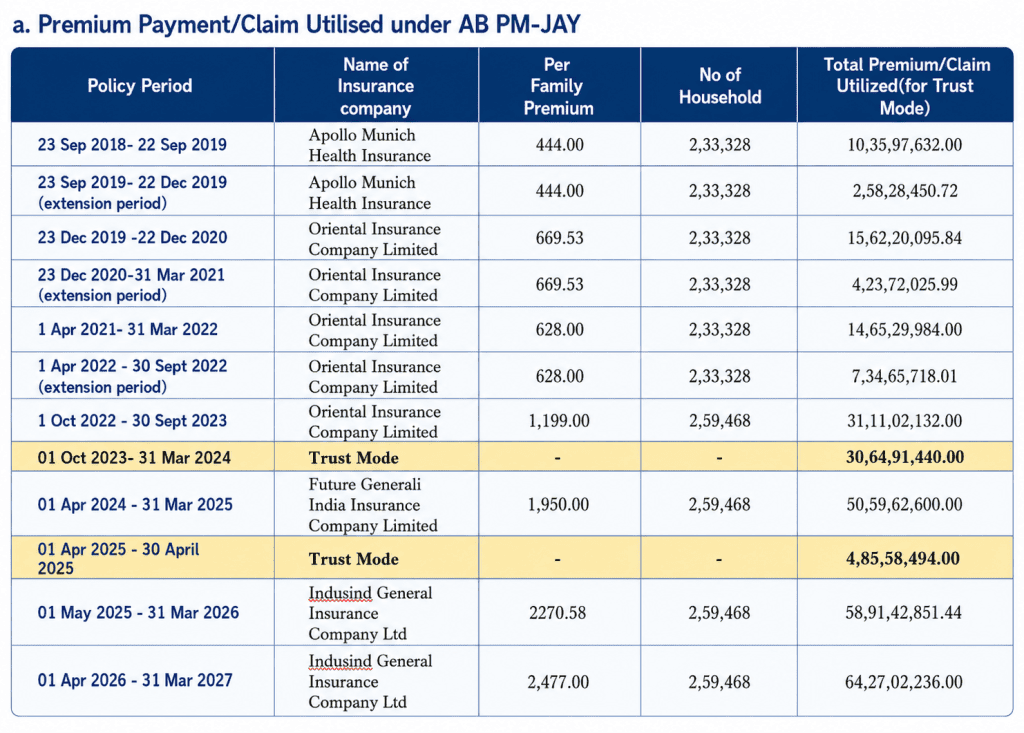
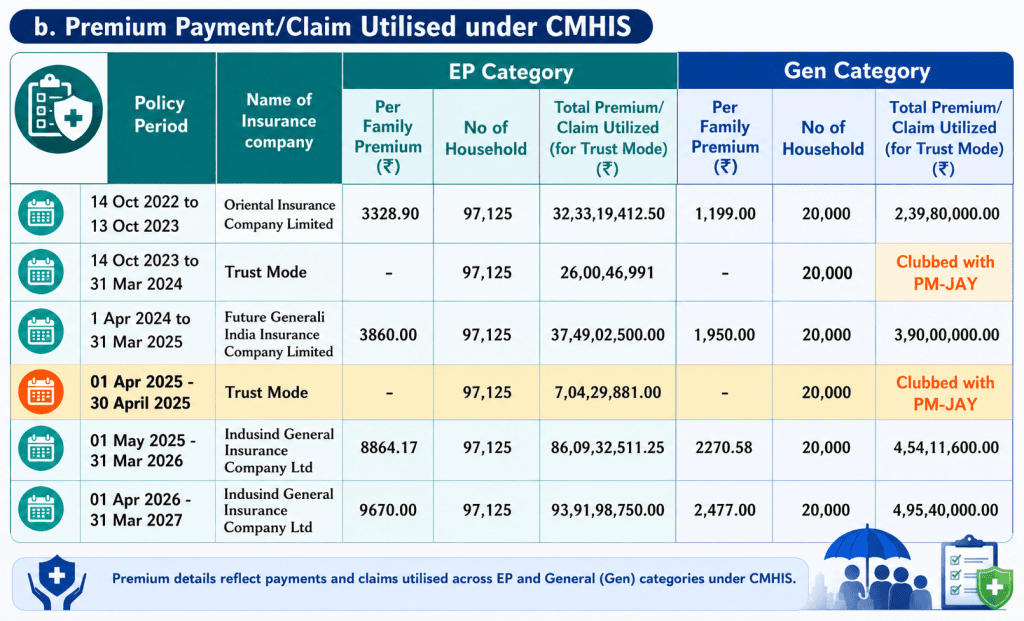
“Technology has become the backbone of CMHIS. Digital beneficiary identification, online registration, paperless claims and real-time monitoring have improved transparency, reduced delays and strengthened accountability across the system.”
The impact is already visible.
Authorised treatment procedures increased from 6,036 during 2022-23 to 23,282 in 2023-24, before rising further to 51,101 during 2025-26, reflecting both wider awareness and improved accessibility.
Taking Healthcare Beyond the Cities
Implementing a health insurance programme across Nagaland comes with challenges that many other states rarely encounter.
Mountainous terrain, scattered settlements, poor internet connectivity and low Aadhaar penetration in remote areas initially slowed beneficiary enrolment.
Rather than depending solely on government offices, the administration adopted a community-based strategy.
Self-Help Groups, Accredited Social Health Activists (ASHAs), the Nagaland State Rural Livelihood Mission (NSRLM) and local organisations became partners in spreading awareness, organising enrolment camps, and assisting people with registration.
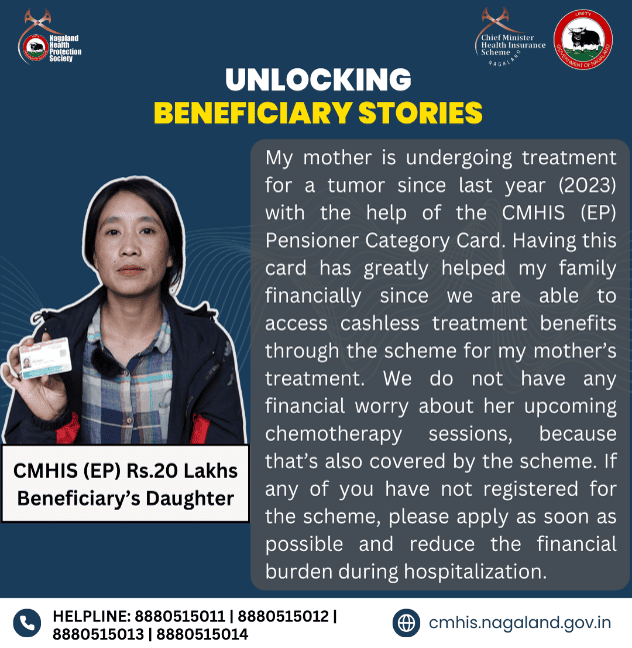
The state also expanded its network of empanelled hospitals so beneficiaries could receive treatment both within and outside Nagaland.
A new initiative—the 100 Days Ayushman Student Coverage Mission—is currently working towards enrolling more students under the programme.
“Reaching remote communities required collaboration. Community networks, outreach camps and local institutions have played a major role in ensuring healthcare benefits reach even the most difficult-to-access villages.”
Reducing the Financial Burden on Families
The strongest measure of any health insurance scheme is its impact on people’s lives.
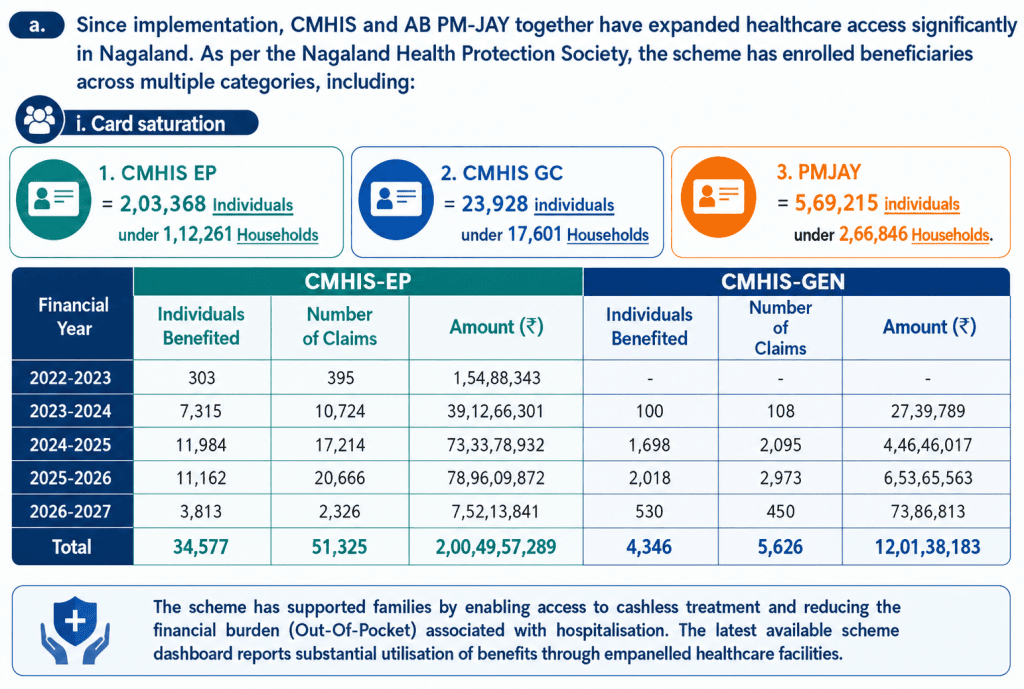
Since implementation, CMHIS-EP has benefited over 34,500 individuals, covering more than 51,000 treatment episodes with claims exceeding ₹200 crore.
Under CMHIS-General, more than 4,300 beneficiaries have availed treatment through over 5,600 claims, amounting to more than ₹12 crore.
When combined with AB PM-JAY, the numbers become even more significant. More than 84,500 beneficiaries have received treatment through over 1.23 lakh treatment episodes, with cumulative claims crossing ₹229 crore.
But statistics only reveal part of the story.
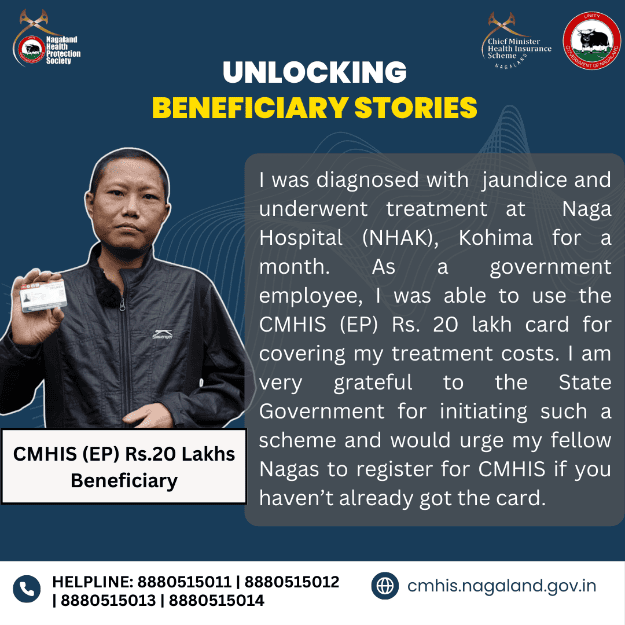
Patients undergoing lifelong dialysis no longer worry about recurring medical expenses. Cancer patients who once struggled to arrange funds can now focus on treatment instead of hospital bills. Families facing major surgeries have avoided catastrophic expenditure because hospital costs are settled directly under the scheme.
“By providing cashless hospitalisation and eliminating upfront payments, CMHIS has significantly reduced out-of-pocket healthcare expenditure while protecting families from catastrophic medical costs,” says Mr Thavaseelan.
These experiences demonstrate how health insurance can improve financial security alongside healthcare access.
Challenges That Continue to Demand Attention
Despite its progress, implementing a statewide insurance programme remains an evolving process.
Hospital empanelment, fraud prevention, grievance redressal, internet connectivity, package rate rationalisation and digital infrastructure continue to require constant attention.
Healthcare providers initially hesitated to join because existing package rates were considered low. The government responded by revising rates and introducing a more flexible Memorandum of Understanding tailored for different hospital groups.
Monitoring claims and preventing misuse also remain continuous administrative priorities.
IAS K Thavaseelan believes adapting the programme based on field experience is essential to sustaining public confidence.
“A scheme of this scale demands continuous improvement. Whether it is strengthening hospital networks, addressing beneficiary grievances or improving digital systems, our focus remains on making healthcare more accessible, efficient and trustworthy.”
Building a Stronger Healthcare Safety Net
Healthcare is often judged not by the hospitals that exist but by whether ordinary people can afford to use them.
Nagaland’s Chief Minister Health Insurance Scheme demonstrates how a state government can strengthen an existing national programme instead of duplicating it. By combining wider coverage, digital governance, community participation and cashless treatment, the scheme has expanded healthcare protection for thousands of families.
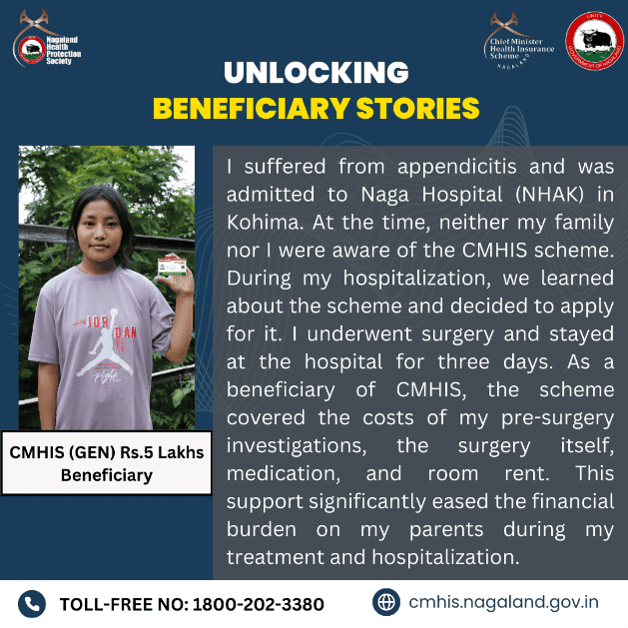
For IAS K. Thavaseelan, the objective goes beyond insurance numbers or claims settled. It is about ensuring that no family postpones treatment because of financial constraints and that quality healthcare becomes accessible regardless of where a person lives.
As CMHIS continues to expand, Nagaland’s approach offers valuable lessons for other states seeking to bridge healthcare gaps while making medical care both affordable and accessible for every citizen.