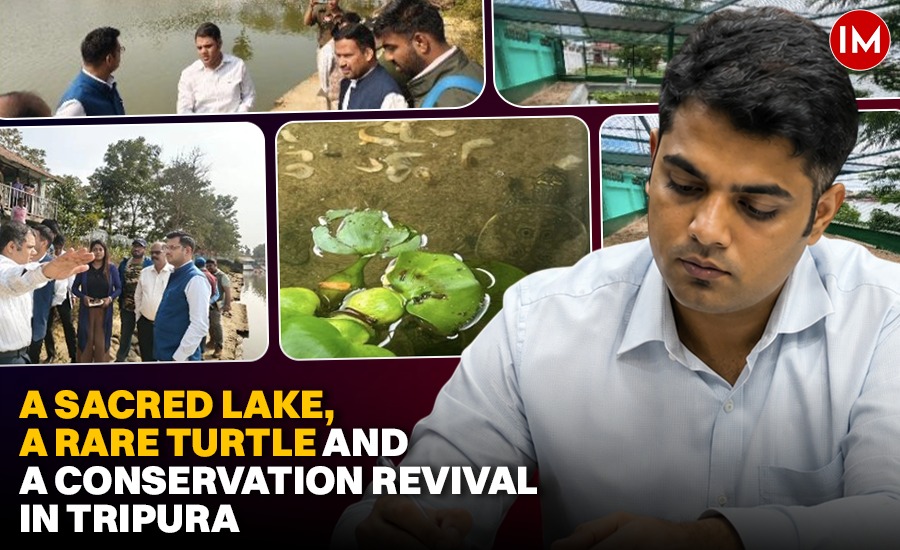
For centuries, the turtles of Kalyan Sagar have lived between faith and nature.
At the edge of the ancient Tripura Sundari Temple in Udaipur, Gomati district, a 6.4-acre sacred lake has quietly sheltered one of India’s rarest freshwater turtles. Devotees come to the temple to pray. Many also come to the lake to feed the turtles, believing them to be sacred manifestations of the Kurma, or tortoise, avatar of Lord Vishnu.
But behind this centuries-old bond between people and turtles was a growing conservation crisis.
The Black Softshell Turtle (Nilssonia nigricans), locally known as the Bostami or Mohini turtle, had once been declared extinct in the wild by the IUCN. Its survival became confined to a few temple ponds across Northeast India and Bangladesh.
At Kalyan Sagar, the species had survived. But survival was becoming increasingly difficult.
A SACRED LAKE UNDER PRESSURE
The Tripura Sundari Temple was built in 1501 AD by Maharaja Dhanya Manikya and is revered as one of the 51 Shakti Peethas. It is also popularly known as “Kurma Peetha”, as the hillock on which the temple stands resembles a tortoise.
This religious connection gave the turtles a special place in the lives of local people and pilgrims. Yet, ironically, some traditional practices began harming the very animals people wanted to protect.
Also Read – When Technology Meets the Forest: How IFS Nitish Kumar Is Reimagining Conservation in Odisha
Large portions of the lake’s banks had been cemented around two decades ago. The hard embankments destroyed natural nesting areas. Plastic waste accumulated around the water. Siltation increased and nitrate levels became a concern.
The turtles were also regularly fed puffed rice, biscuits and other processed food by devotees. While the practice came from devotion, it affected the animals’ natural diet and contributed to the deterioration of the lake’s ecological conditions.
There was another major problem. Nobody had a clear scientific picture of how many turtles actually lived in the lake.
An estimation count conducted in February 2021 recorded around 106 turtles, including 37 large, 49 medium and 20 small individuals. But systematic scientific studies were still missing.
WHEN CONSERVATION NEEDED A NEW DIRECTION
Efforts to protect the turtles had existed since 2014-15. Water quality was tested. Population counts were attempted. Feeding practices were discussed. A basic hatchery was constructed and awareness programmes were conducted.
But these interventions remained scattered.
In August 2023, the Turtle Survival Alliance Foundation of India (TSAF) conducted a detailed field assessment and prepared a comprehensive conservation proposal. The groundwork was ready, but what was needed was sustained administrative support and a coordinated plan.
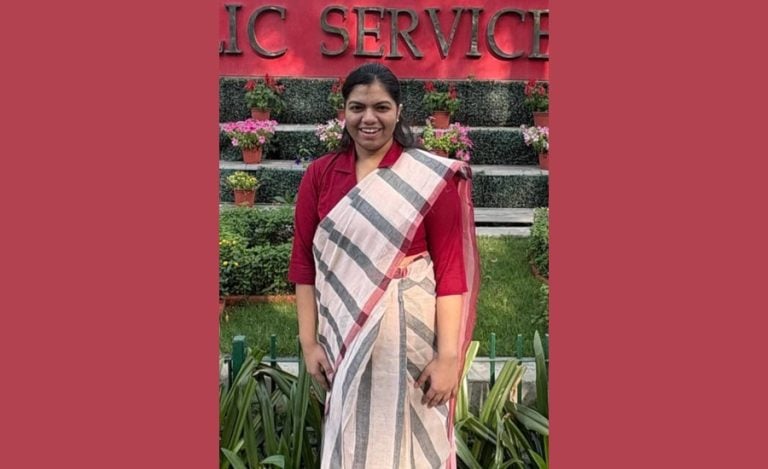
That turning point came during 2024 and 2025, when H. Vignesh, IFS, a 2015-batch officer of the Tripura cadre, served as District Forest Officer of Gomati.
He recognised that Kalyan Sagar needed more than occasional interventions. It needed a programme that brought science, administration, community participation and religious institutions together.
“Accurate population data is lacking due to the absence of scientific studies. This comprehensive study will help us understand the current population and its problems,” Vignesh said.
His approach was to first understand the ecosystem scientifically and then build a system that could continue beyond the tenure of any one officer.
₹14.90 LAKH PROJECT PUTS SCIENCE AT THE CENTRE
In May 2025, the Gomati district administration approved an Integrated Turtle Conservation Project worth ₹14.90 lakh, based on the recommendations of TSAF.
The project gave structure to the conservation effort.
It included systematic population assessment, scientific data collection, development and expansion of the existing hatchery, regular garbage clearance, habitat improvement and educational signages around the lake and temple premises.
Awareness was also made a central part of the programme.
TSAF experts began making repeated visits to Kalyan Sagar. Forest staff and district officials worked alongside them. The hatchery was cleaned and expanded. Plastic and other waste were removed from the lake.
For the first time, modern scientific protocols were introduced to study the turtles in a systematic manner.
The first phase of the year-long scientific study was completed in June 2025. The next phase, following the monsoon, focused on continued monitoring, breeding patterns, water quality and further habitat interventions.
TURNING DEVOTION INTO CONSERVATION
One of the most difficult parts of the project was not scientific. It was social.
For generations, feeding the turtles had been considered an act of devotion. Asking pilgrims to stop feeding them, or to change what they offered, could easily have been interpreted as interference in religious practice.
Instead of confronting faith, the administration chose to work with it.
Temple authorities, the Matabari Panchayat Samiti, local representatives and regular pilgrims were brought into the conservation conversation. Awareness programmes explained how plastic and processed food were affecting the turtles.
Educational signages were installed around the lake. They explained the importance of the species and offered simple dos and don’ts for visitors.
The message was not that devotion was wrong. It was that devotion could become a part of conservation.
Gradually, the same pilgrims who once fed biscuits and processed food began supporting cleaner practices. Temple authorities and community leaders also started helping guide visitors.
This created something unusual: a conservation programme in which faith became an ally of science.
FROM HATCHERY TO THE SACRED WATERS
The results are now beginning to show.
A total of 75 turtles are currently being reared in the expanded hatchery. In an important step for the recovery programme, 10–12 healthy turtles have already been released into Kalyan Sagar.
The process is carefully managed.
Young turtles are protected and reared in the hatchery before being released into the lake. This head-starting approach gives vulnerable hatchlings and juveniles a better chance of survival.
The objective is not simply to increase the number of turtles in the hatchery. The larger goal is to rebuild a healthy population in the lake itself.
Cleaner surroundings, improved habitat, better awareness and scientific monitoring are all being brought together to achieve that goal.
BUILDING A FUTURE BEYOND ONE PROJECT
The ₹14.90 lakh project is only the beginning.
The long-term conservation plan rests on three pillars: institutional ownership, a permanent hatchery and continued community participation.
The Forest Department, district administration and temple authorities will continue joint monitoring and habitat management. The hatchery will remain a facility for head-starting young turtles and releasing them in batches.
The community will also remain central to the effort. The biggest danger would be allowing old practices to return once the initial conservation campaign loses momentum.
Deependra Jewaria, IFS, the current DFO of Gomati, underlines the importance of measuring conservation through long-term ecological outcomes.
“Once we see consistent natural recruitment without heavy dependence on the hatchery, and the population shows stability or growth over successive years, we can say the turtles of Kalyan Sagar have become self-sustaining in their ancestral waters.”
That is why the project will track more than just turtle numbers.
Scientists and officials will monitor the number of healthy adults and juveniles, survival rates of released turtles, natural nesting and hatching inside the lake, and changes in water quality.
The real victory will come when turtles begin reproducing successfully in the lake without heavy human intervention.
WHERE FAITH AND SCIENCE MEET
The story of Kalyan Sagar is ultimately not only about a turtle.
It is about how conservation can succeed when administration understands the people who live around a habitat. It is about recognising that religious traditions do not always have to compete with ecological science.
Under H. Vignesh’s tenure as DFO Gomati, a fragmented conservation effort was turned into a focused programme supported by scientific research, district administration and community participation.
The lake now has a baseline of scientific data. Its hatchery houses 75 turtles. The first 10–12 head-started turtles have returned to its waters. Waste management and awareness have improved. Most importantly, the conservation effort now has an institutional framework.
For a species once considered extinct in the wild, these are more than small victories.
They are signs of possibility.
The Black Softshell Turtle has survived for centuries because Kalyan Sagar was protected by faith. It now needs science, administration and community stewardship to ensure that survival continues.
In the quiet waters beside Tripura Sundari Temple, the old relationship between people and turtles is taking a new form.
Faith brought the turtles into the hearts of people.
Now conservation is giving them a future.
Also Read– Dr. Sanjeev Sharma: The Forest Officer Turning Wildlife Rescue Into a Larger Conservation Mission