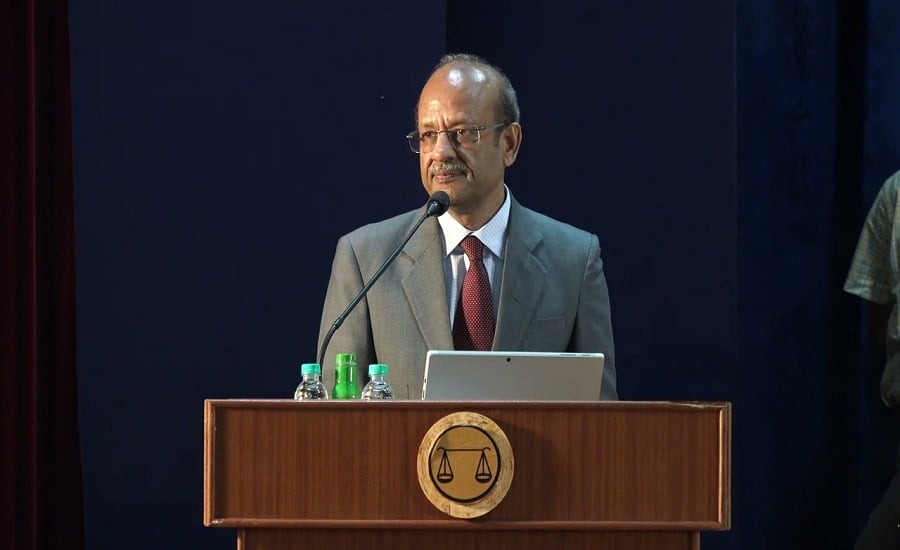
New Delhi: Former Supreme Court judge Justice Rajesh Bindal has been appointed Chairperson of the National Company Law Appellate Tribunal (NCLAT), marking a new chapter in his distinguished judicial career. The appointment, announced on November 6, 2026, comes after the completion of the tenure of former NCLAT Chairperson Justice Ashok Bhushan on July 4, 2026.
Following Justice Bhushan’s retirement, Justice Yogesh Khanna, a judicial member of the appellate tribunal, had been appointed officiating Chairperson with effect from July 5, 2026. Justice Bindal’s appointment now brings a former Supreme Court judge with extensive experience across several High Courts to the leadership of the tribunal.
Justice Bindal retired from the Supreme Court of India on April 15, 2026, after serving at the apex court for more than three years. Before his elevation to the Supreme Court in February 2023, he served as Chief Justice of the Allahabad High Court. During his tenure at the Supreme Court, he authored 166 judgments and participated in numerous important judicial proceedings.
Who Is Justice Rajesh Bindal?
Justice Rajesh Bindal is a former Judge of the Supreme Court of India who has served in several prominent judicial positions, including Chief Justice of the Allahabad High Court and Acting Chief Justice of the Jammu & Kashmir and Ladakh High Court and the Calcutta High Court.
Born on April 16, 1961, in Ambala City, Haryana, he began his legal career in 1985 after completing his law degree. Over the following decades, he built an extensive career in litigation and judicial administration, serving across different High Courts before being elevated to the Supreme Court in 2023.
His judicial experience spans criminal law, civil service disputes, property matters, motor vehicle claims and several other areas of law. He is also associated with initiatives involving judicial technology, including the development of software for medical-legal reports.
Read also: Who Is Justice Yogesh Khanna? Delhi HC Judge Likely to Get Additional Charge as NCLAT Chairperson
Early Life and Educational Qualifications
Justice Rajesh Bindal was born on April 16, 1961, in Ambala City, Haryana.
He completed his Bachelor of Commerce (B.Com) from Panjab University before pursuing a Bachelor of Laws (LL.B.) degree from Kurukshetra University, which he completed in 1985.
His academic background in commerce and law preceded a legal career that began in the Punjab and Haryana High Court.
Legal Career: Practised at Punjab and Haryana High Court
Justice Bindal enrolled as an advocate in September 1985 and began practising at the Punjab and Haryana High Court.
During his two decades in legal practice, he represented several government departments and institutions, including the Income Tax Department, the Employees’ Provident Fund Organisation (EPFO), and various central and state government bodies.
He was also associated with legal proceedings concerning the Satluj-Yamuna Link (SYL) water dispute, one of the significant inter-state water-sharing disputes involving Punjab and Haryana.
His experience in handling government-related litigation and complex legal matters formed an important part of his professional journey before his elevation to the judiciary in 2006.
Judicial Career Across Four High Courts
Justice Bindal was elevated from the Bar to the Bench as a Judge of the Punjab and Haryana High Court on March 22, 2006. He served there for more than 12 years before being transferred to the Jammu & Kashmir High Court in November 2018.
His judicial career subsequently took him to the Jammu & Kashmir and Ladakh High Court, Calcutta High Court and Allahabad High Court, where he held important judicial and administrative positions.
Punjab and Haryana High Court (2006–2018)
Justice Bindal served as a judge of the Punjab and Haryana High Court from March 22, 2006, until November 18, 2018.
During this period, he chaired several important committees dealing with judicial reforms, technology and legal procedures.
In 2016, following a resolution adopted at the Chief Justices’ Conference, he headed a multi-member committee tasked with developing uniform guidelines for the reception, retrieval, authentication and preservation of electronic evidence.
The committee submitted its report, including draft rules for the reception of electronic evidence, to the Supreme Court in November 2018.
He also chaired a committee constituted by the Ministry of Women and Child Development to examine the civil and legal aspects of international child abduction and the inter-country removal and retention of children.
The committee submitted its recommendations, along with a draft of the Protection of Children (Inter-Country Removal and Retention) Bill, 2018, to the ministry in April 2018.
Another significant contribution during his tenure was his involvement in developing MedLEaPR (Medico-Legal Examination and Post-Mortem Reporting System).
The software was designed as a centralised, web-based platform for preparing medico-legal and post-mortem reports, with role-based access and security features for doctors and healthcare institutions.
Initially implemented in Punjab, Haryana and Chandigarh, the system was subsequently extended to other states. In December 2023, the Government of India made its use mandatory across states. It was also integrated with the Crime and Criminal Tracking Network and Systems (CCTNS).
Justice Bindal also guided the development of a Litigation Management System in Haryana to manage government litigation at the High Court and district court levels. The system was later adopted by Punjab, Uttar Pradesh and the Union Territory of Jammu & Kashmir.
Jammu & Kashmir and Ladakh High Court (2018–2021)
Justice Bindal was transferred to the Jammu & Kashmir High Court in November 2018 and took oath as a judge on November 19, 2018.
During his tenure, he was associated with initiatives aimed at improving the use of technology in the judicial system.
He was nominated as Chairman of a committee constituted to assess the optimal use of technology, including Artificial Intelligence (AI), by the National Legal Services Authority (NALSA) and State Legal Services Authorities. The committee subsequently submitted its report to NALSA.
He also served as a member of another NALSA committee tasked with examining the existing framework of Lok Adalats and mediation and recommending measures to improve their operational efficiency, particularly for weaker sections of society.
Justice Bindal was appointed to perform the duties of Acting Chief Justice of the Common High Court for the Union Territories of Jammu & Kashmir and Ladakh with effect from December 8, 2020. He continued in this position until January 4, 2021.
Calcutta High Court (2021)
Following his tenure in Jammu & Kashmir, Justice Bindal was transferred to the Calcutta High Court, where he took oath as a judge on January 5, 2021.
He was subsequently appointed Acting Chief Justice of the Calcutta High Court with effect from April 27, 2021, following the retirement of the incumbent Chief Justice.
He served in the acting capacity until October 10, 2021, before moving to the Allahabad High Court.
Allahabad High Court: Chief Justice (2021–2023)
Justice Bindal took oath as the Chief Justice of the Allahabad High Court on October 11, 2021.
The Allahabad High Court is one of the country’s largest High Courts, and his appointment placed him in charge of a significant judicial institution with extensive administrative responsibilities.
During his tenure, he oversaw judicial and administrative matters, including initiatives relating to technology and the modernisation of court processes.
He continued in the position until February 2023, when he was elevated to the Supreme Court of India.
Supreme Court Tenure: Authored 166 Judgments
On February 13, 2023, Justice Rajesh Bindal was elevated to the Supreme Court of India and assumed office as a judge of the apex court.
His elevation was recommended by the Supreme Court Collegium on January 31, 2023. The Collegium noted his seniority among High Court judges and the need for adequate representation of the Punjab and Haryana High Court on the Supreme Court Bench.
During his tenure of over three years, Justice Bindal authored 166 judgments and participated in 254 benches.
His judgments covered several areas of law, with criminal matters accounting for 46 judgments, followed by service matters (44), property disputes (30), civil matters (20) and motor vehicle cases (17).
Among the notable decisions during his Supreme Court tenure was a judgment co-authored by him that quashed the Punjab Scheduled Caste and Backward Classes (Reservation in Services) Act, 2006.
Justice Bindal retired from the Supreme Court on April 15, 2026, upon attaining the constitutional retirement age of 65 years.
Post-Retirement Academic Engagements
Following his retirement from the Supreme Court, Justice Bindal continued his association with the legal and academic community.
He joined academic institutions in honorary and distinguished academic capacities, including an association with Galgotias University as an Honorary Distinguished Jurist.
He has also been associated with academic initiatives aimed at bringing judicial experience, legal reasoning and practical courtroom understanding into legal education.
What Is NCLAT and What Will Be Justice Bindal’s Role?
The National Company Law Appellate Tribunal (NCLAT) is a statutory appellate body established under the Companies Act, 2013. It hears appeals against orders passed by the National Company Law Tribunal (NCLT).
The tribunal also exercises appellate jurisdiction in matters arising under the Insolvency and Bankruptcy Code, 2016, and the Competition Act, 2002.
Its responsibilities include adjudicating disputes relating to corporate insolvency, bankruptcy, company restructuring and competition-related matters.
As Chairperson, Justice Bindal will head the appellate tribunal responsible for dealing with important corporate and commercial disputes and overseeing its judicial functioning.
His appointment comes at a time when the tribunal’s leadership position had remained under an officiating arrangement for several months.
Justice Ashok Bhushan’s Tenure Ends, Justice Yogesh Khanna Served as Officiating Chairperson
Justice Bindal succeeds former Supreme Court judge Justice Ashok Bhushan, whose tenure as NCLAT Chairperson ended on July 4, 2026.
Following his departure, Justice Yogesh Khanna, a judicial member of NCLAT, was appointed officiating Chairperson with effect from July 5, 2026.
The Central Government subsequently extended Justice Khanna’s officiating tenure in October 2026 while the appointment of a regular Chairperson was awaited.
Justice Bindal’s appointment now fills the leadership position at the appellate tribunal.
With experience spanning the Punjab and Haryana, Jammu & Kashmir and Ladakh, Calcutta and Allahabad High Courts, followed by more than three years at the Supreme Court, Justice Bindal brings nearly two decades of judicial experience to his new assignment.
Read also: How Supreme Court Collegium System Appoints Judges And Why It Faces Criticism