A child today can enter a digital world long before they fully understand the real world around them. A smartphone can become a classroom, a playground, a social circle and, sometimes, a place where dangers arrive silently. Behind every notification, recommendation and online interaction is a system designed to capture attention, predict behaviour and influence choices. The question is no longer whether children will inhabit this world. They already do. The question is whether adults have built a world safe enough for them.
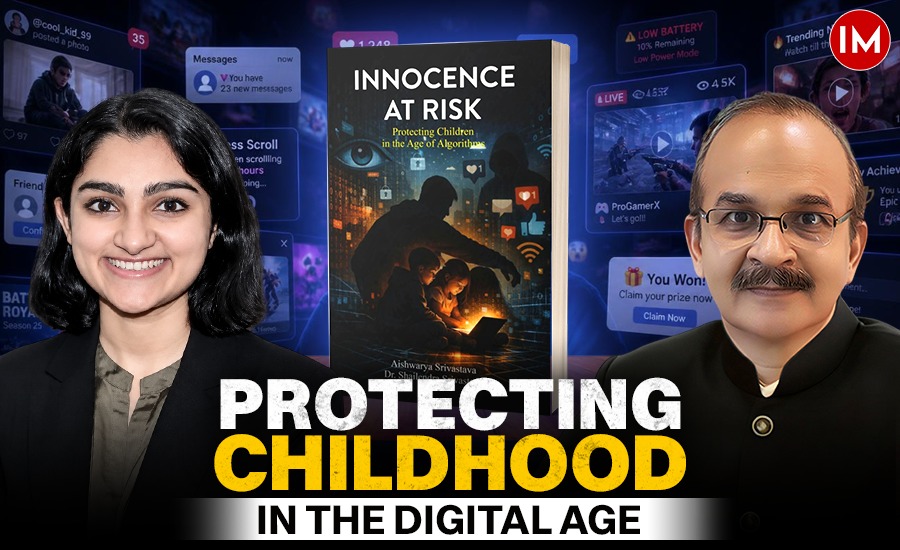
It is this concern that lies at the heart of Innocence at Risk: Protecting Children in the Age of Algorithms, a book written by an unusual and compelling father-daughter duo—lawyer Aishwarya Srivastava and retired IPS officer Dr Shailendra Srivastava.
Their professional worlds could hardly be more different. Aishwarya approaches the digital ecosystem through the lens of technology law, privacy, data protection and platform accountability. Her father, Dr Shailendra, brings more than three decades of policing and law-enforcement experience, including crime investigation, cybercrime and the protection of women and children. Together, they bring two generations and two professional perspectives to one increasingly urgent question: what happens to childhood when it grows up under the constant gaze of technology?
Also Read – Children Need a Digital Safety Standard, Not Just a Screen-Time Rule
A CONVERSATION THAT BEGAN AT THE DINNER TABLE
The origins of the book were not found in a publishing office or a conference room. They began, as the authors describe, at the family dining table, where a father and daughter tried to reconcile what they were witnessing professionally with what they were increasingly concerned about personally.
For Dr Shailendra, digital harm appeared in police records, investigations, devices recovered from homes and in the painful questions asked by parents after something had already gone wrong. For Aishwarya, the same crisis appeared in courtrooms and policy discussions involving privacy, encryption, intermediary liability, corporate governance and digital accountability.
The settings were different, but the pattern was unmistakably similar.
“Children were increasingly at risk in spaces adults barely understood.”
That realisation became the foundation for the book.
The authors argue that the internet, once celebrated primarily as a democratising force, has fundamentally altered the conditions of childhood. It educates and connects, but it also records, exposes, amplifies and remembers. A mistake made at thirteen can potentially follow a child for years, while an algorithm can learn from a child’s behaviour long before the child understands what is happening.
FROM THE DIGITAL CHILD TO THE POWER OF ALGORITHMS
The book begins by asking readers to understand the child growing up in this new environment. Smartphones, social media, gaming platforms, artificial intelligence and constant connectivity have changed the way children learn, communicate, form relationships and construct their identities.
But the authors then take the discussion one step deeper.
Children are not simply consuming digital content. Increasingly, algorithms decide what they see next.
Recommendation engines, social-media feeds and search systems continuously study patterns of attention and behaviour. What a child watches can influence what the algorithm recommends next, creating a cycle in which technology gradually shapes the child’s digital environment.
This is why the book’s concern is not simply about screen time.
Two children may spend the same two hours online and experience completely different worlds. One may be learning, creating or connecting with friends. Another may be exposed to cyberbullying, harmful content, manipulation or unwanted contact.
The clock measures duration. It does not measure danger.
WHEN TECHNOLOGY BECOMES A SOURCE OF VULNERABILITY
From there, Innocence at Risk enters some of the darker corners of the digital world—cyberbullying, online grooming, gaming addiction, misinformation, privacy violations, identity theft, financial fraud, sextortion, deepfakes and algorithm-driven manipulation.
But the book does not treat these simply as technological problems.
Its focus remains on the child behind the screen.
The consequences can extend into mental health, education, relationships, social development and even the legal system. A digital incident that appears small from the outside can have an enormous emotional impact on a young person who may not possess the maturity or support system needed to process it.
This is where the experience of the two authors becomes particularly significant.
Aishwarya’s legal practice increasingly engages with the consequences of the digital ecosystem, including data protection, privacy, cyber-enabled exploitation and platform responsibility. Her perspective pushes the conversation towards a crucial question: when a platform is designed to influence behaviour, how much responsibility should the platform carry for the environment it creates?
The book’s underlying argument is clear: “digital child safety was too often treated as a technical inconvenience rather than as a moral and institutional responsibility.”
A POLICE OFFICER’S VIEW FROM THE OTHER SIDE OF THE SCREEN
Dr Shailendra brings a very different vantage point.
As a police officer who served for more than 35 years and rose to the position of Director General of Police, he witnessed the evolution of crime and policing as technology transformed society. His work included strengthening cybercrime investigation capabilities and dealing with issues involving women and child protection.
For him, the digital world is not an abstract space. It is increasingly part of the crime scene.
“We have seen investigations succeed and institutions falter. We have seen silence deepen harm, and structured compassion restore agency.”
That perspective gives the book a practical dimension. It moves beyond identifying threats to examining what happens after a complaint is made—how investigations proceed, how digital evidence is handled, how forensic processes work and how cases eventually reach the courtroom.
The discussion also examines the POCSO Act and Section 67B of the Information Technology Act in the context of online harm, while considering the difficult balance between privacy, liberty and protection.
FROM PROBLEM TO PROTECTION
Importantly, Innocence at Risk is not written as a catalogue of digital horrors. Its journey gradually moves from understanding the problem to building solutions.
The authors examine what parents, teachers, schools, law-enforcement agencies, policymakers and technology companies can do to create stronger protection systems. Digital literacy, prevention, resilience and responsible digital citizenship become central to that discussion.
For parents, the message is particularly important: they cannot be expected to understand every platform, recommendation system, privacy setting, gaming interaction or emerging digital trend their children encounter.
Protection, therefore, cannot rest entirely on parental vigilance.
Platforms must also build safer environments.
THE CHILD MUST REMAIN THE MASTER OF TECHNOLOGY
The final sections of the book look towards an even more complicated future—artificial intelligence, predictive algorithms, virtual worlds and deepfakes.
These technologies promise extraordinary opportunities, but they also raise a fundamental question: can society preserve childhood, dignity and freedom when so much of a child’s digital experience is shaped by systems designed to predict and influence behaviour?
The answer offered by the father-daughter duo is not to reject technology.
It is to make technology more responsible.
“Digital safety cannot be secured by algorithms alone. Nor can it be achieved by legislation in isolation.”
It requires law, ethical technology, effective institutions, informed parents, responsible platforms and compassionate systems of protection working together.
At its heart, Innocence at Risk is not really a book about technology. It is a book about childhood.
Its central message is both simple and profound: children should remain masters of technology, not subjects of algorithms.
And perhaps that is what makes this father-daughter collaboration especially timely. One brings the perspective of law and the digital policy landscape; the other brings decades of experience from the frontline of policing and child protection. Together, they are asking society to look beyond the screen and see the child.
Because technology will continue to evolve.
The real question is whether our sense of responsibility will evolve with it.
As the authors put it, “Protection is not resistance to progress. It is the condition that makes progress humane.”