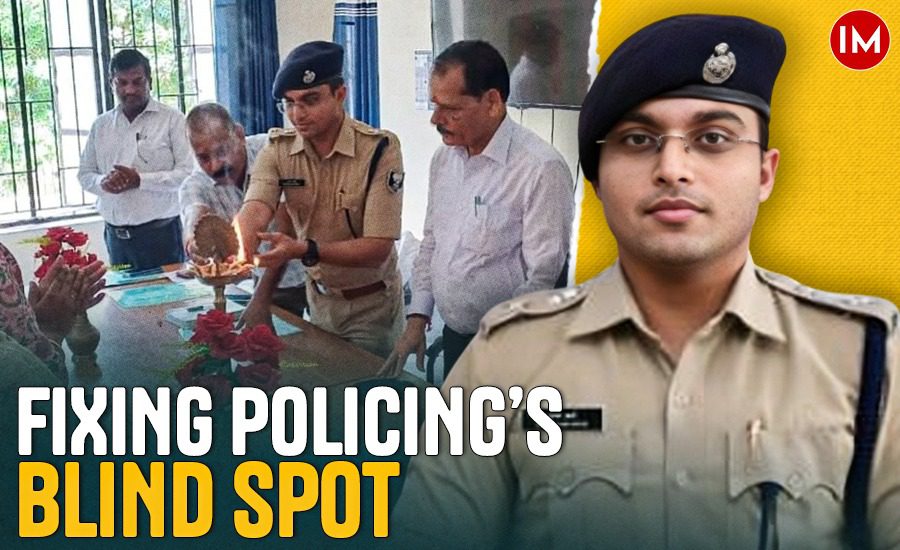
Police malkhanas are rarely discussed. Yet, they quietly hold the backbone of criminal justice — seized weapons, vehicles, liquor, documents, and evidence that decide the fate of cases in court. In most districts, these storehouses remain overcrowded, poorly managed, and dependent on fragile paper records. In Buxar, Bihar, IPS officer Shubham Arya (2019 batch) decided to change that reality—not with a big budget or fancy software, but with a clear idea and an in-house digital solution.
What followed was Bihar’s first structured E-Malkhana system at the district level — an initiative that brought order, accountability, and transparency to one of policing’s most neglected spaces.
A PROBLEM HIDDEN IN PLAIN SIGHT
When Shubham Arya took charge as Superintendent of Police, he noticed a familiar but worrying picture. Malkhanas across police stations looked more like old archives than secure evidence rooms. Items were stacked without proper sorting. Registers were outdated. Tracking a single case property could take hours — sometimes days.
“The system we were following was very old. It was more like an archive, not a management system,” Arya told Indian Masterminds.
The consequences were serious. Case properties went missing. Courts asked for evidence that could not be produced on time. Compliance issues weakened prosecutions. Even officers hesitated to take charge of malkhanas because physical verification of thousands of items was a back-breaking task.
WHY DIGITISATION BECAME NECESSARY
Three issues pushed the district police to act.
- First, missing case properties directly affected convictions.
- Second, delays in producing seized items in court created legal complications.
- Third, charge handover became a nightmare. Officers had to verify each item manually while taking or giving charge, often taking weeks.
“There are officers who don’t even want to take charge of malkhana because of the risk involved,” Mr. Arya says.
There was also a fourth, often ignored issue — non-disposal of properties. Vehicles, trucks, and seized goods from cases already disposed of by courts continued to occupy valuable space for years due to poor record-keeping.
BUILDING IT IN-HOUSE
Instead of waiting for state-level software or an external vendor, Arya chose a practical route. A small four-member team, including a district-level programmer, built the system internally.
“There was no ready-made software. We developed everything in-house,” he says.
The team studied ground realities carefully. What data fields were required? How should properties be categorised? How could locations inside the malkhana be digitally mapped? The plan had to be revised multiple times.
Infrastructure was another challenge. Many police stations function from old buildings with limited space. Digitisation could not magically fix structures, but it could at least bring order.
SORTING BEFORE SOFTWARE
The first step was not technology but physical arrangement. Items were cleaned, sorted, and arranged systematically — case-wise and year-wise. Only then did digitisation begin.
Each seized item was entered into the system with details of the case, description, and exact physical location — rack number, box, and section.
“Today, we know exactly where a particular property is kept — which rack and which box,” Mr. Arya says.
This made retrieval faster and reduced dependency on individual memory. The system also made audits and inspections easier.
EARLY RESULTS ON THE GROUND
Though the project is still evolving, changes are visible. Malkhanas look organised. Accountability has improved. Officers feel more confident during charge handovers. Missing properties have reduced.
“It’s a continuous process. The better the data entry, the better the system works,” Mr. Arya notes.
Digitisation has also helped identify properties eligible for disposal after court orders, freeing up space that had been blocked for years.
A MODEL FOR OTHER DISTRICTS
The Buxar model has already caught attention. The system was presented to the Director General of Police, who responded positively. The state headquarters is now considering wider implementation.
“The idea is that the state can improve it further and then share it with other districts,” Mr. Arya says.
Because it is built in-house, the model is cost-effective and adaptable — a major advantage for resource-constrained districts.
MORE THAN A TECH UPGRADE
What makes the initiative stand out is its intent. It is not just about software, but about respecting evidence and strengthening the justice process. In a system where convictions often fail due to procedural lapses, a well-managed malkhana quietly becomes a powerful reform.
Shubham Arya’s effort shows that meaningful change does not always require massive funds or policy shifts. Sometimes, it begins with noticing a neglected problem — and deciding to fix it, one register at a time.
In Buxar, malkhanas have finally stepped out of the shadows — and into the digital age.