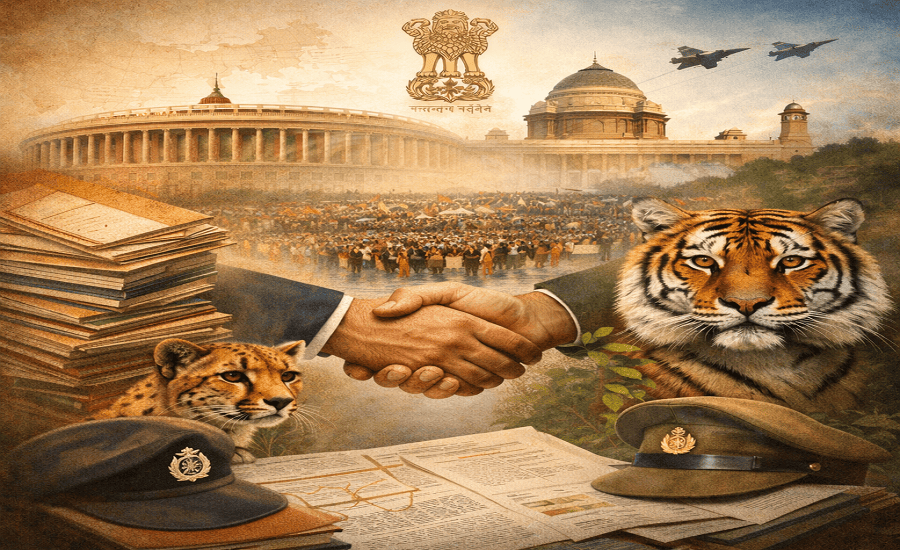
As 2025 draws to a close, India’s governance and administrative ecosystem stands at a defining juncture. The year witnessed historic breakthroughs in representation, large-scale administrative achievements, landmark conservation successes, and moments of intense scrutiny for institutions tasked with upholding public trust. From women breaking long-standing barriers in policing and administration to the centenary celebrations of the Union Public Service Commission, and from managing one of the world’s largest religious gatherings to navigating controversies that tested accountability, 2025 emerged as a year of both progress and introspection for India’s bureaucracy.
Breaking Barriers: Women Redefining Leadership in Policing and Administration
First Women at the Helm of Policing Institutions
The year marked a transformative chapter for Indian policing, as several women officers assumed top leadership roles, reshaping a traditionally male-dominated domain.
1988 batch IPS officer Rashmi Shukla became the first woman DGP of Maharashtra in January 2024, formally assuming charge around 10 January 2024. Her tenure was extended through 31 December 2025, when she is set to retire, marking a significant phase of continuity and reform in the state’s policing framework.
1994 batch IPS officer Tadasha Mishra was appointed DGP of Jharkhand on 7 November 2025, serving in acting/full charge capacity until 31 December 2025, further underscoring the growing presence of women at the apex of state police leadership.
IPS Sonali Mishra (1993 batch, Madhya Pradesh cadre) assumed office as Director General of the Railway Protection Force (RPF) on 1 August 2025, with her appointment valid until her retirement on 31 October 2026. Under her leadership, the RPF has focused on enhancing passenger security and operational efficiency across the vast Indian Railways network.
Together, these appointments symbolised a decisive shift toward inclusivity, inspiring women across the country to aspire to leadership roles in law enforcement.
Administrative Firsts: Women Leading India’s Bureaucratic Institutions
Another historic milestone was achieved when Ms Anu Garg, a 1991-batch IAS officer of the Odisha cadre, became the first woman Chief Secretary of Odisha, officially assuming office on 31 December 2025. Her continuation in the role reflects both administrative confidence and the evolving leadership dynamics within state bureaucracies, where policy execution increasingly demands coordination, negotiation, and resilience.
In the environmental governance space, Ms Bharati, IFS (1992 batch, Sikkim cadre), assumed charge as the first woman Director of the Indira Gandhi National Forest Academy (IGNFA) in October 2025. Her appointment marked a significant institutional milestone, bringing decades of experience in forest protection and sustainable management to one of India’s premier forestry training institutions.
Mahakumbh 2025: A Testament to India’s Administrative Capacity
The Maha Kumbh 2025 at Prayagraj stood out as one of the most demanding administrative undertakings of the year, drawing over 150 million devotees, making it among the largest human gatherings ever managed.
The scale of the event required seamless coordination among district administrations, police forces, health services, disaster management authorities, municipal bodies, railways, and thousands of volunteers. Smart city technologies, extensive CCTV surveillance, mobile applications for crowd guidance, temporary shelters, sanitation infrastructure, and round-the-clock medical facilities were deployed to ensure safety and efficiency.
Railways and Crowd Management Excellence
Indian Railways played a pivotal role, operating over 150 special trains, undertaking massive infrastructure upgrades, and deploying advanced crowd-management systems. According to IRTS officer Ankit Agarwal, meticulous planning, real-time coordination, and technology-driven strategies were central to managing the unprecedented passenger flow.
Adding to capacity-building efforts, 50 police officers from Maharashtra and Madhya Pradesh underwent specialised crowd-management training during the Mahakumbh. The hands-on exposure to traffic systems, command centres, and on-ground coordination is expected to strengthen preparedness for the Simhastha Kumbh in Nashik (2027) and Ujjain (2028).
Civil–Military Coordination in Focus: Operation Sindoor
In May 2025, Operation Sindoor emerged as a major military initiative targeting terrorist infrastructure across Pakistan and Pakistan-Occupied Kashmir, following the Pahalgam terror attack. The operation highlighted strong civil–military fusion, with administrative machinery working closely alongside defence forces.
Government fact-checking units and the Press Information Bureau (PIB) played a crucial role in countering misinformation, while coordinated public communication strategies ensured clarity and restraint. Defence Minister Rajnath Singh later described the operation as a model of effective cooperation between bureaucracy and the armed forces, reinforcing the importance of civilian institutions during national security crises.
UPSC at 100: Celebrating a Century of Meritocracy
The Union Public Service Commission (UPSC) entered its centenary year on 1 October 2025, marking 100 years since its establishment in 1926 under the Government of India Act. The year-long celebrations, continuing until 1 October 2026, include special initiatives, a centenary logo, and events highlighting UPSC’s foundational role in building India’s administrative leadership.
A notable highlight was UPSC Chairman Dr. Ajay Kumar hosting the Commission’s first-ever live virtual town hall, directly engaging with civil services aspirants and addressing questions on examinations and reforms – an unprecedented step in the Commission’s history.
Judicial Milestone: Representation at the Highest Level
On 14 May 2025, Justice Bhushan Ramkrishna Gavai was sworn in as the 52nd Chief Justice of India, becoming the first Buddhist and the second Dalit to hold the nation’s highest judicial office, after Justice K.G. Balakrishnan. Administered the oath by President Droupadi Murmu at Rashtrapati Bhavan, his appointment was widely viewed as a landmark moment for inclusivity in the judiciary.
Elevated to the Supreme Court in 2019, Justice Gavai’s tenure as CJI, lasting until 23 November 2025, has been symbolically significant for representation and social justice within constitutional institutions.
Controversies Testing Institutional Accountability
Centre–State Standoff over Jharkhand DGP Appointment
A major administrative controversy unfolded around IPS officer Anurag Gupta (1990 batch), who became Jharkhand DGP in July 2024 and was reappointed in February 2025 for a two-year term under revised state rules. However, his official retirement on 30 April 2025 triggered a sharp centre–state dispute. The Union Home Ministry objected to his continuation, the UPSC declined to recognise the appointment, and promotions were stalled. Following months of political and administrative deadlock, Gupta resigned in November 2025, bringing the standoff to an end.
Tragic Loss within the Police Services
In October 2025, the death of Haryana IPS officer Y. Puran Kumar (2001 batch) sent shockwaves through administrative circles. His passing and the allegations raised in his note prompted renewed discussions on workplace dignity, institutional support systems, and the need for stronger grievance redressal mechanisms within the services.
Corruption and Cybercrime: Emerging Risks for Institutions
The year also highlighted vulnerabilities within the system. A retired Punjab DGP was reportedly defrauded of ₹2.5 lakh by cyber criminals impersonating CBI officers, underscoring the sophistication of cyber scams. In other cases, cyber-fraud gangs created fake profiles of senior officers to extort money, with arrests made across multiple states.
In Punjab, the Vigilance Bureau arrested a SHO and three police personnel in a cybercrime-linked bribery case, illustrating the ongoing challenge of internal corruption and the need for constant institutional vigilance.
Conservation Successes: Wildlife Governance in Action
Project Cheetah Achieves Official Success
India’s Project Cheetah, launched in September 2022, achieved official success in 2025. With cheetahs reintroduced from Namibia and South Africa, populations established at Kuno National Park and Gandhi Sagar Wildlife Sanctuary have grown to 30–32 cheetahs, including several India-born cubs. The birth of five cubs to Mukhi, the first India-born female cheetah, marked a landmark moment for long-term species viability.
Historic Tigress Relocation
In another first, Tigress PN-224 was airlifted by the Indian Air Force from Pench Tiger Reserve (Madhya Pradesh) to Ramgarh Vishdhari Tiger Reserve (Rajasthan) to enhance genetic diversity. Conducted under expert supervision, the operation showcased innovative inter-state collaboration in wildlife management.
Expanding Protected Areas Amid Environmental Concerns
In 2025, Madhav Tiger Reserve was notified as India’s 58th tiger reserve, while Sikhna Jwhwlao National Park was declared in Assam. New conservation areas such as Tsarap Chu Conservation Reserve in Himachal Pradesh and Dr. Bhimrao Ambedkar Wildlife Sanctuary in Madhya Pradesh were also notified. However, concerns persisted as over 8,500 hectares of forest land were cleared in six months for development projects, raising questions about habitat fragmentation and enforcement.
Looking Ahead: Bureaucracy at a Defining Crossroads
As India steps into 2026, the experiences of 2025 present a nuanced portrait of its bureaucracy—marked by historic achievements, gender breakthroughs, administrative excellence, and environmental leadership, alongside controversies that underline the urgency of reform.
From women leading police forces and state administrations to the UPSC’s centenary reaffirming meritocracy, the year demonstrated the evolving responsibilities of civil servants. At the same time, challenges related to accountability, workplace equity, cyber threats, and environmental sustainability reinforced the need for transparent, resilient, and responsive institutions.
Ultimately, 2025 will be remembered as a year when India’s bureaucracy celebrated its strengths while confronting its vulnerabilities—setting the stage for deeper reforms and a more inclusive governance framework in the years ahead.