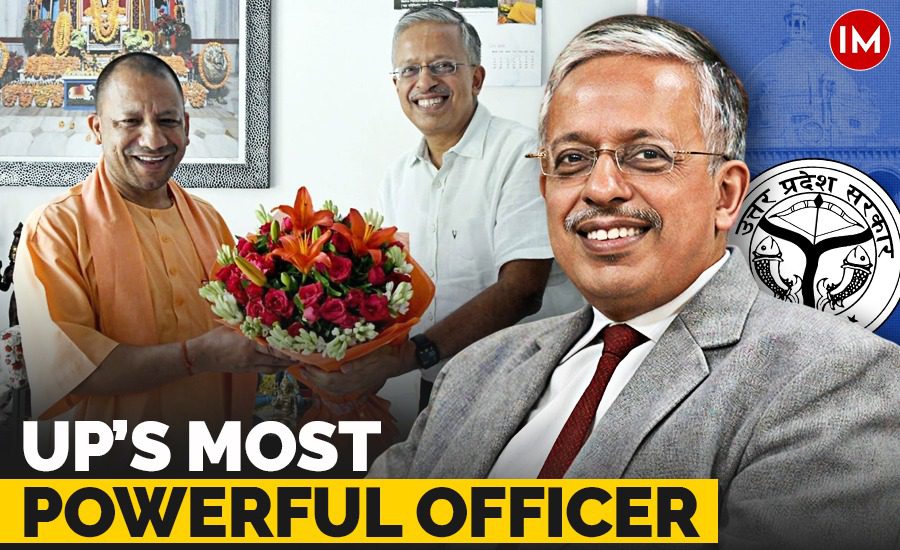
When Shashi Prakash Goyal took charge as the Chief Secretary of Uttar Pradesh on July 31, 2025, it was not merely a change of guard at the top of India’s largest state bureaucracy. It marked the arrival of an officer whose entire career had quietly been moving toward this moment.
A 1989-batch IAS officer, All-India Rank 1 in the civil services examination, SP Goyal’s ascent was never flashy. It was controlled, deliberate, and deeply embedded within the administrative system. By the time he stepped into the state’s highest bureaucratic office, he had already spent nearly eight years inside the Chief Minister’s Office, shaping policy, filtering decisions, and managing power without drawing attention to himself.
His appointment sent a clear message: Uttar Pradesh wanted continuity, control, and a steady administrative hand as the state moved toward the 2027 Assembly elections.
EARLY LIFE AND THE MAKING OF AN ADMINISTRATOR
Born in Lucknow in 1967, SP Goyal’s roots are firmly anchored in Uttar Pradesh. His academic path set him apart early. A graduate in Mathematics, followed by a Master’s degree in Computer Applications, and later an Executive MBA in International Business from IIFT, Goyal developed a rare blend of analytical thinking, technological understanding, and economic awareness.
This combination would later define his administrative style — structured, data-oriented, and focused on systems rather than personalities.
Clearing the UPSC examination in 1989 with the top rank nationwide, he entered the Uttar Pradesh cadre with expectations already attached to his name.
LEARNING GOVERNANCE ON THE GROUND
Goyal’s early years were spent in the field, where authority is tested daily. As Assistant Magistrate in Etawah, Joint Magistrate in Mathura, and later as District Magistrate in districts such as Mathura, Etawah, Prayagraj, Deoria, and Aligarh, he handled law and order, development delivery, and administrative crises firsthand.
He also served as Chief Development Officer in several districts, gaining exposure to grassroots planning and execution. These postings built his reputation as an officer who understood both files and field realities — an essential foundation for later roles at the top.
SURVIVING POLITICAL CHANGE, GROWING WITH THE SYSTEM
One of the defining aspects of SP Goyal’s career is his ability to remain relevant across political regimes. He served in key roles during Samajwadi Party, BSP, and BJP governments, holding sensitive positions such as:
- Secretary, Planning Department
- Principal Secretary, Programme Implementation
- Staff Officer in the Cabinet Secretariat
- Principal Secretary, Public Service Commission
This period sharpened his understanding of political-administrative balance — knowing when to push, when to pause, and when to protect institutional processes.
DELHI AND THE CENTRE OF POWER
Goyal’s career took a decisive turn with his central deputation, where he served as Joint Secretary in the Department of Higher Education and worked in the Prime Minister’s Office and the Presidential Secretariat.
These assignments placed him inside India’s most powerful decision-making spaces. He gained insight into how national priorities are framed, how inter-ministerial coordination works, and how states negotiate power with the Centre.
Equally important, this phase gave him strong working relationships within Delhi’s bureaucratic network — links that later strengthened his standing back in Uttar Pradesh.
INSIDE THE YOGI ADITYANATH GOVERNMENT
In 2017, when Yogi Adityanath became Chief Minister, SP Goyal was brought into the Chief Minister’s Office as Principal Secretary. What followed was an unusually long and influential tenure.
For nearly eight years, Goyal remained at the heart of the CMO, later becoming Additional Chief Secretary, handling critical departments including Civil Aviation, Estate, Protocol, Coordination, and functioning as Additional Resident Commissioner.
Within administrative circles, he came to be known as the CM’s most trusted officer — the person relied upon for sensitive files, complex coordination, and long-term planning. He operated away from cameras, rarely speaking publicly, focusing instead on execution and control.
THE APPOINTMENT THAT CHANGED THE BUREAUCRATIC LANDSCAPE
When SP Goyal was appointed Chief Secretary, it was seen as the logical culmination of this long association. He succeeded Manoj Kumar Singh and took charge at a moment when Uttar Pradesh was pushing hard on infrastructure, industrial investment, and governance discipline.
Along with the Chief Secretary’s role, he was initially given a cluster of powerful additional responsibilities:
- Infrastructure and Industrial Development Commissioner
- Chairman, PICUP
- CEO, UPEIDA
- CEO, UPSHA
- Additional Chief Secretary, Coordination
- Project Director, UPDASP
This made him one of the most powerful bureaucrats in the state, overseeing both administrative machinery and economic expansion.
SETTING THE TONE
From the outset, Goyal made his priorities clear: zero crime, zero corruption, administrative discipline, and rapid industrial growth.
He cracked down on procedural laxity, most notably ordering action against tens of thousands of government employees who failed to submit mandatory asset declarations. Salaries were stopped, departmental action initiated, and deadlines enforced — a move that sent shockwaves through the bureaucracy.
At the same time, he pushed districts to accelerate implementation of flagship schemes such as Ayushman Bharat, Swamitva, and PM-Kisan, openly expressing dissatisfaction with slow performers and demanding accountability.
MANAGING THE STATE’S LARGEST EXERCISES
As Chief Secretary, Goyal also assumed responsibility for preparing Uttar Pradesh for Census 2027, overseeing planning for the deployment of nearly six lakh personnel and steering the state toward digital enumeration readiness.
His approach emphasized coordination across departments, tight monitoring, and early preparation — hallmarks of his administrative method.
HEALTH, SUDDEN LEAVE, AND A TEST OF CONTINUITY
Only weeks into his tenure, Goyal faced a personal health crisis. Diagnosed with coronary artery disease, he underwent heart surgery in Delhi after experiencing chest pain.
His sudden medical leave triggered speculation, but the administration moved swiftly. Senior IAS officer Deepak Kumar was given temporary charge, ensuring continuity. Goyal’s surgery was successful, and he returned to office after recovery — resuming control with minimal disruption.
The episode reinforced the importance of the system he had helped build: one that could function even in his absence.
THE OFFICER BEHIND THE FILES
Among peers and juniors, SP Goyal is described as sharp, outspoken when required, and immune to pressure. He is known for direct instructions, minimal tolerance for delay, and clarity in expectations.
He does not court public attention. Instead, his influence is felt through files that move quickly, meetings that end with clear outcomes, and decisions that align tightly with the political leadership’s priorities.
WHY HIS TIMING MATTERS
With panchayat elections approaching and the 2027 Assembly polls on the horizon, Goyal’s presence at the top of the bureaucracy is strategic. Though scheduled to retire in January 2027, discussions around an extension underline the importance of continuity during a politically sensitive phase.
His elevation reflects not just seniority, but trust — earned over decades, reinforced by central exposure, and cemented by years inside the Chief Minister’s Office.
A CAREER THAT LED HERE
SP Goyal’s journey is not defined by dramatic moments, but by sustained control over complex systems. From a topper entering service with expectations, to a field officer learning governance the hard way, to a central bureaucrat navigating Delhi, and finally to the Chief Secretary steering India’s most populous state — every phase prepared him for this role.
Today, as Uttar Pradesh navigates growth ambitions, political pressures, and administrative scale, SP Goyal stands as the quiet power coordinating it all — firmly in charge, deeply trusted, and fully embedded in the machinery of the state.