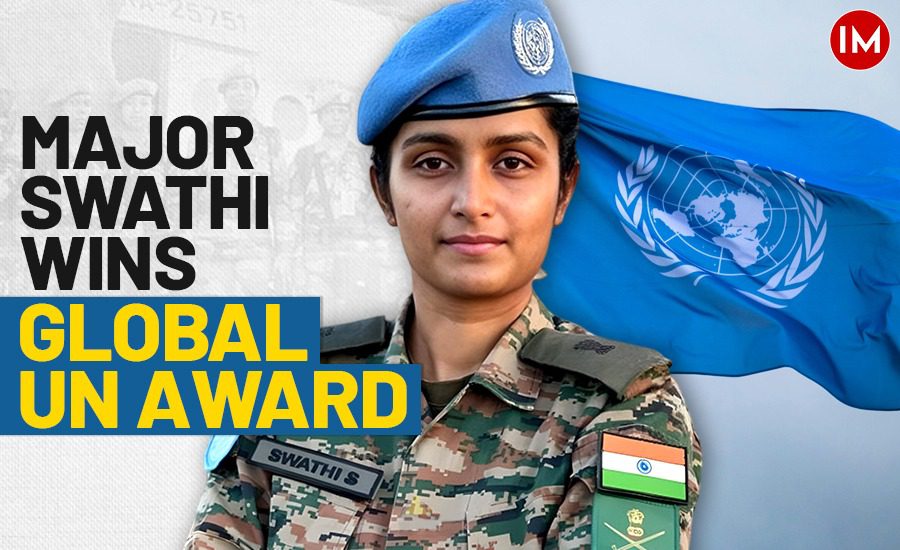
India’s contribution to global peacekeeping received international recognition in 2025 when Major Swathi Shantha Kumar of the Indian Army was honoured with the United Nations Secretary-General’s Award for her outstanding work in gender-inclusive peacekeeping. Serving with the United Nations Mission in South Sudan (UNMISS), Major Swathi emerged as the global winner in the Gender Category for her project titled “Equal Partners, Lasting Peace.”
The award, announced by UN Secretary-General António Guterres as part of the Secretary-General’s Awards 2025, recognises initiatives that advance gender parity and promote gender-responsive peacekeeping in line with the UN mandate. Major Swathi’s project was selected after a competitive UN-wide voting process that involved personnel from peacekeeping missions and UN agencies across the world.
GLOBAL RECOGNITION FOR INDIAN ARMY LEADERSHIP
The Secretary-General’s Award is among the highest internal honours of the United Nations, presented annually to individuals and teams whose work significantly strengthens UN priorities. In 2025, nominations were invited from all UN peacekeeping missions and agencies worldwide. From these, four initiatives were shortlisted in the Gender Category. Major Swathi’s project secured the highest number of votes, reflecting broad international endorsement of her approach and outcomes.
Announcing the award, Secretary-General António Guterres highlighted how UNMISS has strengthened its gender-inclusive framework through initiatives such as Major Swathi’s, underlining the growing importance of inclusive operational planning in modern peacekeeping missions.
“EQUAL PARTNERS, LASTING PEACE”: THE CORE OF THE INITIATIVE
Major Swathi’s award-winning project focused on integrating gender perspectives into day-to-day peacekeeping operations rather than limiting them to policy discussions. As part of UNMISS, she led the Indian Engagement Team, which played a key role in strengthening gender parity and community outreach across conflict-affected regions of South Sudan.
Under her leadership, female peacekeepers were actively deployed in frontline operations. This integration helped peacekeeping forces engage more effectively with local women, who are often among the most affected by conflict yet remain underrepresented in formal peace processes.
The project demonstrated how gender-inclusive teams can improve access, communication, and trust at the grassroots level, particularly in regions with social and cultural barriers that restrict women’s interaction with armed personnel.
OPERATIONS IN CHALLENGING TERRAIN
South Sudan remains one of the UN’s most demanding peacekeeping environments, with large areas affected by conflict, limited infrastructure, and difficult terrain. Major Swathi led her team in conducting a wide range of operational activities, including short- and long-distance ground patrols, integrated river patrols, and air patrols to remote and far-flung counties.
These patrols were not symbolic. They were designed to improve security, ensure freedom of movement, and create safer conditions for community engagement. According to the United Nations, sustained operations under Major Swathi’s command helped stabilise several areas and enabled local populations to interact more confidently with peacekeeping forces.
A key outcome of these efforts was increased participation by women at the community level. More than 5,000 women were able to move more freely, attend community meetings, and take part in local engagement activities after the team’s continued presence and outreach.
STRENGTHENING TRUST AT THE GRASSROOTS
The United Nations noted that Major Swathi’s work significantly improved trust between peacekeepers and local communities. By combining security operations with inclusive engagement strategies, the Indian Engagement Team helped bridge gaps that often exist between international forces and conflict-affected populations.
UNMISS cited the initiative as an example of how gender perspectives can be effectively integrated into operational planning and field-level execution, rather than treated as separate or secondary objectives. The project has since been referenced internally as a model for similar missions.
FROM BEGALURU TO GLOBAL PEACEKEEPING
Major Swathi Shantha Kumar hails from Bengaluru and is the eldest of three daughters. According to her family, she expressed a desire to join the Indian Army from an early age. She completed her schooling in Bengaluru and graduated from New Horizon College of Engineering before being commissioned into the Indian Army.
An officer of the Corps of Electronics and Mechanical Engineers (EME), she is part of the Indian Army contingent deployed under UNMISS. Her father, R. Shantha Kumar, described the award as a moment of pride for the family and a recognition of her discipline and dedication, while also acknowledging the challenges of serving in demanding conditions.
Major Swathi has been deployed in South Sudan for nearly 15 months and is expected to return to India soon, after which she will be posted in Secunderabad.
INDIA’S ROLE IN UN PEACEKEEPING
Major Swathi’s recognition highlights India’s long-standing and active participation in United Nations peacekeeping operations. Indian Army officers and troops have served in some of the UN’s most complex missions, often combining operational effectiveness with community engagement.
The Secretary-General’s Award 2025 reinforces how Indian peacekeepers continue to contribute beyond traditional security roles, shaping more inclusive and people-centric approaches to peacekeeping.
By demonstrating how gender-inclusive practices can be embedded into daily operations, Major Swathi Shantha Kumar’s work has added a meaningful chapter to India’s peacekeeping legacy and set a benchmark for future UN missions worldwide.