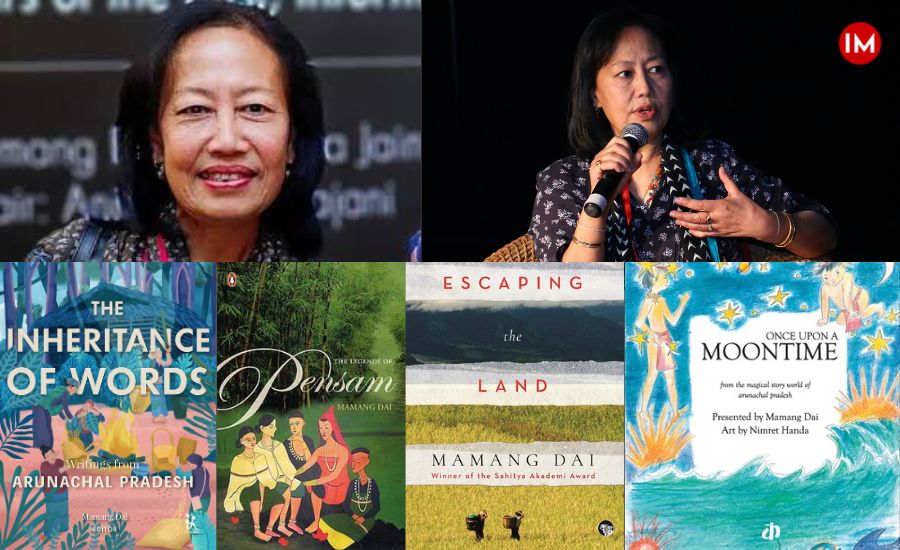
Mamang Dai’s journey from Arunachal Pradesh’s first woman Indian Administrative Service (IAS) officer to a celebrated author and cultural advocate is a story of bold choices, creative brilliance, and a deep connection to her roots. Born on February 29, 1957, in Pasighat, East Siang district, Dai grew up in the lush landscapes of Arunachal Pradesh, surrounded by the vibrant traditions of the Adi tribe. Her parents, Matin and Odi Dai, nurtured her curiosity and love for learning, laying the groundwork for a career that would blend administrative excellence, literary artistry, and cultural preservation.
EARLY LIFE AND EDUCATION
Dai’s childhood in Arunachal Pradesh immersed her in a world of oral storytelling, where myths and folklore shaped her understanding of her Adi heritage. Her parents, likely educators or community leaders, encouraged her intellectual growth, fostering a blend of tribal pride and academic ambition. She attended Pine Mount School in Shillong, Meghalaya, a prestigious institution that introduced her to a diverse cultural environment. This experience broadened her worldview, allowing her to navigate the intersection of her tribal identity and a cosmopolitan outlook.
Her academic path led her to Gauhati University in Assam, where she earned a Bachelor’s degree in English Literature. Here, Dai’s passion for poetry and prose deepened, setting the stage for her future literary contributions. Her engagement with literature during these formative years was not merely academic—it was a calling that would later define her career.
ARUNACHAL’S FIRST WOMAN IAS OFFICER
In 1979, at the age of 22, Mamang Dai achieved a historic milestone by becoming the first woman from Arunachal Pradesh to clear the Union Public Service Commission (UPSC) examination and join the Indian Administrative Service. This accomplishment was extraordinary, particularly for a woman from a remote state with limited access to resources at the time. Her selection was a source of immense pride for Arunachal Pradesh, showcasing the potential of its youth to compete on a national stage.
As an IAS officer, Dai took on various administrative roles, likely focusing on development and governance initiatives in her home state. Her work in the bureaucracy provided her with a firsthand understanding of Arunachal’s socio-economic challenges and cultural richness. Yet, despite her success in this prestigious career, Dai felt a stronger pull toward storytelling and cultural expression. In a bold decision, she left the IAS to pursue journalism and literature, choosing a path that allowed her to amplify the voices of her people and preserve their stories.
A LITERARY VOICE FOR THE NORTHEAST
Mamang Dai’s literary career is a celebration of Arunachal Pradesh’s landscapes, traditions, and human experiences. Her writing, known for its lyrical prose and vivid imagery, captures the essence of Northeast India while exploring universal themes of identity, nature, and belonging. Her debut poetry collection, River Poems (2004), introduced readers to her evocative style, weaving personal reflections with the rhythms of Arunachal’s rivers and forests.
Her novels and non-fiction works further demonstrate her versatility. The Black Hill (2014), a historical novel set in 19th-century Northeast India, earned her the Sahitya Akademi Award in 2017 for its compelling narrative and cultural depth. Arunachal Pradesh: The Hidden Land (2003), a detailed exploration of her state’s traditions and biodiversity, won the Verrier Elwin Prize in 2013. Other notable works include:
- The Legends of Pensam (2006), a novel interweaving stories of the Adi tribe.
- Escaping the Land (2021), a reflection on change and continuity in Arunachal.
- Once Upon a Moontime (2003), a collection of folk tales preserving tribal narratives.
- The Balm of Time (2008), a poetic meditation on memory.
- Hambreelmai’s Loom (2014), a tribute to tribal craftsmanship.
- Midsummer Survival Lyrics (2014), a poetry collection exploring survival and identity.
- The Sky Queen, a children’s story engaging young readers.
- Stupid Cupid, a light-hearted narrative.
- Mountain Harvest: The Food of Arunachal Pradesh, a journey through the state’s culinary heritage.
Dai’s writing draws heavily from her Adi heritage, blending oral traditions with modern literary forms. Her works serve as a bridge between the remote villages of Arunachal and the global literary stage, earning her recognition as a leading voice of Northeast India.
JOURNALISM AND MEDIA
After leaving the IAS, Dai ventured into journalism, contributing to prominent publications such as The Telegraph, Hindustan Times, and The Sentinel. Her articles often focused on the socio-cultural and environmental issues facing Northeast India, shedding light on the region’s challenges and beauty. As an anchor and interviewer for All India Radio (AIR) and Doordarshan Kendra (DDK) in Itanagar, she used media to share local stories and perspectives, giving a platform to voices often overlooked.
Her role as a programme officer for the World Wide Fund for Nature (WWF), focusing on the Eastern Himalayas Biodiversity Hotspots, reflected her commitment to environmental conservation. This work aligned with the themes of nature and sustainability that permeate her writing, allowing her to advocate for the preservation of Arunachal’s rich ecosystems.
LEADERSHIP AND CULTURAL ADVOCACY
Dai’s influence extends beyond her literary and journalistic contributions. As General Secretary of the Arunachal Pradesh Literary Society, she has fostered literary activities in her state, nurturing a new generation of writers. Her involvement with the North East Writers’ Forum and her role as a General Council member of the Sahitya and Sangeet Natak Akademi have strengthened literary and artistic exchanges across India. In 2011, she served as a member of the Arunachal Pradesh State Public Service Commission, contributing to the state’s administrative framework.
Through these roles, Dai has elevated the cultural profile of Arunachal Pradesh and the Northeast, establishing herself as a respected figure in both literary and public spheres.
AWARDS AND RECOGNITION
Mamang Dai’s contributions have earned her numerous accolades. In 2011, she received the Padma Shri, India’s fourth-highest civilian honour, for her distinguished work in literature and education. The Verrier Elwin Prize in 2013 recognised her book Arunachal Pradesh: The Hidden Land for its insightful documentation of the state’s cultural heritage. In 2017, the Sahitya Akademi Award for The Black Hill cemented her status as a literary luminary.
On June 1, 2025, Mamang Dai received the Sahitya Surja Lummer Dai Award in her hometown of Pasighat, presented by Asam Sahitya Sabha president Dr Basanta Kumar Goswami. This award, instituted in memory of Lummer Dai, a pioneering Assamese journalist and writer from Arunachal, includes a citation, memento, and cash prize. It honours Dai’s lifelong dedication to literature and her role in fostering cultural ties between Assam and Arunachal Pradesh.
A LIFE ROOTED IN HERITAGE
Based in Itanagar, Mamang Dai maintains a low public profile, letting her work speak for itself. Her writings reflect a profound connection to her Adi heritage and the landscapes of Arunachal Pradesh. Her involvement in cultural and environmental initiatives underscores her commitment to preserving the Northeast’s heritage for future generations. While details about her personal life remain private, her works suggest a deep bond with her community and environment.
Mamang Dai’s journey from Arunachal’s first woman IAS officer to a celebrated literary figure is a story of courage, creativity, and cultural pride. Her works have enriched Indian literature and brought global attention to the Northeast’s unique identity.