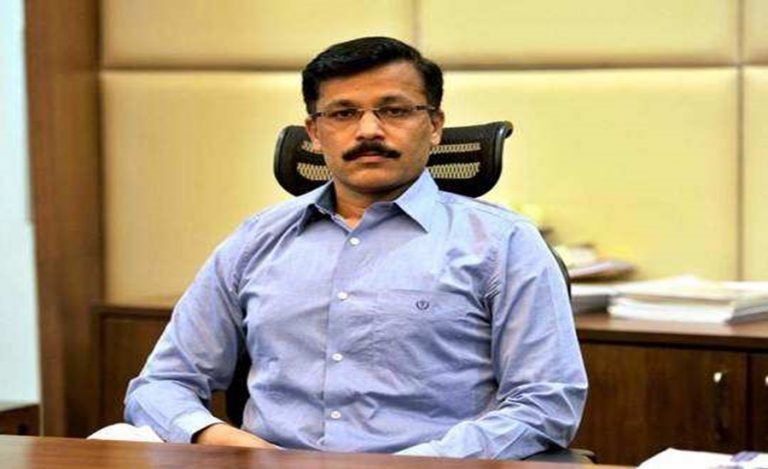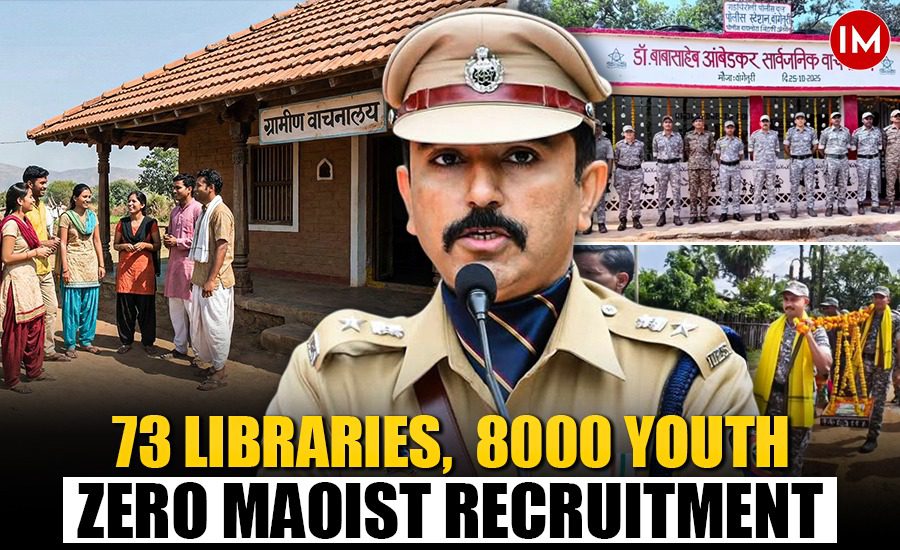
A young police officer, Neelotpal was the proud recipient of the Nexus of Good Annual Award, 2025 for his initiative of setting up 73 public libraries in Gadchiroli where he was posted as Superintendent of Police. These libraries that have already had a profound impact on security and social stability.
Gadchiroli district, situated at the far eastern edge of Maharashtra, stands as one of the most geographically isolated and socio-economically underdeveloped regions in the State. Over seventy-six percent of its vast landmass is covered by dense forests and inhabited primarily by tribal communities. The district’s remoteness, coupled with its complex security situation, has made it one of the six most Maoist-affected districts in India, as classified by the Ministry of Home Affairs, Government of India in March 2025.
This persistent insurgency, combined with the district’s challenging terrain, has gravely impeded infrastructure development, hindering the growth of transport, industry, healthcare, and education. Basic amenities such as paved roads, electricity, public transport, and telecommunication remain inadequate in many areas. In several interior villages, residents still walk long distances to access even basic services. Amid these constraints, education has suffered the most.
Schools in remote and conflict-affected regions are few, under-resourced, and often face disruptions due to security concerns. Many children, particularly girls, have to undergo travel upto several kilometers to attend school, leading to high dropout rates. The absence of libraries, reading rooms, and digital learning facilities further limits access to knowledge, leaving young minds disconnected from the outside world and from opportunities available elsewhere.
Recognizing education as a key to empowerment and peace, Gadchiroli Police envisioned and launched a transformative initiative—“One Village, One Library”—aimed at fostering intellectual growth, educational access, and social harmony across this sensitive region. The philosophy behind the initiative echoes the timeless belief that “The pen is mightier than the sword.”
The idea took root from the realization that, while much of the world is progressing into the digital and information age, many villages in Gadchiroli remain deprived of both books and internet connectivity. Schools located under the jurisdiction of Police Stations, Sub-Police Stations, and Armed Outposts often lacked even the most basic library facilities. Gadchiroli Police, being the most consistent government presence in this remote region, decided to bridge this gap through community partnership and innovative use of available infrastructure.
The first public library under this initiative was inaugurated on 18th January 2023 in Kotgul village, located near the Chhattisgarh border—an area historically affected by Maoist activity. The launch was marked by a symbolic “Granth Dindi” (book procession), which saw enthusiastic participation from students, teachers, elders, and women of the community. The event reflected the awakening of social consciousness and the community’s collective aspiration for peace, learning, and progress.
Since that historic beginning, the initiative has expanded rapidly. As of today, 73 public libraries have been established across Gadchiroli district. Among them, the first modern library equipped with Wi-Fi connectivity was set up at hyper sensitive Nargunda Police Station, providing digital learning opportunities to students who had never before accessed online study resources. In approximately 20 libraries, internet connectivity has been facilitated through nearby police stations, while three libraries are also equipped e-learning facilities.
Each library houses a diverse collection of books—including competitive exam guides, novels, biographies, poetry, newspapers, and magazines—carefully curated to cater to various educational and intellectual needs. These libraries have gradually evolved into vibrant centres of learning and dialogue, where police officers serve as mentors and facilitators. Their engagement not only provides academic guidance but also builds trust, discipline, and confidence among rural youth.
The initiative has also received generous support from voluntary organizations,Public representative, NGOs, and local donors, who continue to contribute books, furniture, and digital equipment to enhance and sustain these centres of learning.
The impact of “One Village, One Library” has been both tangible and transformative. In areas once associated with fear and conflict, these libraries have become symbols of peace, curiosity, and creativity. Rural youth, who once viewed the police solely as law enforcers, now see them as partners in progress. For many students, these libraries have become the first real window to the world of ideas and opportunities. They now have access to study materials that help them prepare for careers in the police, armed forces, and civil services—dreams that once seemed beyond reach.
The initiative has already begun to show remarkable results. Currently, 73 libraries are operational, directly benefiting over 8,000+ youth, and 205 students have secured government employment across various departments through the resources and guidance provided by these libraries. Each year, on 15th October, the birth anniversary of Dr. A.P.J. Abdul Kalam, is celebrated as “World Students Day.” On this day, over 9,000+ students participate in the “One Hour Reading” campaign, fostering a culture for reading and learning. Notably, the program has also contributed to reducing Maoist recruitment, as no youth from Gadchiroli have joined Maoist fold in the past five years—a clear reflection of the initiative’s impact in promoting constructive engagement, social empowerment, and national integration.
Another remarkable achievement of the program is its contribution to women’s empowerment. With access to reading material and safe, inclusive spaces, more young women are engaging in education and self-development. In several villages, women-led reading groups have emerged, creating new avenues for shared learning and leadership. These libraries have also helped disseminate information about government welfare schemes, health initiatives, and employment opportunities, encouraging more informed and active community participation.
The initiative’s success has also had a profound impact on security and social stability. By creating avenues for constructive engagement, it has effectively reduced the appeal of extremist ideologies. In the heart of one of India’s most challenging districts, education has become a bridge between authority and aspiration—replacing fear with faith and violence with vision.
In essence, “One Village, One Library” is not merely about establishing reading rooms; it represents a quiet revolution in rural education and community engagement. It bridges the digital and educational divide that once alienated these communities. It restores the confidence of marginalized youth, proving that with opportunity and guidance, even the most remote corners of India can nurture enlightened, responsible citizens.
As the initiative continues to expand, the Gadchiroli Police envision setting up libraries in every village across the district, ensuring that every child, every woman, and every villager has access to the world of knowledge. Plans are also underway to introduce mobile libraries, digital reading devices, and career counseling sessions to further strengthen the project’s reach and impact.
The story of Gadchiroli’s libraries is a wonderful example of Nexus of Good. It not merely an account of infrastructure development—it is a story of hope, resilience, and transformation. It demonstrates how education can serve as the most powerful tool to overcome fear, ignorance, and violence. In the heart of one of India’s most challenging districts, books have begun to replace bullets, and learning has started to illuminate the path toward lasting peace and progress.