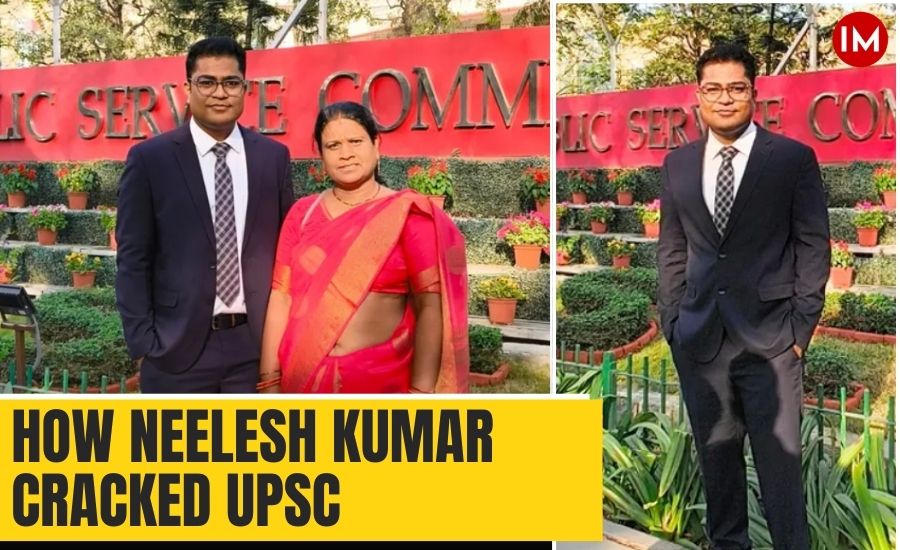
When the UPSC Civil Services Examination 2024 results were announced, one name quietly carried the weight of history for an entire district. Neelesh Kumar, who secured All India Rank 621, became the first civil services selectee from Seoni district in 17 years. For his village, Hinotiya, and for the Sanodiya community, it was a moment never witnessed before.
Neelesh Kumar cleared the UPSC and secured a position in the IRS—a milestone achieved through disciplined self-study, clarity of purpose, and lived experience of rural India. He is preparing for another attempt.
A RURAL BEGINNING
Neelesh hails from Hinotiya village in Seoni district, Madhya Pradesh—a completely rural setting where access to quality education remains limited. His father is a farmer, and farming income funded his education from the very beginning.
“My father educated me through farming,” Neelesh shared in a conversation with Indian Masterminds. “Whatever I am today has come from that.”
His schooling up to Class 12 was entirely in the village. Despite choosing Maths and Science, the infrastructure around him was weak. There were no laboratories, limited exposure, and few academic role models. Every day, he cycled four kilometres to attend school—an effort that shaped his understanding of rural challenges early in life.
ENGINEERING AND A TURNING POINT
After completing school, Neelesh pursued B.Tech from Indore. Like many engineering graduates, he stood at a crossroads. For him, the choice of civil services was not inherited or suggested—it was deliberate.
“It was my dream, not my parents’,” he says. “I wanted civil servants who understand villages, because many policies fail when they don’t consider rural realities.”
During his preparation, Neelesh noticed a pattern in UPSC selections. Only 12–15 percent of candidates come from rural backgrounds, a statistic that strengthened his resolve.
“Urban upper-middle-class candidates don’t always understand rural problems deeply,” he explains. “That’s where administration needs people with lived experience.”
DELHI WITHOUT COACHING
After graduation, Neelesh moved to Delhi, staying in Regar Pura near Karol Bagh, an area known for its affordability rather than comfort. Financial constraints meant no coaching institutes. His preparation was entirely self-driven.
“In the village, you can’t just sit and study. You end up doing farming work,” he says. “That’s why I prepared from Delhi.”
His first UPSC attempt did not even reach the preliminary examination stage. In his second attempt (2023), he cleared Prelims, wrote Mains, reached the interview—but missed the final list. Many aspirants drop out at this stage. Neelesh continued.
In his third attempt (2024), he cleared all three stages and secured AIR 621.
PREPARING PRELIMS AND MAINS TOGETHER
Neelesh’s preparation strategy was clear and practical. He identified one common mistake among aspirants early on.
“People keep preparing only for prelims again and again,” he says. “Then they’re not ready when Mains comes.”
From the start, he prepared Prelims and Mains simultaneously. When he reached Mains in 2023, he was already equipped to handle it.
His note-making approach was precise. Instead of bulky notebooks, he focused on short, keyword-based notes—especially for data, reports, committee recommendations, and ethics values.
“For Mains, you should have short notes for core themes,” he explains. “Things you might forget should already be written down in keywords.”
BOOKS, REVISIONS AND DISCIPLINE
For prelims, Neelesh stuck to standard books and revised them repeatedly. He believes frequent switching between resources is one of the biggest reasons candidates fail.
“If you’ve chosen Laxmikant for Polity, read it ten times,” he says. “Spectrum for Modern History—read it ten times.”
The same rule applied to current affairs. He advises aspirants to follow one monthly magazine consistently, instead of mixing multiple sources.
ANSWER WRITING AND SKILL DEVELOPMENT
Neelesh credits his success in Mains largely to answer writing practice. Studying toppers’ copies helped him understand how to respond to the exact demand of a question.
“You must understand what the question is asking,” he says. “Then you add value—examples, case studies, schemes—without losing focus.”
His engineering background helped with analytical thinking, but writing skills, he says, can be developed by anyone through consistent practice.
INERVIEW: DAF IS THE SYLLABUS
For the personality test, Neelesh prepared strictly around his Detailed Application Form (DAF). Every word, he learned, can become a question.
“They even asked me the meaning of ‘Jaam’ in my post office name,” he recalls. “You must prepare every keyword thoroughly.”
He encourages aspirants to research their hometowns, hobbies, academic subjects, and background deeply. Mock interviews and speaking practice, he says, make a visible difference.
Away from textbooks, Neelesh finds calm in sketching and calligraphy. These hobbies helped him disconnect from exam pressure and regain focus during long preparation phases.
THE RESULT THAT CHANGED EVERYTHING
When the final result came, celebrations went beyond his immediate family. The achievement marked a first for both his district and community.
“In Seoni district, this was the first selection in 17 years,” he says. “And in our community, no one had reached this level before.”
For his parents, it was validation of years of sacrifice. For his village, it was proof that civil services are not out of reach.
ADVICE FOR ASPIRANTS
Neelesh’s guidance to aspirants is direct and experience-based. He urges Prelims candidates to start early and give equal importance to CSAT, which many underestimate.
“For Mains aspirants, December is the last month,” he advises. “From January, prelims must become the priority.”
For interview candidates, his advice is simple: know your DAF better than anyone else.
“Prepare questions from every keyword,” he says. “Use tools like ChatGPT, think of multiple angles, and practice speaking.”
NO SAFETY MET, ONLY FOCUS
Asked about a Plan B, Neelesh is honest.
“I didn’t really think about it,” he says.
That focus has now placed him among India’s civil servants. His journey stands as a clear example of how structured preparation, clarity of purpose, and consistency can carry a candidate from a small village classroom to the country’s most competitive examination.