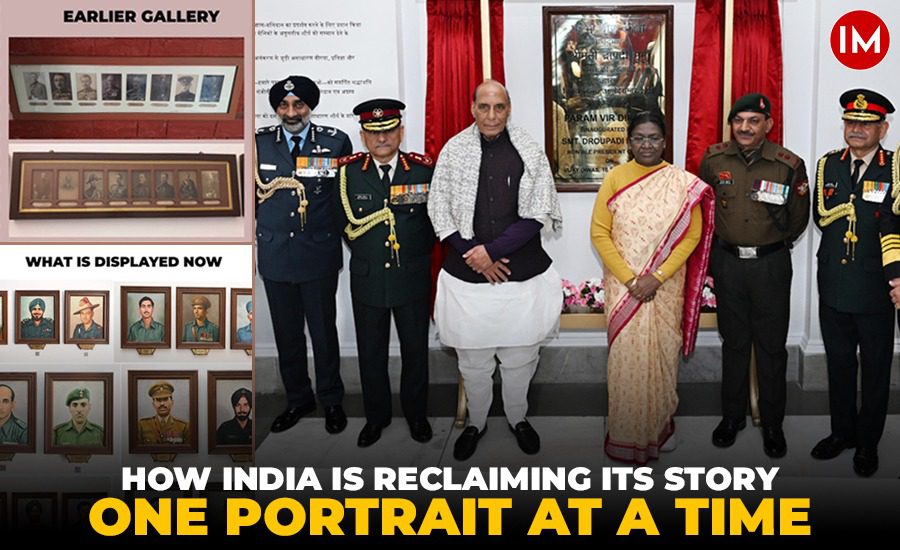
On Vijay Diwas, December 16, as India commemorated a decisive military victory, an equally decisive symbolic transformation unfolded inside Rashtrapati Bhavan. The portraits lining its historic corridors—once dedicated to British-era military aides-de-camp—were replaced by the faces of India’s bravest warriors: the 21 recipients of the Param Vir Chakra.
The newly unveiled gallery, named Param Vir Dirgha, is not just a tribute to gallantry. It is a conscious act of nation-building—one that reflects the spirit of Panch Pran of Amrit Kaal, articulated by Prime Minister Narendra Modi from the ramparts of the Red Fort on August 15, 2022. Among the five pledges for the next 25 years, the resolve to remove every trace of the colonial mindset finds perhaps its most eloquent expression in this quiet but powerful transformation.
PANCH PRAN AND THE END OF COLONIAL SYMBOLS
The Panch Pran—Developed India, freedom from colonial mindset, pride in our roots, unity, and sense of duty—are meant to guide India’s journey towards 2047, the centenary of Independence. They are not merely policy goals, but moral and cultural anchors.
Colonialism shaped not only India’s institutions but also its symbolism. Even decades after Independence, portraits of colonial officers occupied pride of place in the Republic’s most important constitutional building. Their removal is not about denying history, but about redefining what—and whom—India chooses to honour.
By installing the Param Vir Dirgha, the Republic has replaced imperial memory with indigenous valour.
WHY RASHTRAPATI BHVAN IS CENTRAL TO THIS SHIFT
Rashtrapati Bhavan was originally built as the Viceroy’s House—the embodiment of British authority. Over time, it has been reimagined as the seat of a democratic republic. What adorns its walls therefore carries immense meaning.
When foreign dignitaries, constitutional authorities, students, and citizens walk through Rashtrapati Bhavan today, they encounter not reminders of colonial command, but the faces of soldiers who defended India’s sovereignty. The symbolism is unmistakable: authority in India flows from sacrifice, not domination.
THE HEROES WHO LINE THE CORRIDORS
The Param Vir Chakra, instituted in 1950, is India’s highest military decoration, awarded for the most conspicuous bravery in the presence of the enemy. It has been conferred only 21 times, underscoring the extraordinary courage it represents—14 awards were posthumous.
The gallery begins with Major Somnath Sharma, India’s first PVC awardee, who laid down his life defending Srinagar in the 1947–48 war, followed by heroes like Naik Jadunath Singh, Second Lieutenant Rama Raghoba Rane, Company Havildar Major Piru Singh, and Lance Naik Karam Singh, whose actions in the first war after Independence shaped the nation’s early military legacy.
From the 1962 Sino-Indian War come legends such as Major Dhan Singh Thapa, Subedar Joginder Singh, and Major Shaitan Singh, whose stand at Rezang La remains one of the most heroic last stands in military history.
The 1965 war is represented by Company Quartermaster Havildar Abdul Hamid, whose destruction of enemy tanks at Asal Uttar turned the tide of battle, and Lieutenant Colonel A.B. Tarapore, who led armoured assaults despite grave injuries.
The 1971 war, which led to the creation of Bangladesh, features gallant officers like Lance Naik Albert Ekka, Flying Officer Nirmal Jit Singh Sekhon—the only PVC awardee from the Indian Air Force—Major Hoshiar Singh Dahiya, and the youngest PVC recipient, Second Lieutenant Arun Khetarpal, who fought on at just 21.
Later conflicts are equally present. Naib Subedar Bana Singh is remembered for his daring assault on the icy heights of Siachen, while Major Ramaswamy Parameswaran displayed exceptional courage during Operation Pawan in Sri Lanka.
The Kargil War heroes—Captain Manoj Kumar Pandey, Grenadier Yogendra Singh Yadav, Rifleman Sanjay Kumar, and Captain Vikram Batra, whose words “Yeh Dil Maange More” became immortal—bring the narrative into the modern era, reminding visitors that courage is timeless.
Together, these portraits narrate the military history of independent India—not through dates and maps, but through human sacrifice.
A LIVING ARCHIVE, NOT A CEREMONIAL HALL
Param Vir Dirgha is not merely a place of remembrance. It functions as a living archive—educating visitors about India’s military history and reinforcing constitutional values of service, duty, and unity.
For young Indians, it reshapes aspiration. Heroism is no longer associated with colonial authority or inherited privilege, but with courage, discipline, and selflessness. For international visitors, it presents India as a confident republic that honours its own.
PART OF A LARGER NATIONAL REORIENTATION
The gallery aligns with a broader effort to decolonise India’s public spaces and institutional memory. From Rajpath becoming Kartavya Path, to the redesign of the Indian Navy Ensign, installation of Netaji Subhas Chandra Bose’s statue at India Gate, renaming of roads and islands, and replacement of colonial-era criminal laws, the direction is clear.
India is reclaiming its story.
SYMBOLS SHAPE DEMOCRACIES
Symbols are not cosmetic. They define who a nation chooses to remember and what values it transmits across generations. By replacing colonial portraits with the faces of India’s bravest soldiers at Rashtrapati Bhavan, the Republic has made a profound statement.
Power is borrowed, not owned. Authority must be earned through service.
As India moves through Amrit Kaal towards 2047, Param Vir Dirgha stands as a reminder that a confident future is built on an honest remembrance of courage. The Republic has chosen its heroes—and in doing so, has taken another step towards fulfilling the Panch Pran.