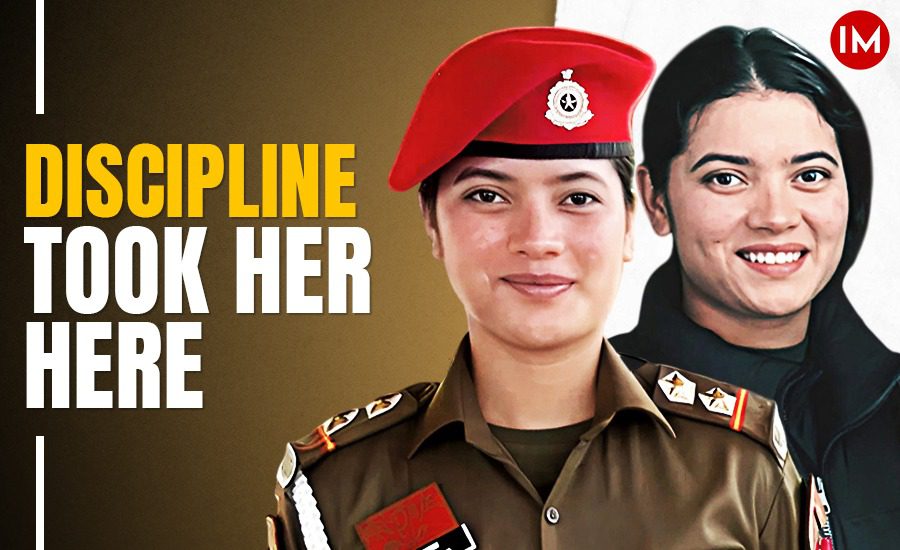
When Subedar Preeti Rajak was promoted in January 2024, the moment carried significance far beyond a routine rank advancement. For the first time in the Indian Army’s history, a woman had risen to the rank of Subedar, a junior commissioned officer position long held exclusively by men. That she came from Madhya Pradesh, from a family with no military background, and that her father ran a dry-cleaning shop, made the milestone even more striking.
Preeti Rajak’s journey links two demanding worlds – elite sport and military service – and shows how performance, discipline, and institutional change can converge to reshape long-standing traditions.
GROWING UP IN ITARSI
Preeti grew up in Itarsi, a railway town in Narmadapuram district. Life there followed a predictable rhythm. Her father worked long hours as a dry cleaner, while her mother was involved in social work. There were no shooters or soldiers in the family, and no clear roadmap for a career in sports.
What the family did have was openness. When an opportunity arose in 2015 to enrol Preeti and her elder sister in a local shooting programme, her parents agreed. It was not driven by grand ambition or a medal target. It was simply a chance to explore something new.
That decision quietly changed the direction of Preeti’s life.
DISCOVERING TRAP SHOOTING
Trap shooting demands precision, patience, and consistency. Targets are launched at high speed, and shooters have fractions of a second to react. Preeti took to the discipline quickly. She joined the Madhya Pradesh Shooting Academy in 2016, where training was structured and unforgiving.
Days were built around repetition – hundreds of shots, constant corrections, and regular assessment. Early results were uneven. Like most young shooters, she faced technical gaps and competition nerves. But steady improvement at state-level events gave her confidence and visibility.
By her late teens, she was competing at national competitions. Coaches noted her controlled approach and ability to remain composed under pressure, qualities that would later define her performances at higher levels.
ASIAN GAMES BREAKTHROUGH
The turning point came at the Asian Games in Hangzhou in 2023. Competing in the women’s trap team event alongside Rajeshwari Kumari and Manisha Keer, Preeti helped secure a silver medal for India. It was the country’s first medal in that category at the Asian Games.
The achievement placed her firmly on the international map. It also drew attention within the Indian Army, where she had enlisted a year earlier.
In December 2022, Preeti had joined the Army’s Corps of Military Police. For the Army, her sporting record aligned with its growing focus on nurturing elite athletes within its ranks. For Preeti, military service offered structure, stability, and a platform to continue competing at the highest level.
Following the Asian Games success, she received an out-of-turn promotion. On January 27, 2024, she was promoted from Havildar to Subedar, becoming the first woman in Indian Army history to hold the rank.
TRAINING AS A SOLDIER AND ATHLETE
Today, Preeti trains at the Army Marksmanship Unit in Mhow, one of the country’s premier shooting centres. Her daily routine blends physical conditioning, technical shooting sessions, and academic commitments as she continues her education.
Balancing military duties with international competition is demanding. Training schedules are tight, travel is frequent, and injuries remain an occupational risk. Yet the Army’s sports ecosystem has allowed her to pursue both roles without compromise.
Her performances after the Asian Games indicate that the momentum has not slowed. In August 2025, at the Asian Shooting Championship in Shymkent, Preeti was part of the Indian team that won gold in the trap team event. The result reinforced her position among India’s leading trap shooters and underlined her consistency at continental competitions.
WHAT HER RISE REPRESENTS
Preeti Rajak’s promotion matters for several reasons. Within the Army, it signals a shift in how leadership roles are opening to women, particularly in ranks that traditionally formed the backbone of command at the unit level. Her elevation was not symbolic; it was performance-driven.
In sport, her journey highlights how talent from smaller towns can reach global stages when supported by structured training and institutional backing. Shooting remains a resource-intensive sport, often associated with privilege. Preeti’s background challenges that assumption.
For young athletes, especially women, her story expands the idea of what career pathways can look like – where sport and service reinforce rather than exclude each other.
LOOKING AHEAD
Preeti now trains with a long-term focus on the Los Angeles 2028 Olympic Games. The road ahead will involve qualification events, technical refinement, and sustained performance under pressure. Expectations have grown, but so has experience.
From a local shooting range in Itarsi to international podiums, and from an Army recruit to Subedar, her journey has unfolded step by step. It is not defined by slogans or dramatic turns, but by years of training, competition, and steady advancement.
In rewriting a small but significant part of Indian Army history, Subedar Preeti Rajak has shown how achievement—when backed by opportunity—can redraw boundaries that once seemed fixed.