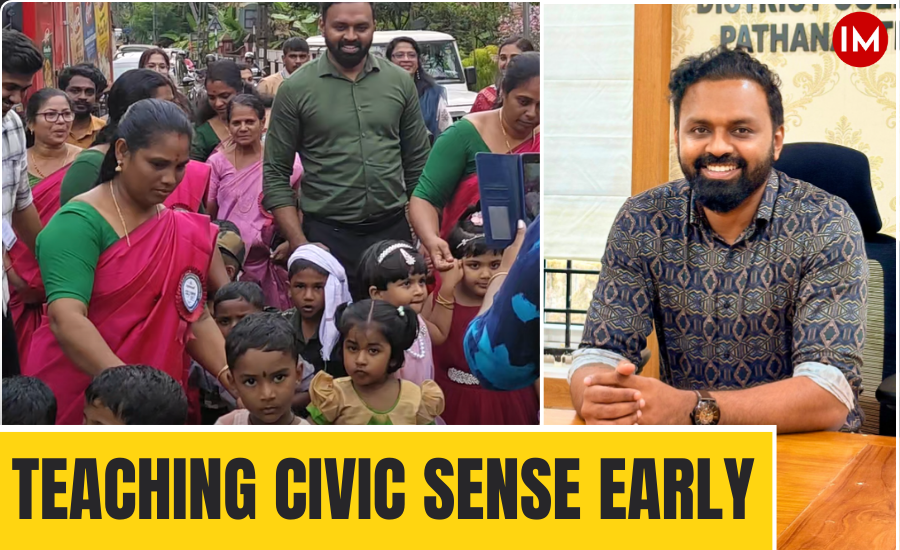
In Pathanamthitta, Kerala, children are learning lessons that go beyond textbooks. IAS Prem Krishnan S, the 2017-batch (Kerala cadre) District Collector, has started Project Roots, an innovative initiative aimed at nurturing civic sense in young minds. The idea is simple but powerful: instil good habits early so that respect for public spaces and social responsibility become second nature.
“The spark for Project Roots came during my travels in Europe. I was amazed by the clean streets, orderly traffic, and people following simple rules without being reminded. I thought, “Why can’t we teach our children these habits from the beginning? ” IAS Prem Krishnan S shared in a conversation with Indian Masterminds.
STARTING YOUNG
Project Roots targets children as young as Anganwadi age up to Class 3. The program focuses on everyday civic behaviour—using dustbins, avoiding spitting, minimising noise, and following traffic rules. But rather than theoretical lessons, children learn through experience.
“We don’t just tell them what to do. We take them outside—cafes, shops, streets—and guide them through practical exercises. If a child gets a toffee, they are encouraged to find a dustbin and throw the wrapper correctly,” the Collector explains. “Seeing them do it with excitement is rewarding—it shows that habits can take root early.”
This hands-on approach is inspired by practices in Europe, where children regularly go on field visits to learn social etiquette, road safety, and waste disposal. “I saw teachers there guiding young children through simple tasks, teaching them how to behave in public. That consistency is why adults there naturally respect rules. I wanted the same for our children,” says Mr Krishnan.
LEARNING THROUGH REAL-LIFE PRACTICE
Project Roots emphasises experiential learning, moving beyond classroom lectures. Children practise crossing roads at zebra crossings, walking on footpaths, and minimising unnecessary honking. These exercises might seem small, but they are building blocks of responsible citizenship.
During one activity, after receiving toffees, the children instinctively searched for a dustbin to dispose of the wrappers. “That moment showed me that the spark is already there. We just need to nurture it,” the Collector recalls. These small wins signal the potential for long-term transformation in civic behaviour.
FROM ONE SCHOOL TO MANY
The initiative started modestly in a single school, yet the response was immediate and enthusiastic. Parents, teachers, and children embraced the idea, prompting over 13 schools to request inclusion in their curriculum. Mr Krishnan is now preparing a Standard Operating Procedure (SOP) to make it easy for any school to implement Project Roots.
“The challenge is not interest—schools are lining up. The real task is making this a permanent part of education, so it continues regardless of administrative changes,” he notes. He emphasises that the programme is low-cost and scalable. Teachers can dedicate an hour a week or month for these activities without extra resources.
“The goal is not to add more academic pressure, but to enrich a child’s life. Civic sense is as important as reading or maths. It shapes the environment we live in,” says the collector.
OVERCOMING CHALLENGES
The project is not without challenges. Scheduling and coordination with schools have been the main hurdles, compounded by election periods. But enthusiasm from the educational community remains high.
“If the Education Department formally includes this, it will be part of the curriculum permanently. One short outing every month is enough to make a difference. It’s simple, effective, and sustainable,” the Collector emphasises.
The initiative also addresses a societal gap—many adults in India lack habits taught in childhood. “When I returned from Europe, I felt sad that we were never taught these things when we were young. That’s why we still honk unnecessarily, cross roads anywhere, and litter. It should have started earlier, but it’s never too late,” he adds.
A VISION FOR THE FUTURE
The larger vision is clear: make civic sense a normal part of every child’s upbringing in Pathanamthitta. By starting with the youngest, the initiative hopes to cultivate adults who are aware, responsible, and considerate of shared spaces.
“Civic sense improves the quality of life for everyone. It’s not about policing; it’s about guiding and nurturing. If children learn it early, it will stay with them forever,” says IAS Prem Krishnan S.
Already, the initiative has created small but significant changes. Children’s enthusiasm, parents’ support, and teachers’ commitment are encouraging signs that Project Roots could grow into a model for other districts.
“These moments show us that change is possible. Civic sense can begin from the youngest, and eventually, it will shape a cleaner, more orderly society,” he says.
PLANTING SEEDS FOR TOMORROW
Project Roots is more than a programme; it’s a movement to teach responsibility, respect, and awareness from the very beginning. IAS Prem Krishnan S believes that cultivating civic sense from childhood is a small step that can transform society over time.
“This is about nurturing good citizens, one child at a time. If we can plant these roots now, the tree of civic awareness will grow naturally,” he concludes.
In Pathanamthitta, children are learning to pick up litter, walk safely, and respect public spaces—not because they are forced, but because they understand and enjoy the practice. With Project Roots, IAS Prem Krishnan S is showing that real change starts with young minds and small habits, creating a foundation for a better tomorrow.