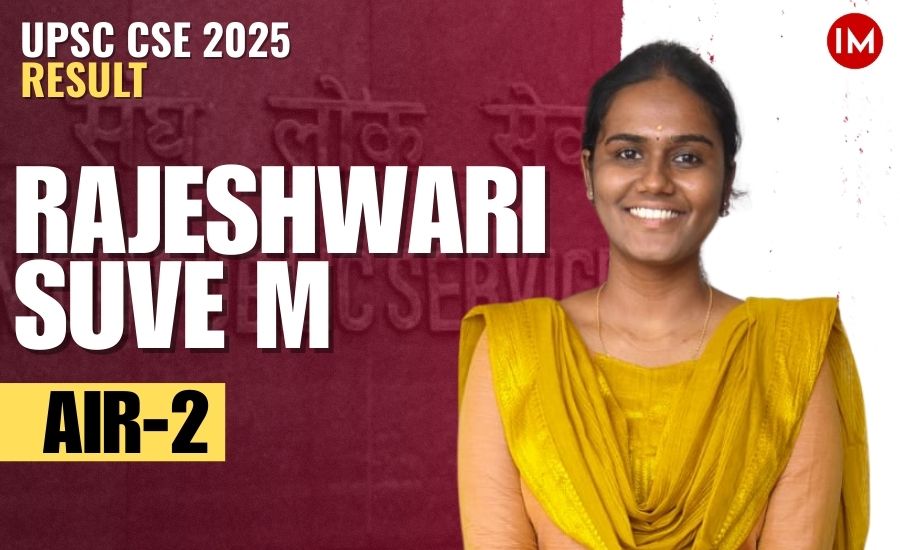
In a country where more women are stepping forward to shape governance and policy, the success of Rajeshwari Suve M. in the Union Public Service Commission Civil Services Examination 2025 stands out as a powerful reminder that women are steadily claiming their space in leadership roles.
Hailing from Vadipatti in the Madurai district of Tamil Nadu, Rajeshwari secured the All India Rank (AIR) 2 in the prestigious UPSC Civil Services Examination 2025, emerging as the highest-ranked woman candidate this year and the only woman in the top five.
Her journey is not just about academic success. It reflects the importance of family support, disciplined preparation, and the confidence that women can perform equally well in the country’s toughest competitive examinations.
A FAMILY THAT ENCOURAGED BIG DREAMS
Rajeshwari Suve M grew up in a supportive household that valued education and ambition. Her father is a businessman, while her mother works as an associate professor. She also has an elder sibling, who is now a doctor.
The encouragement she received from her parents played an important role in shaping her career path.
Rajeshwari completed her Bachelor of Engineering (B.E.) in Electrical and Electronics Engineering in 2018, after which she began preparing for the civil services.
“The initial push came from my parents. During my final year of graduation, they suggested I consider preparing for UPSC,” Rajeshwari shared in an exclusive conversation with Indian Masterminds.
“After going through the syllabus, I realised this career offers both personal growth and the opportunity to contribute to society. That combination made the exam very interesting to me.”
YEARS OF PREPARATION AND LEARNING FROM SETBACKS
Rajeshwari’s journey to AIR 2 was not quick or easy. She began preparing for the UPSC Civil Services Examination in 2018 and cleared the exam in her fifth attempt in 2025.
“This was my fifth attempt, and it has been seven years of preparation. There were definitely days when I felt low in confidence and wondered whether I could clear the exam.”
Instead of giving up, Rajeshwari relied on the encouragement of her family and stayed focused on her goal.
Her experience reflects the reality many aspirants face while preparing for the highly competitive civil services exam, where success often comes after multiple attempts and consistent improvement.
CLEARING TAMIL NADU PSC AND JOINING AS DEPUTY COLLECTOR
While continuing her UPSC preparation, Rajeshwari also appeared for the Tamil Nadu Public Service Commission examination.
In 2024, she successfully cleared the exam and joined the Tamil Nadu state administration as a Deputy Collector. She is currently undergoing training in the Dindigul district.
“After joining as a Deputy Collector, it became an even bigger motivation. Working in administration, I saw how civil servants can directly benefit citizens and make a real difference.”
MANAGING JOB RESPONSIBILITIES AND UPSC PREPARATION
Preparing for UPSC while working in a demanding government role can be extremely challenging. However, Rajeshwari managed to balance both through disciplined time management.
Since she had already been preparing for several years before joining her job, she had built a strong academic base.
She used early mornings and evenings after office hours for study and took study leave closer to the examination.
“I have a very supportive District Collector and an encouraging department. Their support helped me continue my preparation alongside work.”
THE MOMENT SHE LEARNED ABOUT AIR 2
The moment of success came unexpectedly.
Rajeshwari was in the middle of her training attachment when the UPSC results were declared. During her lunch break, she checked the results and initially found it hard to believe.
“At first I thought it might be a fake result, but then I confirmed it was true.”
Soon after, congratulatory messages from friends, family members, and colleagues began pouring in. For Rajeshwari and her family, it was the culmination of years of effort and patience.
A MESSAGE FOR WOMEN ASPIRANTS
Rajeshwari’s success also carries a strong message for women preparing for competitive examinations.
Being the only woman in the top five this year highlights both the progress women have made and the need for continued support.
According to Rajeshwari, talent and capability are not determined by gender.
“Women are equally competent in any field. What matters most is having a supportive environment.”
She believes that when families encourage daughters and provide equal opportunities, women can achieve extraordinary success.
“If every girl gets the kind of support I received from my parents and family, they can achieve anything.”
Her story is a reminder that empowering women through education and encouragement can bring significant change not only in families but also in governance and public administration.
PREPARATION STRATEGY FOR UPSC ASPIRANTS
Rajeshwari also shared important insights from her preparation strategy that may help future aspirants.
“Don’t get distracted by the large number of materials available. Stick to the basics and focus on UPSC-relevant content.”
Instead, she focused primarily on analysing previous year question papers and practicing through test series.
“My preparation in this successful attempt was based purely on UPSC’s past questions rather than institute predictions.”
She also emphasized the importance of continuous evaluation through mock tests.
“Choose one or two good test series, follow their schedule strictly, analyse your performance, and improve in the next test. That iterative process makes a huge difference.”
A NEW CHAPTER AHEAD
With AIR 2 in the UPSC CSE 2025, Rajeshwari Suve M is now set to enter the country’s top administrative services.
Her journey from a small town in Tamil Nadu to the top ranks of the civil services exam reflects how determination, family support, and a clear strategy can shape success.
For thousands of women preparing for competitive exams across India, her story sends a clear message: opportunities are expanding, and women are ready to lead.
Rajeshwari’s achievement is not just a personal milestone — it represents a larger movement of women stepping into positions of authority, shaping governance, and contributing to the country’s development.