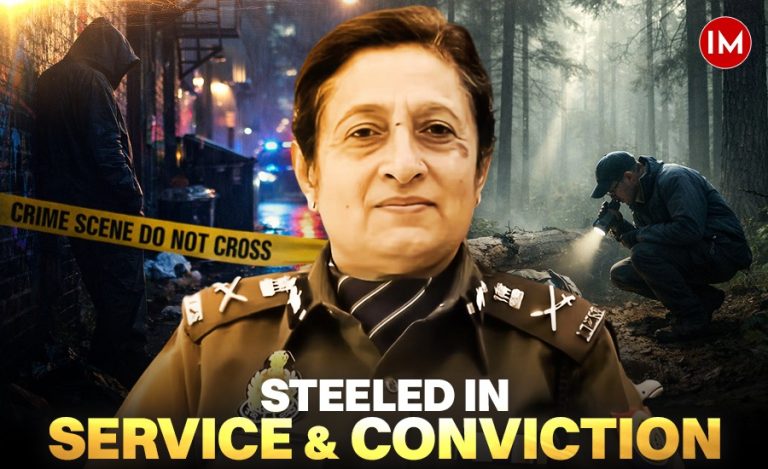
Delhi rarely offers its police chief a quiet first day. When Satish Golcha took charge as the 26th Commissioner of Police, Delhi, on August 21, 2025, the capital was already on edge. Just a day earlier, an attack on Chief Minister Rekha Gupta during a public hearing had put security arrangements under sharp scrutiny. Officials clarified that Golcha’s appointment had nothing to do with the incident, yet the timing underlined a simple truth: Delhi needed an experienced, steady leader. Few officers fit that description better than Satish Golcha.
A 1992-batch IPS officer of the AGMUT cadre, Golcha brings with him over three decades of policing experience, much of it forged in Delhi’s most testing moments.
A CAREER ROOTED IN DELHI POLICING
Satish Golcha’s professional life has been deeply intertwined with the Delhi Police. Over the years, he has served in a wide range of operational and administrative roles—DCP in multiple districts, and later as Joint Commissioner and Special Commissioner of Police. His postings have spanned sensitive units such as Special Cell, Crime Branch, Intelligence, Traffic, Vigilance, Economic Offences Wing (EOW), and Law & Order.
What sets Golcha apart is not just the variety of roles, but the consistency with which he has handled high-pressure assignments. Colleagues often describe him as a no-nonsense officer, someone who prefers quiet control over loud policing.
TESTED DURING CRISIS: THE 2020 NORTHEAST DELHI RIOTS
One of the most defining phases of Golcha’s career came during the 2020 North-East Delhi riots, when he was serving as Special Commissioner of Police (Law and Order). The violence posed one of the gravest law-and-order challenges the city had seen in decades.
At a time when misinformation, communal tension, and street-level violence threatened to spiral further, Golcha played a central role in restoring order. His approach—firm action combined with structured deployment—earned him respect within the force and confidence from the administration.
Watch the video here:
EXPERIENCE BEYOND DELHI: ARUNACHAL AND CBI
Golcha’s experience is not limited to the capital. From February 2022 to June 2023, he served as the Director General of Police (DGP), Arunachal Pradesh, where he handled policing in a complex border state with unique security challenges.
Earlier, during his tenure with the Central Bureau of Investigation (CBI), Golcha investigated several high-profile and sensitive cases, including the Ruchika molestation case, the Rizwanur Rahman murder case, and aspects related to the 1984 anti-Sikh riots. He is also credited with helping dismantle a false narrative in the 2009 Shopian rape case, later found to be a conspiracy.
These assignments strengthened his reputation as an officer comfortable dealing with politically sensitive and emotionally charged investigations.
FROM Tihar TO TOP COP
Before becoming Delhi Police Commissioner, Golcha served as Director General (Prisons), Delhi, overseeing Tihar, Mandoli, and Rohini jails. Initially given interim charge amid rising gang violence and unrest inside prisons, his posting was later regularised.
Managing Asia’s largest prison complex is no small task, and Golcha’s experience there sharpened his focus on institutional discipline, intelligence-led supervision, and systemic reform—skills that now feed directly into his role as Commissioner.
THE DELHI POLICE COMMISSIONER SYSTEM
Delhi follows the Police Commissioner system, a structure that gives the Commissioner wide executive powers. This system traces its roots to the Justice G.D. Khosla-led Delhi Police Commission, set up by the Government of India in 1966 to examine policing challenges in the capital.
Based on the Commission’s recommendations, Delhi Police was reorganised, and the Commissioner system was formally adopted on July 1, 1978. Under this framework, the Commissioner of Police exercises powers of both policing and executive magistracy—making the role one of the most powerful and demanding police positions in the country.
As Commissioner, Golcha holds a rank equivalent to Director General of Police (DGP) and reports directly to the Ministry of Home Affairs (MHA).
THE ROAD AHEAD
With a tenure extending till April 2027, Satish Golcha steps into the role at a time when Delhi faces layered challenges—street crime, cyber offences, organised gangs, public protests, and heightened security expectations.
A Chartered Accountant by qualification, Golcha combines analytical thinking with field experience. Awarded the President’s Police Medal for Distinguished Service in 2018, his career reflects a balance of investigation, intelligence, and command.
For a city that rarely slows down, Delhi’s new police chief represents continuity, control, and calm leadership—qualities that may matter more than ever in the years ahead.