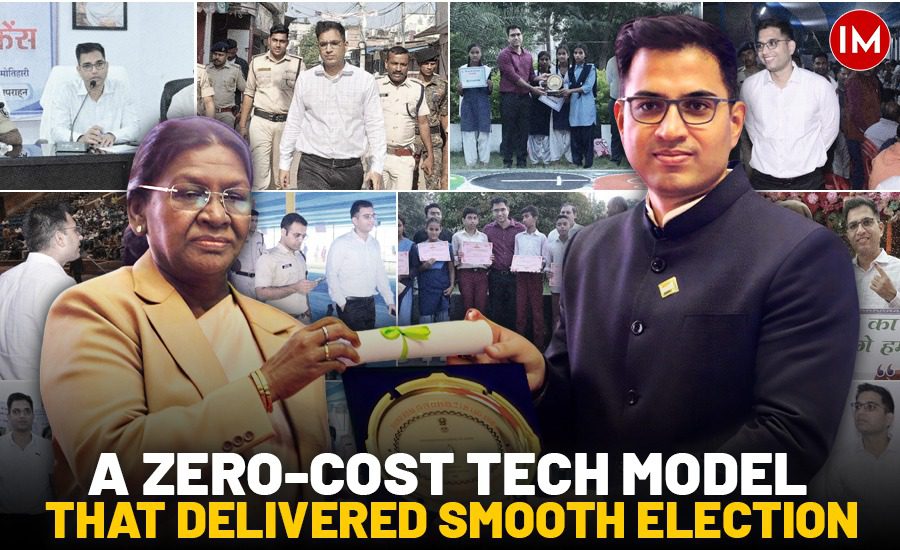
In a district where geography tests governance at every step, elections are never just about polling day. In East Champaran, Bihar – one of the state’s most populous, complex, and sensitive districts—the 2025 Bihar Assembly Elections became a landmark in electoral management. Leading this transformation was Sh. Saurabh Jorwal, IAS (2014 batch, Bihar cadre), District Magistrate and District Election Officer (DEO), whose technology-driven innovations earned him the Best Electoral Practices Award under the General Award for Election Management category and was honoured by the president.
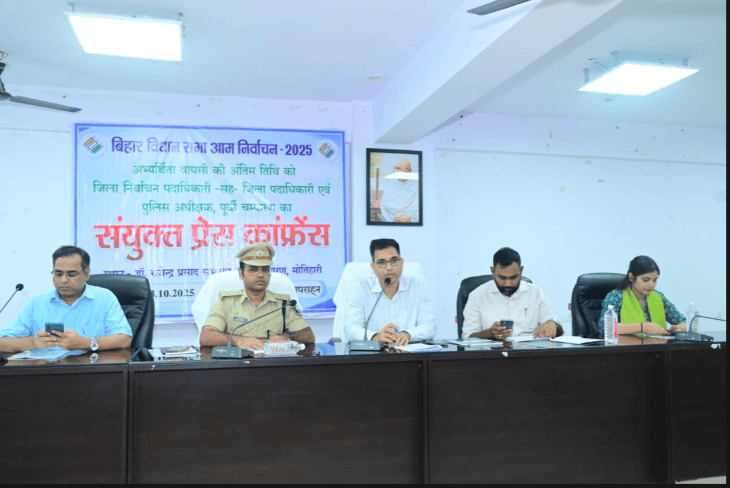
Spanning nearly 4,000 square kilometres, housing over 60 lakh people and 34.42 lakh voters, and sharing a 120-kilometre international border with Nepal, East Champaran presents challenges few districts do. Flood-prone riverine belts, remote villages, dense urban clusters, and heavy security requirements make election management a daunting exercise. Yet, the 2025 elections here stood out—not for complications, but for precision, transparency, and efficiency.
THE CHALLENGE OF SCALE AND SECURITY
With 4,095 polling booths across 1,905 locations, and the deployment of 123 CAPF companies, traditional manual methods of security allocation had long been stretched to their limits. Matching forces to polling station locations used to take 5–8 days of continuous manual work, often prone to estimation errors, uneven load distribution, and navigation challenges for security personnel unfamiliar with local terrain.
“East Champaran demanded a system that could think faster, calculate better, and remain completely transparent,” recalls Mr. Jorwal during a conversation with Indian Masterminds
It was this realization that pushed the district administration to attempt something unprecedented at the district level.
A TECHNOLOGICAL TURNING POINT
Leveraging his background in information technology, Mr. Jorwal led the development of a fully automated, in-house, Python-based Geospatial CAPF Deployment System—a first-of-its-kind initiative at the district level. Built entirely using open-source tools, the system required zero additional cost, no proprietary software, and no specialised hardware.
Using precise GPS coordinates of all polling station locations and CAPF bases, the algorithm scientifically optimised deployments by minimising travel distances, ensuring fair load distribution, and guaranteeing Assembly Constituency-wise compliance. What earlier took days was now achieved in under 20 minutes—with 100% accuracy and complete auditability.
“What earlier took nearly two weeks of manual effort was completed in a few hours, with mathematically proven accuracy. And the model is fully scalable,” Mr. Jorwal explains.
FROM ALGORITHM TO ACTION ON GROUND
The innovation did not stop at deployment planning. The system auto-generated company-wise information sheets containing booth details, GPS coordinates, route charts, QR-coded navigation links, and complete communication hierarchies. These sheets ensured CAPF personnel reached their assigned locations on time—without confusion or dependency on local guides.
To further simplify operations, QR-code-based GPS navigation was introduced for polling parties, sector officers, CAPF units, and micro observers. One scan provided precise directions, route sequences, and distance matrices—even in remote or flood-affected areas.
BUILDING A DIGITAL ELECTION ECOSYSTEM
Under Mr. Jorwal’s leadership, East Champaran adopted a holistic digital ecosystem for election management. Interactive booth-mapping dashboards replaced bulky spreadsheets. Pre-printed dispatch and receiving registers eliminated handwriting errors and reduced congestion at dispatch centres. A single-sheet communication plan consolidated over 20 stakeholder contacts, ensuring swift escalation and response.
On counting day, a live dashboard integrated with ENCORE data enabled round-wise monitoring, candidate-wise tracking, and real-time margin analysis. CCTV-based queue management helped identify long queues in the final hours of polling, allowing officers to intervene proactively. As a result, all polling stations completed voting smoothly by 6:15 PM.
IMPACT THAT WENT BEYOND NUMBERS
The results were striking. East Champaran recorded an 11.27 percentage point increase in voter turnout, rising from 60.28% in 2020 to 71.55% in 2025. Female participation was unprecedented—77.49%, significantly higher than male turnout.
Equally important was what did not happen: there were zero incidents of violence, disruption, or law-and-order breakdowns across all 4,095 booths.
The Election Commission’s emphasis on transparency, efficiency, and voter confidence found real expression on the ground.
A MODEL FOR THE FUTURE
What makes East Champaran’s story truly remarkable is its replicability. The entire system is modular, cost-free, and adaptable to districts of any size. By replacing subjective judgment with data-driven decisions, the initiative has set a new benchmark for election management in India.
At its core, the success reflects a simple but powerful idea: when technology is designed around field realities, democracy becomes stronger.
As India looks ahead to increasingly complex elections, East Champaran’s 2025 experience – led by 2014-batch IAS officer Saurabh Jorwal – offers a blueprint where innovation, integrity, and inclusion move together.