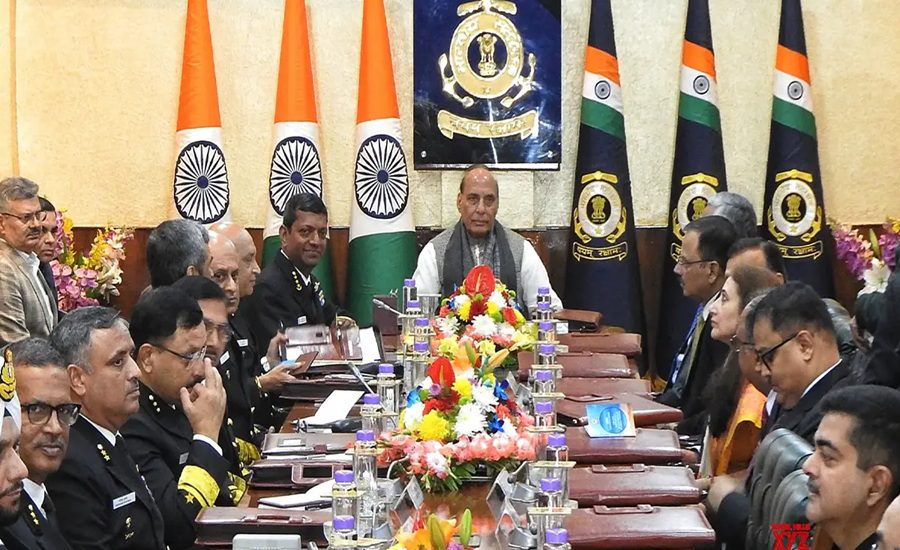
New Delhi: India’s Defence Acquisition Council (DAC), chaired by Defence Minister Rajnath Singh, is set to convene on December 26, 2025, for a crucial meeting expected to green-light major missile and defence weapon approvals under Emergency Procurement (EP) powers.
The council’s decisions are anticipated to significantly bolster India’s defence readiness, indigenisation goals and aerial surface defence capabilities, especially amid evolving regional security challenges.
Context & Strategic Imperatives of DAC Weapons Approvals
The upcoming DAC meeting assumes heightened importance as India confronts persistent security pressures along its borders and seeks to rejuvenate critical inventories depleted in recent operations such as Operation Sindoor — a cross-border counter-terrorism mission.
Emergency Procurement (EP) powers grant the Ministry of Defence (MoD) the ability to fast-track acquisitions by bypassing longer procurement procedures to urgently fill capability gaps.
This method is especially critical when stock levels of strategic weapons — particularly missiles and precision munitions — need swift replenishment. Analysts say that the EP route will be instrumental in rapidly equipping all three services — the Indian Army, Navy, and Air Force — with cutting-edge missile systems.
DAC Weapons Approvals Highlights: MR-SAM Missile Procurement for Indian Navy
One of the most prominent items on the agenda is the proposed acquisition of over 700 Medium-Range Surface-to-Air Missiles (MR-SAM) for the Indian Navy. Jointly developed by DRDO (Defence Research and Development Organisation) and Rafael Advanced Defence Systems (Israel), MR-SAMs are manufactured domestically by Bharat Dynamics Limited (BDL).
MR-SAM Capabilities
- Designed for engaging aircraft, helicopters, UAVs and cruise missiles
- Operational range: up to 70 km
- Platform integration: Installed on major naval ships including INS Vikrant and Visakhapatnam-class destroyers
- Enhances layered air defence for Indian fleet assets against a range of aerial threats
The acquisition is expected to reinforce maritime air defence against both traditional and emerging aerial threats.
This comes amid navies in the Indo-Pacific rapidly enhancing surface-to-air capabilities to counter increasingly sophisticated airborne weapons systems.
Astra Mk-2 Missiles: Boosting Air Force Strike & Defence Power
The Indian Air Force (IAF) is pushing for the clearance of over 600 Astra Mk-2 beyond-visual-range (BVR) air-to-air missiles. These missiles represent a significant leap in long-range engagement capability compared to earlier variants.
Key Features of Astra Mk-2
- Enhanced range: Approximately 200 km, enabling greater standoff engagement
- Dual-pulse rocket motor: Improves performance in endgame terminal manoeuvres
- Designed to counter advanced threats including long-range Chinese PL-15 and Pakistani PL-15E missiles
- Integration expected on Su-30MKI and Tejas fighters
The Astra Mk-2 programme is a flagship indigenous missile project of DRDO, supporting India’s broader Aatmanirbhar Bharat initiative to reduce foreign dependency in critical defence technologies.
Triggered in part by demand following Operation Sindoor and in recognition of evolving aerial threat environments, approval of the Astra Mk-2 order would significantly raise the IAF’s air dominance and deterrence posture.
Other Equipment on the Agenda of DAC Weapons Approvals
Beyond missile systems, the DAC is also reviewing proposals for other critical defence technologies:
Precision-Guided Munitions
Over 300 units of SPICE-2000 precision-guided bombs may be approved for rapid replenishment after their successful roles in past operations. These munitions are compatible with platforms such as Mirage-2000 aircraft and offer enhanced standoff accuracy.
Advanced Radar Systems for Army Air Defence
More than two dozen Low-Level Lightweight Radars (LLLWR) developed by Bharat Electronics Limited (BEL) are under consideration to augment the Army’s air defence surveillance network when integrated with systems such as Akashteer. These radars can track low radar cross-section drones and multiple aerial targets simultaneously.
Potential Broader Impact of DAC Decisions
The DAC meeting on December 26 is expected to:
1. Replenish Depleted Stocks
Rapidly fills defence inventory gaps exposed in recent operations.
2. Advance Indigenous Defence Capabilities
Approval would drive domestic missile manufacturing, create jobs, and further India’s defence self-reliance goals.
3. Strengthen Tri-Service Defence Posture
Upgrades in naval and air defence systems improve India’s response capability in both maritime and air domains.
4. Strategic Deterrence
Modernised weapons systems enhance deterrence credibility against adversaries with advanced airborne capabilities.