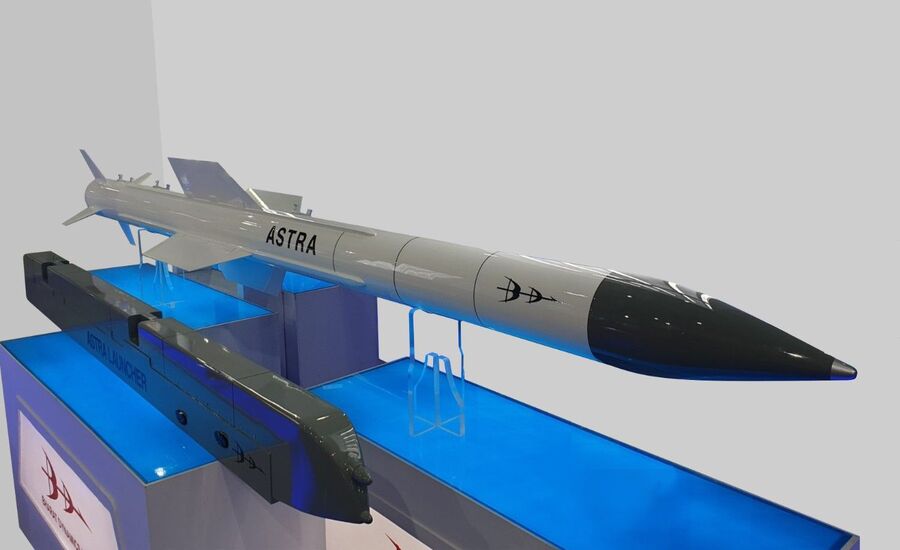
New Delhi: Defence Research and Development Organisation (DRDO) is on the cusp of a significant milestone as it prepares to launch series production of the indigenous ASTRA Mk-2 beyond-visual-range air-to-air missile (BVRAAM) starting July 2026, according to the latest defence developments.
The long-range missile, boasting an engagement envelope of over 200 kilometres, represents a substantial leap in India’s aerial combat capabilities and advances the nation’s strategic edge in the regional defence landscape.
Background of ASTRA Mk-2 Series Production
The ASTRA missile family is India’s flagship Beyond Visual Range Air-to-Air Missile (BVRAAM) system developed by DRDO to provide Indian Air Force (IAF) fighters with a potent long-range strike capability.
The earlier Astra Mk-1 variant is already operational, with a maximum range of around 110 km, integrated on platforms such as the Su-30MKI and HAL Tejas.
The ASTRA Mk-2, building on this legacy, extends engagement distances dramatically — now exceeding 200 km, positioning India among a small group of nations fielding long-range AAMs with such reach.
Technology Advancements Behind ASTRA Mk-2
Here are the following technology advancements of ASTRA Mk-2 series production;
Extended Engagement Range & Propulsion
The ASTRA Mk-2 incorporates advanced propulsion architecture, reportedly using dual-pulse motors and refined aerodynamic design to sustain flight over extended distances with high stability and speed.
This dual-pulse configuration significantly enhances overall burn efficiency, enabling sustained thrust throughout mid- and long-range flight phases — a key factor in surpassing previous range estimates and reaching the 200+ km threshold.
Advanced Guidance and Seeker Systems
Another cornerstone of the Mk-2’s performance is its active radar homing seeker, capable of autonomous target acquisition and engagement in contested electronic environments.
While earlier generations relied on simpler homing heads, this improved seeker architecture enhances hit probability against highly maneuverable fighter aircraft and electronic countermeasure (ECM)-equipped adversaries.
These technologies not only expand engagement envelopes but also allow for earlier launch, improved hit precision, and reduced vulnerability to enemy evasive maneuvers.
Strategic Value of ASTRA Mk-2 Series Production for Indian Air Power
The integration of ASTRA Mk-2 into the IAF fleet will significantly bolster India’s aerial superiority by enabling fighter jets to engage hostile aircraft at distances where counterstrikes are highly challenging for adversaries.
At over 200 kilometres, the missile’s engagement window provides pilots with tactical flexibility to shape air battle geometry and seize first-strike advantage.
This capability becomes particularly consequential when calibrated against near-peer adversarial missile systems such as China’s PL-15, which has been reported to have long-range engagement capabilities. With ASTRA Mk-2, Indian jets can engage before entering the effective range of rival platforms, enhancing operational safety and strategic deterrence.
Integration and Deployment Timeline of ASTRA Mk-2 Series Production
According to official sources, India will begin limited series production of ASTRA Mk-2 from July 2026 — following the near-completion of extensive user trials and developmental testing. The series production phase represents a transition from prototype and trial builds to full-scale manufacturing readiness.
Manufacturing and Induction of ASTRA Mk-2 Series Production
State-owned defence firms like Bharat Dynamics Limited (BDL) along with private sector partners are expected to spearhead production, supplying the IAF with an initial inventory possibly extending into the 2027-28 financial year and beyond.
While official numbers remain subject to formal defence procurement announcements, independent defence analysts project orders in the hundreds of units, aligning with IAF’s ongoing fighter fleet modernization and expansion efforts.
Impact of ASTRA Mk-2 Series Production on India’s Defense Export Potential
Beyond domestic capabilities, the ASTRA Mk-2’s advanced technology and competitive performance place it as a potential export product for allied air forces seeking long-range air combat solutions.
Defence exports from India have seen steady growth, and the maturity of ASTRA-family missiles may further expand India’s footprint in the global defence market.