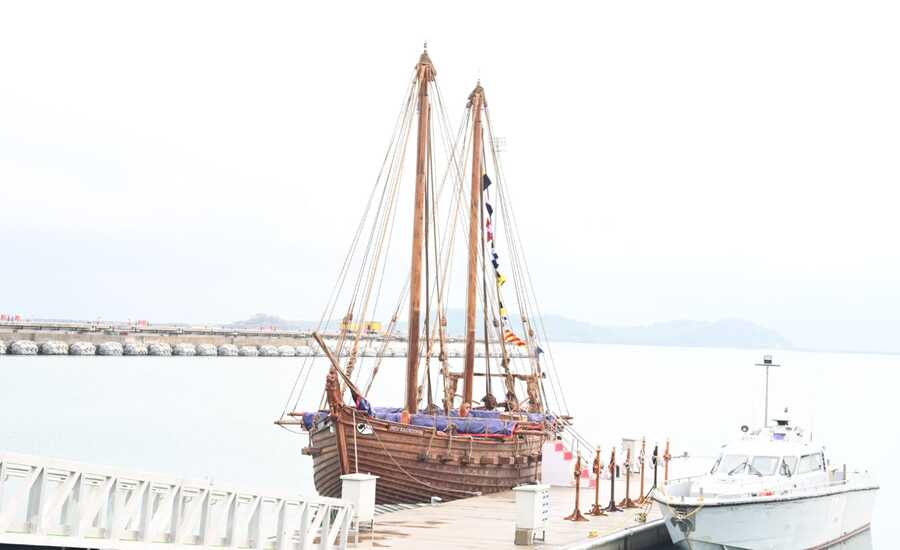
In a landmark initiative blending heritage, craftsmanship and maritime prowess, the Indian Navy’s pioneering stitched sailing vessel – INSV Kaundinya is set to embark on its maiden overseas voyage on 29 December 2025, sailing from Porbandar, Gujarat (India) to Muscat, Oman. This symbolic expedition aims to retrace the historic maritime routes that linked the Indian subcontinent with the wider Indian Ocean world for millennia, reaffirming India’s deep-rooted maritime legacy.
INSV Kaundinya: Reviving India’s Ancient Seafaring Traditions
The INSV Kaundinya represents an extraordinary revival of India’s ancient shipbuilding traditions and nautical heritage. What sets this vessel apart is its stitched-plank construction technique, a method historically prevalent along India’s coasts and across the Indian Ocean long before metal fasteners became commonplace.
Read also: Indian Navy Signs Pact With Crimson Energy to Build AI-Powered Deepdarshak Maritime Analytics System
Unlike modern ships built with steel and welding, Kaundinya’s wooden hull planks are stitched together using coconut coir rope and sealed with natural resins, recalling a shipbuilding technology used by Indian mariners for centuries.
This technique empowered seafarers to undertake long-distance voyages to West Asia, Africa, and Southeast Asia well before modern navigation and metallurgy existed.
From Ancient Depictions to Ocean-Going Reality
The design of INSV Kaundinya draws inspiration from ancient Indian depictions of ships. Specifically, historians and maritime archaeologists attribute similar ship imagery to artwork from the Ajanta Caves, one of India’s UNESCO World Heritage sites.
Expert shipwrights translated these historical visuals into a fully functional ocean-going vessel.
This rare convergence of history, craftsmanship, traditional knowledge and modern naval science underscores India’s ability to recreate a vessel from iconography and historical references — not blueprints — and bring it to life on the high seas.
Tripartite Collaboration: Tradition Meets Modern Science
The construction of Kaundinya was realized through a tripartite Memorandum of Understanding (MoU) between the Ministry of Culture, the Indian Navy, and M/s Hodi Innovations (OPC) Pvt Ltd — a Goa-based traditional shipbuilder.
Under the supervision of Master Shipwright Shri Babu Sankaran and a team of skilled artisans, the boatbuilding revival project was guided by extensive research, design validation, hydrodynamic testing, and naval expertise from the Indian Navy alongside support from academic institutions.
The result is a seaworthy sailing vessel, fully capable of ocean navigation despite its strictly traditional build.
INSV Kaundinya: A Living Symbol of Maritime Heritage
Named after the legendary mariner Kaundinya, who is believed to have sailed from India to Southeast Asia in ancient times, the vessel embodies India’s historic identity as a maritime nation.
According to historical records and folklore, Kaundinya’s voyages contributed to the earliest known Indian cultural and maritime influence in Southeast Asia.
The ship not only serves as a tribute to India’s illustrious seafaring past but also showcases India’s cultural continuity, blending ancient shipbuilding with modern navigational preparedness.
Its upcoming voyage will link India not just geographically but historically with countries across the Indian Ocean — symbolizing centuries of trade, exchange and cultural interaction.
Setting Sail: The Maiden Overseas Voyage of INSV Kaundinya
The maiden overseas voyage of the INSV Kaundinya is scheduled to commence on 29 December 2025, with the vessel being officially flagged off from Porbandar, Gujarat. The journey’s first leg sees the ship sailing across the Arabian Sea to Muscat, Oman, reminiscent of ancient maritime routes that historically united India with West Asia.
This expedition has broader significance beyond symbolism — it represents India’s aspiration to revive and celebrate indigenous knowledge systems and align its rich historical traditions with contemporary cultural diplomacy and naval heritage conservation.
Modern Reinvention of Ancient Craftsmanship
The stitched-plank technique employed in Kaundinya is a hallmark of ancient naval architecture in India and parts of the Indian Ocean rim. Instead of nails or modern fasteners, planks are bound with coir rope (coconut fiber) and natural resins, forming a robust and flexible hull.
Such sewn boats were historically common in the Indian Ocean, facilitating trade and exploration long before advanced metallurgy arrived.
By successfully reintroducing this technique, India not only honours its maritime ancestors but also contributes to the global understanding of traditional navigation and shipbuilding history.
Strategic Maritime Diplomacy Through Heritage
The voyage of INSV Kaundinya resonates beyond historical nostalgia. At a time when maritime strategy and Indo-Pacific engagement are of central geopolitical importance, such initiatives underscore India’s commitment to its cultural legacies, naval history, and oceanic outreach.
By physically retracing ancient sea routes, India strengthens cultural diplomacy and highlights shared histories with nations along the Indian Ocean coastline, fostering people-to-people and institutional ties.
INSV Kaundinya: A Testament to India’s Maritime Legacy
From its handcrafted hull to its symbolic voyage path, Kaundinya stands as a living testament to India’s seafaring roots — an embodiment of ancient ingenuity, artisanal skill, and modern visionary collaboration.
As the Indian Navy prepares to set this unequaled ship on its maiden overseas voyage, the world watches a narrative of history, heritage, and heritage-driven modern identity unfold across the Indian Ocean.
Read also: GRSE Delivers ASW SWC Anjadip to Indian Navy, Marks Fifth Warship Delivery in 2025