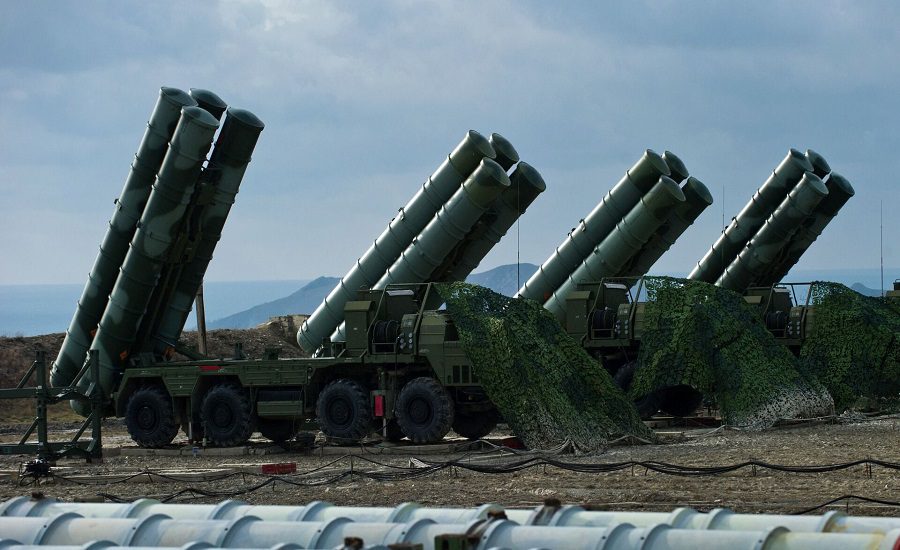
New Delhi: Russia has officially confirmed that the fourth squadron of the potent S-400 Triumf long-range air defence system will be delivered to the Indian Air Force (IAF) by the end of May 2026.
This milestone marks a significant step in India’s ongoing effort to build a layered air and missile defence capability under its Sudarshan Chakra doctrine, strengthening national security amid rising regional tensions.
Background of the Fourth S-400 Delivery Timeline
India and Russia signed the landmark S-400 defence agreement in October 2018, committing approximately ₹40,000 crore (about USD 5.4 billion) for five air defence regiments.
These systems are designed to intercept aircraft, drones, and ballistic missiles at extended ranges, enhancing India’s strategic deterrence along its borders with Pakistan and China.
The S-400 Triumf (NATO designation: SA-21 Growler) is widely regarded as one of the most advanced surface-to-air missile systems in operation. It integrates powerful radars, advanced command-and-control units, and multiple missile types to engage targets at varied distances and altitudes.
So far, three of the five squadrons have been delivered and inducted into the IAF — with the first becoming operational in December 2021 near the Punjab sector. These deployments are strategically positioned to reinforce India’s air defence grid and deter cross-border aerial threats.
Why the Fourth S-400 Delivery Timeline Squadron Matters
Here is the Importance of fourth S-400 delivery timeline;
Strengthening the Air Defence Umbrella
The fourth S-400 unit will expand India’s long-range interception envelope, further consolidating the multi-layered air defence architecture that combines indigenous systems like Akash with imported platforms.
This expanded coverage is critical as India continues to manage complex security dynamics on multiple fronts.
Combat Validation: Operation Sindoor
The system’s role during Operation Sindoor, the 2025 India-Pakistan military escalation, has reinforced its operational relevance.
The S-400 reportedly played a key role in thwarting hostile incursions, with Indian defence sources affirming its effectiveness in real combat scenarios.
Supply Chain Revival
The timeline reflects improvements in Russian defence supply chains, which were previously disrupted due to the Russia-Ukraine conflict and related sanctions.
Moscow’s renewed commitment to meeting the contract schedule signals stabilisation and the continued strategic cooperation between the two nations.
What are the Features of the S-400 Air Defence System
The S-400 platform features:
- A 91N6E “Big Bird” long-range surveillance radar with detection ranges up to 600 km.
- A 92N6E “Grave Stone” engagement radar for tracking and interception cues.
- Multiple interceptor missiles (e.g., 40N6, 48N6, 9M96E2) capable of covering extensive range and altitude profiles.
- Command-and-control integration for rapid data processing and networked engagement.
These capabilities make it highly versatile against aircraft, cruise missiles, drones, and ballistic threats — crucial for modern, layered defence.
What are the Implications of Fourth S-400 Delivery Timeline for India
With China and Pakistan continuously modernising their air and missile capabilities, India’s expanded S-400 deployment enhances strategic deterrence, making any attempt to achieve air superiority more challenging for potential adversaries.
Global Defence Cooperation
Despite external geopolitical pressures — including US warnings under the Countering America’s Adversaries Through Sanctions Act (CAATSA) — India has maintained its strategic autonomy in defence procurement. This willingness to balance relationships with multiple global partners reflects New Delhi’s broader security calculus.
Future Capabilities and Indigenous Development
While the S-400 continues to bolster air defence, India is also progressing on indigenous projects like Project Kusha, aimed at developing long-range surface-to-air missile systems to complement imported assets.
Looking Ahead: Fourth S-400 Delivery Timeline
Russia has also indicated that the fifth and final squadron under the original contract is slated to arrive by 2027, completing the full delivery cycle of India’s S-400 order. This progression reflects sustained defence collaboration and a shared interest in strategic stability across the Indo-Pacific region.
As India continues to modernise its air defence mosaic, the S-400 system remains a core component — bridging current capability gaps while complementing future indigenous systems and reinforcing the nation’s readiness for evolving aerial and missile threats.
Read also: What Is Krasukha-2 EW System? and How It Can Protect S-400 Air Defence Without Firing a Shot