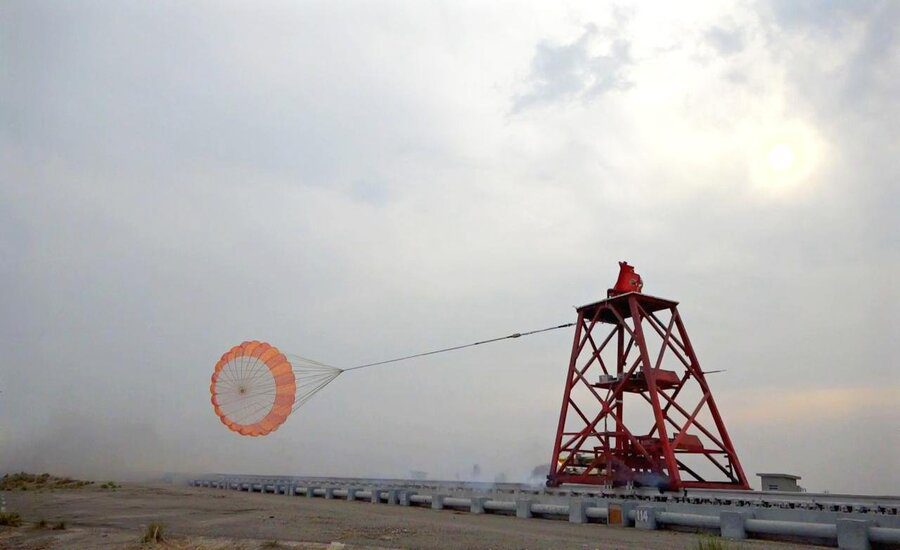
New Delhi: India’s human spaceflight programme achieved a critical new milestone with a successful qualification level load test of the Gaganyaan drogue parachute, reinforcing mission safety and boosting confidence in crew re-entry systems. The test was conducted at the Defence Research and Development Organisation’s (DRDO) specialised Rail Track Rocket Sled (RTRS) facility at the Terminal Ballistics Research Laboratory (TBRL) in Chandigarh, marking a key step forward in India’s first crewed spaceflight endeavour.
What Is the Gaganyaan Drogue Parachute Qualification Test?
The drogue parachute is a crucial component of the Gaganyaan spacecraft’s recovery system. Deployed early during atmospheric re-entry, it stabilises and slows the crew module before the main parachutes open, ensuring controlled descent and safe splashdown for astronauts.
In this recent test, the parachute was subjected to qualification level loads at speeds and forces exceeding expected maximum flight loads, simulating extreme stresses it must endure during real mission scenarios. This helps confirm structural strength and safety margins far beyond routine conditions.
Collaborative Effort: DRDO & ISRO Teams
The qualification test was carried out on 18 February 2026 with a joint team comprising:
- Defence Research and Development Organisation (DRDO)
- Vikram Sarabhai Space Centre (VSSC), Indian Space Research Organisation (ISRO)
- Aerial Delivery Research and Development Establishment (ADRDE), DRDO
- Terminal Ballistics Research Laboratory (TBRL) support teams
The high-speed RTRS facility enables scientists and engineers to simulate realistic aerodynamic loads and ballistic conditions for critical aerospace systems.
Importance of Gaganyaan Drogue Parachute Qualification Test
The Gaganyaan mission aims to send Indian astronauts into Low Earth Orbit (LEO) and bring them safely back to Earth. With human lives at stake, every system — especially recovery and re-entry components — must meet strict reliability and safety standards.
- The successful load test demonstrates India’s technical expertise in designing and manufacturing high-strength ribbon parachutes.
- It validates parachute performance under extreme conditions.
- It advances India’s readiness for a future crewed mission.
- It underscores synergy between DRDO, ISRO, and allied Indian aerospace organisations.
Defence Minister Rajnath Singh praised the achievement, affirming it as an important stride towards Atmanirbhar Bharat in critical aerospace technologies.
About the RTRS Facility
The Rail Track Rocket Sled (RTRS) facility at TBRL, Chandigarh, is one of India’s most advanced dynamic test installations. It is used for high-speed tests simulating conditions that parachutes and aerospace recovery systems encounter during flight and descent.
RTRS helps scientists recreate aerodynamic and ballistic forces in a controlled ground environment — a vital requirement for validating aerospace hardware before real world deployment.
Future Steps for Gaganyaan’s Parachute System
The successful qualification test clears a major certification requirement for the parachute system ahead of:
- Final integrated parachute tests,
- Crew module drop and recovery trials,
- Subsequent Gaganyaan flight missions.
Reliable parachute systems are essential for ensuring the safety of Indian astronauts returning to Earth. The test also highlights the ongoing progress toward India’s first human spaceflight and builds confidence in indigenous aerospace technologies.
Read also: DRDO’s Microwave Weapon Explained: Technology, Range, and Strategic Impact on India’s Defence