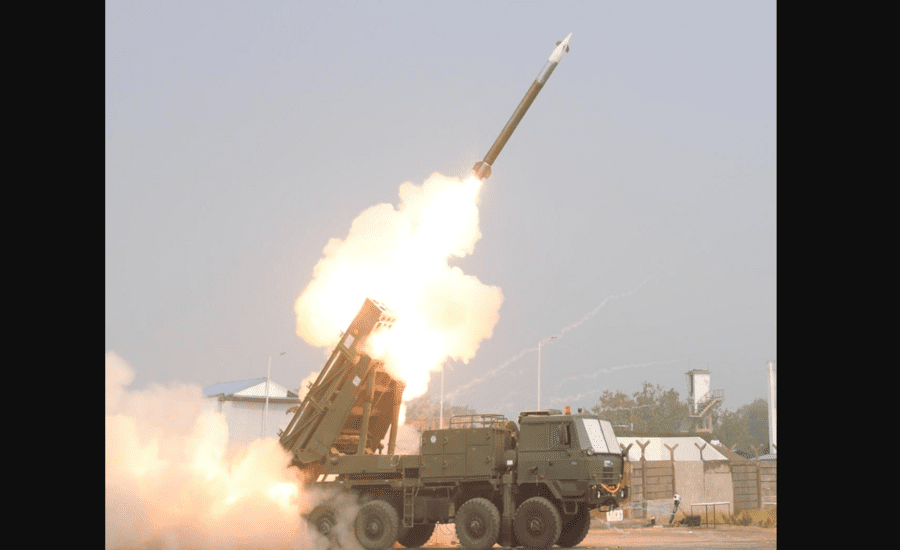
Chandipur, Odisha: India has marked a significant leap in indigenous defence capabilities with the successful maiden flight test of the Long-Range Guided Rocket (LRGR-120), an advanced variant of the Pinaka Multi-Barrel Rocket Launcher (MBRL) system. The test was conducted at the Integrated Test Range (ITR), Chandipur, Odisha, further strengthening India’s long-range precision strike and artillery modernisation programme.
Developed by the Defence Research and Development Organisation (DRDO), the LRGR-120 demonstrated a strike range of 120 kilometres, positioning India among a select group of nations with advanced guided rocket artillery systems.
Details of Pinaka LRGR-120 Rocket Test
The maiden flight test of the Pinaka LRGR-120 was carried out on December 29, 2025, validating the rocket’s guidance, propulsion, navigation and accuracy under operational conditions.
Read also: Akash-NG Missile Trials: DRDO Confirms High-Precision Intercepts and Combat Readiness
According to defence sources, all mission objectives were met successfully, with the rocket achieving its intended range and precision parameters.
DRDO successfully conducted maiden flight test of Pinaka Long Range Guided Rocket (LRGR-120) at ITR Chandipur. Achieving a range of 120 km with textbook precision, the rocket demonstrated all planned in-flight manoeuvres.
— Ministry of Defence, Government of India (@SpokespersonMoD) December 30, 2025
Read here: https://t.co/krP00OZcPn@rajnathsingh… pic.twitter.com/HfUot0RJMk
The test marks a crucial step toward field induction and mass production, paving the way for enhanced operational readiness of the Indian Army.
What Is the Pinaka LRGR-120 Rocket?
The LRGR-120 is an advanced, guided evolution of the Pinaka Multi-Barrel Rocket Launcher System, originally conceptualised as an indigenous alternative to imported artillery systems.
What are the Key Features of Pinaka LRGR-120 Rocket
- Maximum range: 120 kilometres
- Guidance system: Integrated navigation and guidance for high accuracy
- CEP (Circular Error Probable): Less than 20 metres
- Launch compatibility: Existing Pinaka launchers
- Role: Precision strike against high-value and strategic targets
The rocket significantly extends the earlier Pinaka variants—MK-1 and MK-2, which had ranges of up to 90 kilometres.
Precision Strike Capability with Minimal Collateral Damage
One of the most critical features of the LRGR-120 is its high accuracy, achieved through an advanced guidance system. With a CEP of under 20 metres, the rocket is capable of pinpoint strikes, making it highly effective against strategic targets while minimising collateral damage.
This precision capability is particularly vital in mountainous and high-altitude regions, where conventional artillery faces accuracy and mobility challenges.
Seamless Integration with Existing Pinaka Systems
A major operational advantage of the LRGR-120 is its backward compatibility with existing Pinaka launchers. The system requires no substantial modifications to current vehicles or infrastructure, ensuring:
- Faster induction timelines
- Lower deployment costs
- Simplified logistics and training
Existing Pinaka systems that earlier supported 40 km and 75 km rockets can now seamlessly deploy the 120 km guided variant, significantly enhancing battlefield reach.
Engineering Innovations Behind the Extended Range
Achieving a 120-kilometre range required overcoming significant engineering challenges. DRDO engineers addressed these by:
- Increasing propellant capacity
- Optimising rocket aerodynamics
- Slightly increasing rocket diameter without compromising mobility
These innovations enabled a longer range while maintaining launcher stability and transportability.
What are the Importance of Pinaka LRGR-120 Rocket for India’s Border Defence
The induction of LRGR-120 will substantially boost India’s deterrence posture along northern and eastern borders, particularly in regions such as Ladakh, where precision and long-range firepower are critical.
Compared to similar Chinese systems like PHL-03 and A-100, which also offer 120 km range but rely on heavier launch platforms, the Pinaka LRGR-120 provides greater mobility and faster deployment, a key advantage in rugged terrains.
Procurement Plans and Industrial Participation
The Indian Army has initiated procurement proposals valued at approximately ₹2,500 crore for the LRGR-120 rockets. These plans have received clearance from the Defence Acquisition Council (DAC).
This procurement builds on earlier contracts worth over ₹10,000 crore for Pinaka regiments and ammunition, signalling a strong long-term commitment to indigenous artillery systems.
Role of Private Industry
Production will involve private sector partners such as Solar Industries, supporting:
- Faster manufacturing cycles
- Improved quality control
- Strengthening of the Atmanirbhar Bharat defence ecosystem