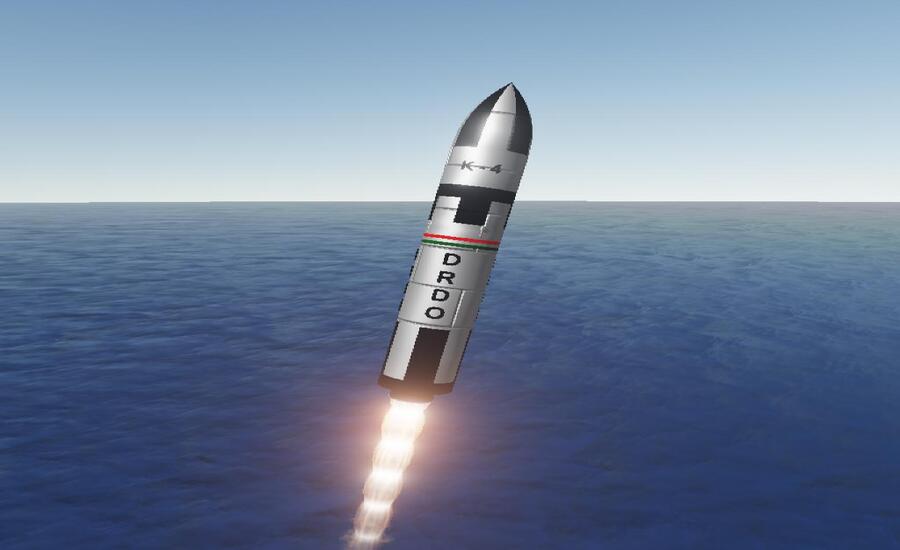
New Delhi: In a significant strategic development, India has reportedly conducted a user trial of the K-4 submarine-launched ballistic missile (SLBM) from its indigenous nuclear-powered ballistic missile submarine INS Arihant in the Bay of Bengal.
The K-4 SLBM missile trial achieving an estimated maximum range of approximately 3,500 km, marks a key step forward in operationalising India’s sea-based nuclear deterrent and second-strike capability.
While the Ministry of Defence has not yet issued an official confirmation, details have circulated widely across defence media, social media and defence observer networks, indicating progress toward a mature sea leg of India’s nuclear triad.
What Is the K-4 SLBM?
The K-4 missile is an intermediate-range, solid-fuel submarine-launched ballistic missile developed by India’s Defence Research and Development Organisation (DRDO) and manufactured by Bharat Dynamics Limited.
Designed specifically for Arihant-class SSBNs (nuclear-powered ballistic missile submarines) such as INS Arihant and INS Arighaat, the K-4 features the following characteristics:
Range: Up to ~3,500 km
Propulsion: Two-stage solid rocket motor
Length: Approx. 10–12 meters
Weight: Approx. 17–20 tonnes
Payload: ~2,000 kg strategic (nuclear) warhead capability
Guidance: Inertial navigation with GNSS (including India’s NavIC)
Launch: Cold launch from submarine launch tubes
This range significantly extends India’s undersea strike envelope compared to earlier SLBMs such as the K-15 (Sagarika) with ~700 km range, enabling deterrence without approaching hostile coastlines.
Strategic Significance of the K-4 SLBM Trial
The reported K-4 SLBM Trial represents a shift from development trials to repeatable user training, indicating confidence in the missile’s reliability and integration with submarine platforms.
Successful SLBM tests from operational vessels underpin survivable deterrence, especially given the stealth of SSBNs beneath the ocean surface.
Sea-Based Deterrence and Second-Strike
India’s nuclear doctrine emphasises Credible Minimum Deterrence and a No First Use policy. Within this framework, a viable second-strike capability — the assured ability to retaliate even after sustaining a first strike — is vital. Submarine-launched ballistic missiles are central to this deterrent posture due to their survivability and stealth.
By extending the SSBN ballistic reach to 3,500 km, India ensures that its underwater platforms can hold potential adversary targets at risk from standoff positions in the Indian Ocean, enhancing strategic stability and deterrence.
INS Arihant: Backbone of India’s Sea Leg
INS Arihant is the lead vessel of India’s Arihant-class SSBNs, developed under the Advanced Technology Vessel (ATV) project.
With four vertical launch tubes, Arihant can carry either:
- 12 smaller SLBMs (K-15), or
- 4 longer-range SLBMs (K-4)
The K-4 SLBM Trial from INS Arihant underscores its role as a cornerstone of India’s sea-based strategic forces.
Its stealth and underwater endurance ensure continuous deterrence patrols, even in remote oceanic regions.
K-4 SLBM Trial Impact on Broader SSBN Fleet Expansion
India is actively expanding its SSBN fleet to enhance patrol availability and deterrence persistence:
INS Arighaat: (second Arihant-class submarine) commissioned in August 2024 with K-4 integration.
INS Aridhaman: (third SSBN) in advanced sea trials and nearing commissioning, with capacity for multiple long-range missiles.
These developments point to a growing capability to maintain continuous at-sea deterrence (CASD) — a key feature for strategic stability in the Indo-Pacific amid evolving regional security dynamics.
Regional and Geopolitical Context of K-4 SLBM Trial
The Indo-Pacific security environment remains dynamic, with major powers advancing strategic weapon systems.
SLBMs with intermediate to long ranges can serve not just as deterrents but also as stabilisers by reinforcing mutual vulnerability under deterrence frameworks.
For India, enhancing the reach and reliability of SLBMs like the K-4 counters regional threats while reducing the risk of first-strike pressures.
Future systems under development (e.g., longer-range K-5 SLBMs) are likely to extend this capability further into deeper strategic depths in the years ahead.