Bengaluru: The Indian Space Research Organisation (ISRO) has successfully concluded a critical series of qualification tests for the Gaganyaan mission’s drogue parachutes at the Terminal Ballistics Research Laboratory (TBRL) in Chandigarh, marking yet another major milestone for India’s ambitious human spaceflight program.
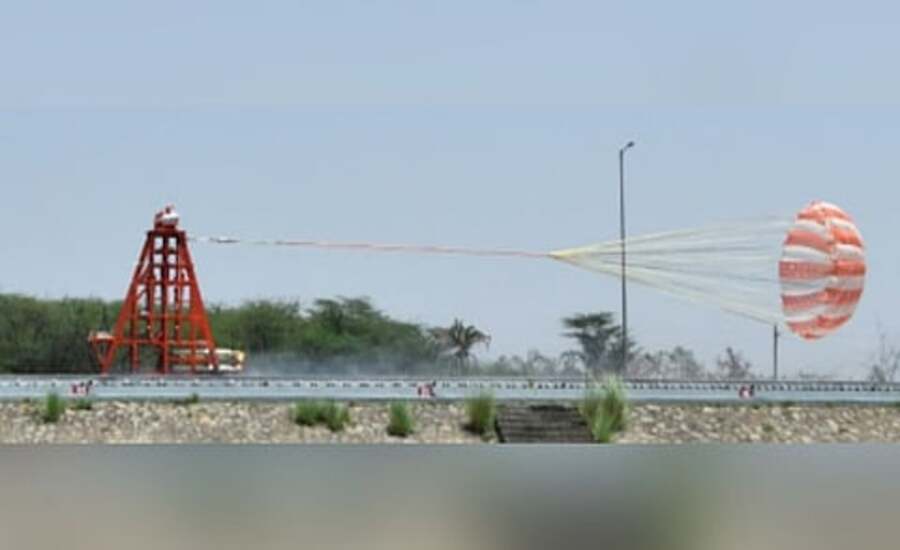
Conducted on December 18 and 19, 2025, the tests were carried out on the Rail Track Rocket Sled (RTRS) facility — a specialized high-speed sled system designed to simulate extreme descent conditions that the Gaganyaan Crew Module will experience during atmospheric re-entry.
This accomplishment underscores India’s growing capabilities in space technology as well as the high levels of collaboration between ISRO and the Defence Research and Development Organisation (DRDO) to ensure astronaut safety.
What is Gaganyaan Drogue Parachute Qualification Tests
The drogue parachutes are a pivotal part of the Gaganyaan Crew Module’s deceleration system, designed to stabilise and slow the spacecraft as it returns to Earth from space.
In the full parachute deployment sequence:
- 1. Two apex cover separation parachutes jettison the protective cover of the parachute compartment.
- 2. This is followed by two drogue parachutes that stabilize and reduce the capsule’s velocity.
- 3. Upon their release, three pilot parachutes deploy to extract three main parachutes that further slow the spacecraft for a safe splashdown.
The drogue parachutes specifically are responsible for controlling instability and decelerating the module during the most challenging phases of descent.
Read also: ISRO’s Solar Observatory Aditya-L1 Provides First Direct Proof of 40-Year-Old Solar Wind Theory
Their reliable performance is essential to ensure the safety of astronauts during Gaganyaan’s manned missions.
Advanced Testing at TBRL’s RTRS Facility
The Terminal Ballistics Research Laboratory at Ramgarh near Chandigarh — operated by DRDO — is uniquely equipped with rocket-propelled sled technology capable of simulating high-velocity flight conditions. The RTRS tests can replicate speeds multiple times the speed of sound, essential for parachute systems qualification.
During these qualification tests, the drogue parachutes were subjected to credible variations in simulated flight parameters.
According to ISRO, all test objectives were achieved, and the parachutes demonstrated robustness and reliability even under extreme simulated conditions.
This success significantly builds confidence in the parachute system’s performance envelope, ensuring that the spacecraft will behave as expected under real-world atmospheric re-entry conditions.
Strategic Importance for Gaganyaan Mission Timeline
The completion of these drogue parachute qualification tests brings ISRO closer to finalising the parachute deceleration system — one of the most critical safety subsystems required for crewed spaceflight certification.
The Gaganyaan mission, first announced in 2018 as part of India’s Human Spaceflight Programme (IHSP), aims to send Indian astronauts into low Earth orbit and safely return them to Earth.
In earlier stages, ISRO has conducted other significant tests, including:
- Integrated Air Drop Tests, which simulated end-to-end parachute deployment in real air-drop conditions.
- Qualification tests for main parachutes targeting final descent and touchdown phases.
The successful completion of the drogue parachute tests therefore establishes a crucial confidence boost for downstream flight tests, including the upcoming uncrewed and crewed missions planned under the Gaganyaan timeline.
Collaborative Effort Behind Gaganyaan Drogue Parachute Qualification Tests
This testing milestone reflects high-level synergy between ISRO and several key organisations, including:
- Vikram Sarabhai Space Centre (VSSC) — Leading parachute development
- Aerial Delivery Research and Development Establishment (ADRDE) — Contributing parachute design expertise
- Terminal Ballistics Research Laboratory (TBRL) — Conducting high-speed sled testing
- Active involvement of DRDO technical support teams
Such collaboration brings together civilian space research and defence-grade testing infrastructure to push the envelope of India’s aerospace capabilities.