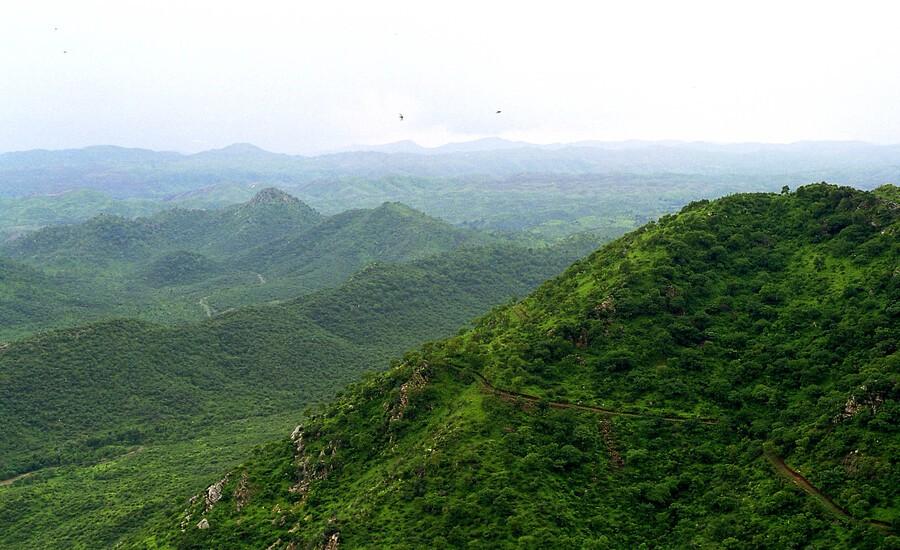
New Delhi: In a significant legal and environmental development, the Supreme Court of India has accepted the Union government’s proposal to restrict protection of the Aravalli range to a 100-metre buffer, even though the court’s own statutory advisory body had earlier opposed the move.
The decision, taken within the last 48 hours, has triggered renewed debate over environmental safeguards, mining regulation, and the long-term ecological future of one of India’s oldest mountain systems.
What Is the Government 100m Aravalli Definition
The 100-metre rule refers to a definition proposed by the Ministry of Environment, Forest and Climate Change (MoEFCC), under which only land falling within 100 metres of officially recorded Aravalli hill features would be treated as protected.
This definition effectively narrows the scope of the Aravalli ecosystem, excluding large stretches of lower hill formations and forested terrain that have traditionally been considered part of the range.
Supreme Court’s Decision on Government 100m Aravalli Definition
On November 20, the Supreme Court accepted the government’s recommendation without detailed scrutiny of alternative definitions. The acceptance came a day after the proposal was formally placed before the court.
Notably, the court’s own monitoring body — the Central Empowered Committee (CEC) — later clarified that it had neither examined nor approved the ministry’s recommendation.
Despite this, the court proceeded to accept the proposal, giving it legal backing.
Why the Decision Is Controversial
In an internal communication dated October 14 and reviewed recently, the CEC underlined that the definition formulated by the Forest Survey of India (FSI) should be adopted instead.
According to the CEC:
- The FSI’s three-degree slope-based definition captures the lower hills of the Aravalli range
- These lower formations are ecologically critical for groundwater recharge, biodiversity, and climate regulation
- The 100-metre rule risks leaving vast tracts unprotected
The panel warned that narrowing protection could undermine decades of conservation jurisprudence.
What Is the FSI’s Definition of the Aravallis?
The Forest Survey of India uses a scientific, terrain-based approach, defining Aravalli land based on:
- Slope gradient (three degrees and above)
- Geological continuity
- Forest cover and ecological function
This broader definition includes foothills and degraded forest patches that play a crucial environmental role but may not appear as prominent hill structures in revenue records.
Legal Background: Role of the Central Empowered Committee
The CEC was constituted by the Supreme Court in 2002 to oversee compliance with court orders related to forests and the environment.
Its recommendations have historically shaped landmark rulings on mining bans, forest clearances, and wildlife protection. The present case marks a rare instance where the court accepted a proposal without the committee’s endorsement.