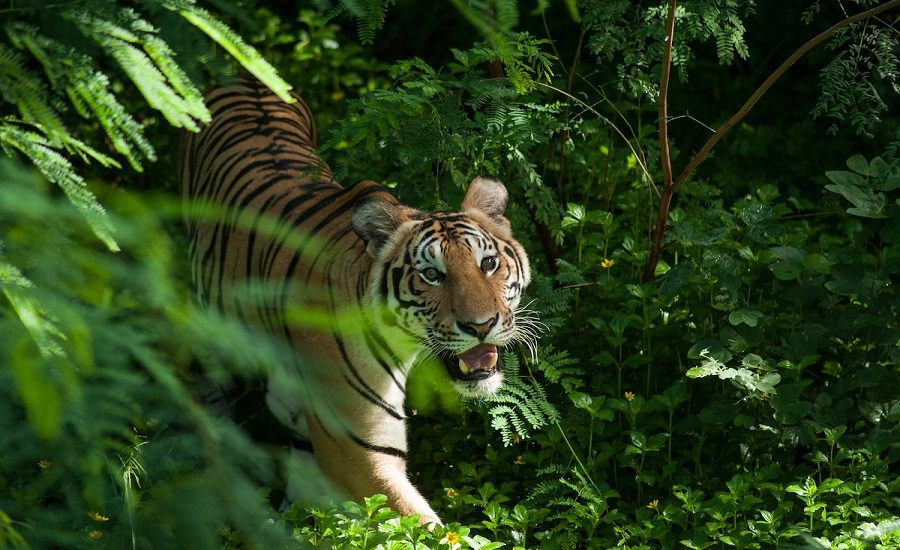
Mysuru: Karnataka is gearing up for the 6th cycle of the All-India Tiger Estimation (AITE-26), a nationwide exercise conducted every four years to assess the population and distribution of tigers across India. This year’s survey, spanning 2025–26, will cover fieldwork across all 54 Forest Divisions in Karnataka, followed by advanced data analysis and camera trap surveys. The results are scheduled for release in 2027.
Historical Tiger Population Trends in Karnataka and India
Over the past five cycles of tiger estimation, India’s tiger population has shown steady growth:
- 2006: 1,411 tigers
- 2010: 1,706 tigers
- 2014: 2,226 tigers
- 2018: 2,967 tigers
- 2022: 3,682 tigers (nearly 70% of the global wild tiger population)
Karnataka’s tiger population has also grown consistently:
- 2006: 290 tigers
- 2010: 300 tigers
- 2014: 406 tigers (ranked #1 in India)
- 2018: 524 tigers (ranked #2)
- 2026 estimate (current): 563 tigers (still #2, after Madhya Pradesh)
Read also: Madhya Pradesh’s Kuno National Park Sees India’s Cheetah Population Rise to 30 Under Project Cheetah
Nodal Officers and Training Initiatives
Dr. Ramesh Kumar P, IFS, the former Conservator of Forest, Project Tiger, Mysuru, has been nominated as the State Nodal Officer for Karnataka for AITE-26. He attended the State Nodal Officers meeting and training at the Wildlife Institute of India (WII), Dehradun, on 22nd August 2025.
To ensure uniform methodology across South Indian states, a Training of Trainers (ToT) workshop was held at Mudumalai-Bandipur Tiger Reserve from 24–26 September 2025, attended by 61 frontline staff and forest officers from Karnataka. Subsequently, field staff training was conducted over October–December 2025, covering all 5 tiger reserves and 13 forest circles in Karnataka with the support of the Karnataka Wildlife Technical Cell (KWTC).
Three-Phase Methodology of AITE-26
The 6th cycle of AITE is being conducted in three phases:
- Phase I – Field Surveys (January–February 2026):
- Exercise 1: Carnivore Sign Survey
- Conducted over 3 days per block, walking at least 5 km/day along forest tracks.
Records indirect signs of tigers, leopards, wild dogs, wolves, foxes, and mega herbivores like elephants and Indian gaurs.
Conducted across 54 forest divisions in Karnataka in 2 blocks:
- Block I: 5–7 January 2026 (38 divisions)
- Block II: 15–17 January 2026 (14 divisions)
- DNA analysis: Fresh tiger/leopard scats and herbivore dung collected in 2,700 ziplock bags supplied by WII.
- Exercise 2: Line Transect (LT) Survey
- Conducted over 4 days per beat along 2 km predetermined transects.
- Estimates ungulate abundance through direct sightings (spotted deer, sambar, gaur, wild pigs, etc.).
- Uses See-through Compasses and Range Finders for accurate measurement.
- Phase I LT survey divided into 5 blocks across Karnataka, with 9,276 staff deployed.
Phase II – Remote Sensing & GIS Analysis:
- Conducted at WII, Dehradun using RS and GIS techniques to map habitats and tiger distribution.
Phase III – Camera Trap (CT) Survey:
- Tigers monitored via 2×2 sq. km grid system in tiger reserves and other forest divisions.
2,230 camera traps deployed across Karnataka’s 5 tiger reserves:
- Nagarahole: 600 cameras
- Bandipur: 550 cameras
- BRT: 300 cameras
- Bhadra: 330 cameras
- Kali: 450 cameras
Camera trap surveys already started in tiger reserves and progressing in phases.
Additional camera traps are supplied by tiger reserves to nearby wildlife sanctuaries and forest divisions (e.g., Bandipur supplying Cauvery Wildlife Sanctuary).
Significance of AITE-26
This 6th cycle of AITE reflects India’s ongoing commitment to tiger conservation and scientific wildlife management. Karnataka, with the second-largest wild tiger population, plays a crucial role in national tiger conservation efforts. The survey’s results will guide policy, resource allocation, and habitat management strategies in the coming years.