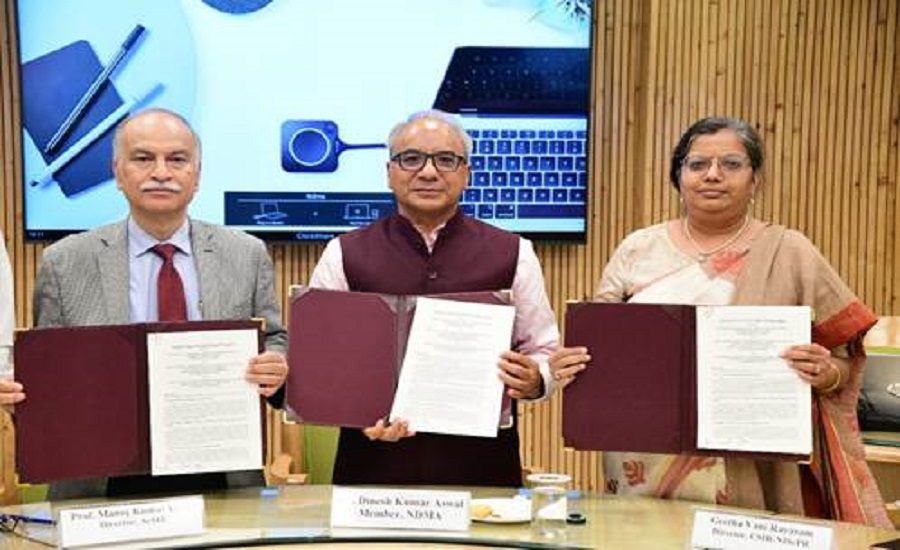
New Delhi: In a significant move to bolster India’s disaster resilience framework, the National Disaster Management Authority (NDMA), the Academy of Scientific and Innovative Research (AcSIR), and the CSIR–National Institute of Science Communication and Policy Research (CSIR–NIScPR) have signed a Memorandum of Understanding (MoU) to promote academic programmes, interdisciplinary research, and policy engagement in the areas of Disaster Management and Risk Reduction (DMRR).
The collaboration seeks to integrate science, technology, and public policy to create a disaster-resilient India by enhancing disaster management strategies, building capacity, and improving science communication.
Key Highlights of the MoU
The MoU outlines the following key initiatives:
- Launch of a PhD Programme in Disaster Management under AcSIR at CSIR–NIScPR, with support from NDMA.
- Joint research and policy studies focused on science communication, disaster preparedness, and risk reduction strategies.
- Capacity-building initiatives to strengthen institutional frameworks and improve community-level disaster response mechanisms.
This partnership represents a comprehensive approach to disaster risk reduction, leveraging academic excellence and cutting-edge research.
Read also: India and Brazil Sign MoU to Boost Steel Sector Mining and Advanced Mineral Technologies
Bridging Science and Policy for Disaster Resilience
Dr. Dinesh Kumar Aswal, Member of NDMA, emphasized the importance of integrating scientific research with societal preparedness for better disaster management. He highlighted the role of communication channels in enhancing early warning systems, risk communication, and community outreach.
“By institutionalizing systematic post-disaster studies and documentation, we aim to create a culture of continuous learning that will help strengthen preparedness and refine response mechanisms,” Dr. Aswal said.
NDMA, as the apex body for disaster management policy under the Ministry of Home Affairs, will provide strategic direction and domain expertise under this collaboration.
Expanding Academic and Research Opportunities
Prof. Manoj Kumar Dhar, Director of AcSIR, described the MoU as a gateway to new academic and research opportunities. He pointed out that AcSIR’s focus on interdisciplinary research will foster innovative solutions for addressing disaster management challenges.
AcSIR, with over 7,000 enrolled students and research spanning across various scientific domains, aims to nurture the next generation of experts in disaster resilience as part of India’s Viksit Bharat 2047 vision.
Advancing Science Communication and Policy Research
Dr. Geetha Vani Rayasam, Director of CSIR–NIScPR, emphasized the unique role of her institute in science communication and evidence-based policy research. CSIR–NIScPR publishes 15 research journals and leads national initiatives on science communication.
Through this collaboration, CSIR–NIScPR will contribute to disaster preparedness and risk communication, aligning rigorous scientific inquiry with policymaking to deliver solutions that are both scientifically robust and socially responsive.
Strategic Step Towards Disaster-Resilient India
This tripartite collaboration marks a pivotal step in embedding scientific research, science communication, and policy-driven strategies into India’s disaster management ecosystem. The partnership aims to strengthen disaster preparedness, response, and long-term resilience across the country.
With NDMA’s strategic leadership, AcSIR’s academic strength, and CSIR–NIScPR’s expertise in policy research, the MoU provides a framework to improve India’s disaster management efforts at both the institutional and community levels.
About the National Disaster Management Authority (NDMA)
The National Disaster Management Authority (NDMA), under the Ministry of Home Affairs, is the apex body responsible for formulating policies, plans, and guidelines for disaster management in India. NDMA plays a crucial role in mitigating disaster risks and strengthening the nation’s resilience to natural and man-made hazards.