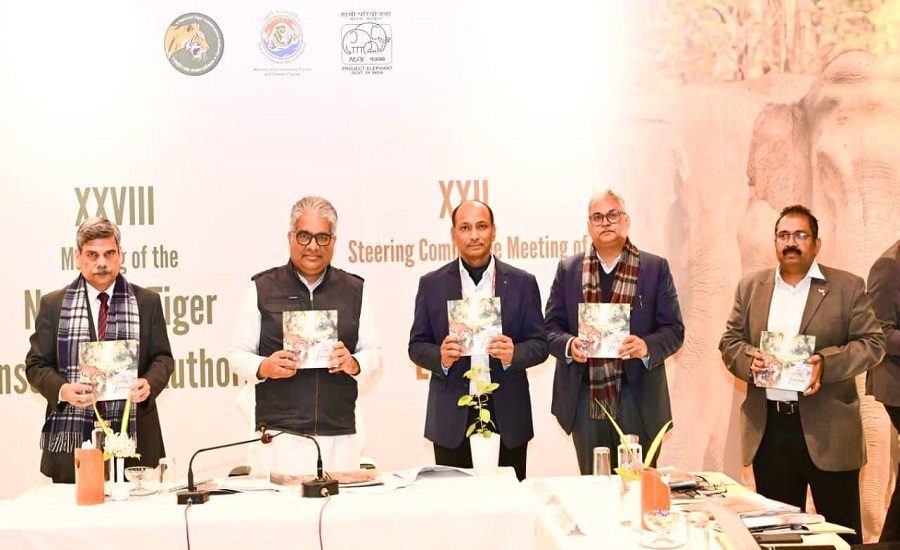
New Delhi: The 28th meeting of the National Tiger Conservation Authority (NTCA) and the 22nd Steering Committee meeting of Project Elephant were held on 21 December 2025 at the Sundarbans Tiger Reserve in West Bengal, chaired by Union Minister for Environment, Forest and Climate Change and NTCA Chairman, Mr. Bhupender Yadav. Senior officials from tiger- and elephant-bearing states, scientists, field experts, and representatives of leading conservation institutions participated to review progress and discuss strategies for wildlife conservation in India.
Key Highlights of the NTCA Meeting
During the meeting, Mr. Yadav emphasized India’s globally recognized tiger conservation model, highlighting science-based management, landscape-level planning, community participation, interstate coordination, and international collaboration. The minutes of the 27th NTCA meeting held on 18 April 2025 were confirmed, and an action-taken report on previous decisions was reviewed.
Discussions focused on human-tiger conflict mitigation, with the introduction of a three-pronged strategy and the launch of the “Management of Tigers Outside Tiger Reserves” project. Challenges such as staff shortages, budget constraints, habitat degradation, and invasive species management were also examined, and states were directed to follow up appropriately.
The NTCA’s Technical Committee decisions were approved, covering tiger conservation plans, expansion of Project Cheetah, tiger translocation, enhancement of prey species, landscape management planning, carnivore health management training programs, and inputs provided to the National Board for Wildlife (NBWL) on project proposals.
Updates were shared on compliance with directives from the 7th NBWL meeting, including the expansion of Project Cheetah to Gandhisagar Wildlife Sanctuary and Banni Grasslands in Gujarat, along with CAMPA-supported initiatives. Preparations for the proposed Global Big Cat Summit were also reviewed.

Project Elephant Steering Committee Review
The 22nd Steering Committee meeting of Project Elephant began with confirmation of the action-taken report from the 21st meeting. Members and invitees discussed ongoing issues and reviewed the status of regional action plans for elephant conservation in Southern and Northeastern India. Progress made by elephant-range states was highlighted, and priority areas for coordinated interstate action were identified. Updates on the All-India Synchronized Elephant Estimation, crucial for evidence-based planning and decision-making, were also reviewed.
Release of Four NTCA Publications
On the occasion, Mr. Yadav released four major publications to strengthen outreach and documentation of India’s wildlife conservation journey:
- Project Cheetah Booklet – Highlighting key milestones, progress, and international collaboration under Project Cheetah.
- STRIPES Magazine (December 2025 Edition) – Focusing on technology-driven tiger monitoring and the launch of the sixth cycle of the All India Tiger Estimation (AITE).
- NTCA Booklet – Documenting India’s tiger conservation journey, policy milestones, and initiatives.
- Tigerverse – Showcasing biodiversity, culture, and conservation stories from India’s tiger reserves.

Towards Future Conservation Goals
Mr. Yadav emphasized the importance of science-based monitoring, community engagement, and international collaboration for both tiger and elephant conservation. He noted that these publications and strategic reviews will guide policy, improve management practices, and strengthen India’s position as a global leader in wildlife conservation.
About NTCA
Established in 2005, the National Tiger Conservation Authority (NTCA) is a statutory body under the Ministry of Environment, Forest and Climate Change, tasked with tiger protection, habitat management, and policy guidance for tiger reserves across India. It also coordinates closely with Project Elephant for the conservation of elephants and their habitats.