New Delhi: In a landmark moment for India’s space ambitions, Russia has agreed to transfer 100% technology rights of its advanced semi-cryogenic rocket engine RD-191M to Indian Space Research Organisation (ISRO). The deal — expected to be finalised during President Vladimir Putin’s upcoming visit to India — could markedly boost the payload capacity of India’s heavy-lift rockets, thereby reshaping the country’s future in satellite launches, lunar missions and beyond.
This development marks more than just a technical upgrade; it signals a deepening of space-sector collaboration between India and Russia, bringing India closer to self-reliance in high-end rocket propulsion and heralding a new era for its planetary and lunar exploration ambitions.
What is RD-191M — A technical snapshot
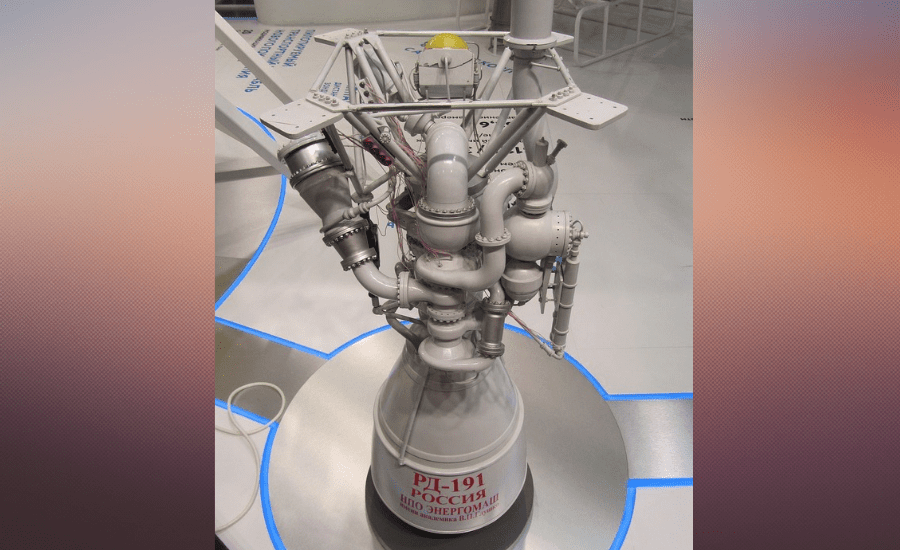
The RD-191M is a semi-cryogenic rocket engine, derived from the wider engine family developed by Russian firm NPO Energomash. Unlike fully cryogenic engines that use liquid hydrogen and liquid oxygen, RD-191M uses RP-1 (refined kerosene) as fuel and liquid oxygen (LOX) as the oxidiser.
Read also: From Polar Ice to Indian Shipyards: Russia Proposes Arctic-Class Vessel Collaboration With India
This propellant combination, while simpler to handle compared to hydrogen, offers substantial thrust and efficiency, making it a reliable choice for heavy-lift rockets.
With a thrust rating of approximately 192 tonnes, RD-191M stands among the most powerful single-chamber semi-cryogenic engines currently in operational use — as seen in Russia’s own heavy-lift rockets such as the Angara series.
This robustness and maturity of design and operation reduce the risk for ISRO in adopting the engine — an attractive alternative to developing from scratch.
Importance of RD-191M engine deal— Boosting India’s Rocket Power
Currently, ISRO’s heavy-lift rocket LVM3 (earlier known as GSLV Mk-III) can place a payload of roughly 4.2 tonnes into Geostationary Transfer Orbit (GTO).
Integration of RD-191M-powered stages into LVM3 could raise that capacity to 6.5–7 tonnes to GTO — effectively adding 2.5–3 tonnes per launch.
This jump is significant for multiple reasons:
- Heavier communication, navigation, and earth-observation satellites can be launched directly without splitting into multiple launches.
- It paves the way for larger interplanetary and lunar spacecraft — critical for future missions such as the next phases of the Chandrayaan programme or deep-space exploration.
- It makes India much more competitive in the global commercial launch market, offering heavier-lift services at potentially lower cost.
RD-191M Engine Deal: Aligning with “Make in India” — Technology Transfer & Indigenous Production
A key aspect of the deal is full technology transfer (TOT). This means India will not just import engines — it will have the capability to design, manufacture, test and maintain them domestically.
Agencies such as Hindustan Aeronautics Limited (HAL), in collaboration with ISRO, are likely to host new manufacturing lines dedicated to these semi-cryogenic engines — opening the door for true self-reliance.
This could eventually allow India to not only service its own missions but also export launch capabilities to other countries — supporting the goal of India emerging as a global space-launch hub.
Bridging Short-Term Needs While Indigenous Engines Mature
India has already been developing its own semi-cryogenic engine (e.g., the project code-named SCE-200 or SE-2000) for LVM3 — but progress has been gradual.
Given the pressing demand for heavier satellite launches and upcoming deep-space missions, adopting RD-191M immediately allows India to meet those demands now — instead of waiting years for indigenous designs to become fully operational. This pragmatic approach could accelerate India’s space ambitions without compromising long-term self-reliance.
Strategic & Geopolitical Dimensions of RD-191M Engine Deal
- The engine deal underscores the long-standing strategic partnership between India and Russia, now expanding beyond defence and traditional cooperation into cutting-edge space collaboration.
- By transferring critical rocket-propulsion technology, Russia is not only aiding India’s space ambitions but also signaling a deep trust — potentially paving the way for more joint ventures in human spaceflight, space-station development and interplanetary missions.
Timing — Opportunity Amid Global Realignments
Global space dynamics are shifting rapidly, with increasing competition among major powers and growing demand for satellite launches. For India, which aims to expand its role in the global space economy, the timing of RD-191M acquisition could not be better. It offers a faster path to ready heavy-lift capacity — while also aligning with broader geopolitical needs of autonomy and diversification.
Moreover, the readiness to receive and produce such advanced engines signals India’s ambition to not remain reliant on foreign suppliers for critical space infrastructure — a strategic posture likely to pay dividends in future diplomacy and space commerce.
Potential Impact of RD-191M Engine Deal on India’s Upcoming Missions
Lunar and Planetary Missions — e.g., Chandrayaan & Beyond: With the enhanced capacity that RD-191M could bring, future lunar missions (next phases of Chandrayaan) and interplanetary missions become more feasible with larger scientific payloads, more complex instrumentation, and potentially more ambitious mission architectures.
Heavier launch capability could enable landers/rovers with robust instrumentation or even orbiters with advanced arrays — opening possibilities beyond the scope of current designs.
Human Spaceflight & Space Station Ambitions: India’s human spaceflight programme Gaganyaan and any future pursuit of a national space station would demand reliable, high-thrust, heavy-lift capabilities. RD-191M could serve as a powerful booster or core stage for such rockets, enabling safe and efficient crewed launches.
Similarly, futuristic ambitions such as building a national orbital station (or participating in international ones) would benefit from such engine capability — making orbital construction and resupply more viable.
Commercial Launch Market & Export Potential: With heavier payload capacity and domestic manufacturing, India could market launch services to other countries — offering competitive pricing and reliability. This could significantly boost India’s share in the global commercial launch market.
Moreover, as RD-191M production matures within India, downstream industries (manufacturing, supply-chain, materials, propulsion test facilities) could grow — cultivating a robust space-industrial ecosystem with export potential beyond engines, to complete lift-vehicles or satellite launches.
Key Challenges and Considerations
While the RD-191M deal presents enormous promise, executing it will not be without challenges:
Integration Complexity — Adapting RD-191M into LVM3 (or future rockets) will require structural, thermal, and engineering modifications; integration, testing, and certification will demand time and careful oversight.
Dependency vs Indigenous Development Balance — Accepting foreign technology now might raise concerns among purists of “Atmanirbhar Bharat” (self-reliant India). The government and ISRO will need to ensure indigenous programmes (like SE-2000) continue and ideally converge with foreign-derived capabilities.
Infrastructure & Manufacturing Readiness — Building new facilities, training personnel, adhering to safety and quality norms, and ensuring rigorous testing protocols will be essential.
Geopolitical Uncertainties — While the deal is underway now, global geopolitics — sanctions, export controls, global tensions — might pose long-term risks on continuity, export potential and technology updates.
Nevertheless, many analysts believe the potential upside outweighs the risks, especially if managed with foresight and a long-term vision.
Read also: Milestone in Space Propulsion: ISRO’s CE20 Cryogenic Engine Boots Up Without External Start-Gas