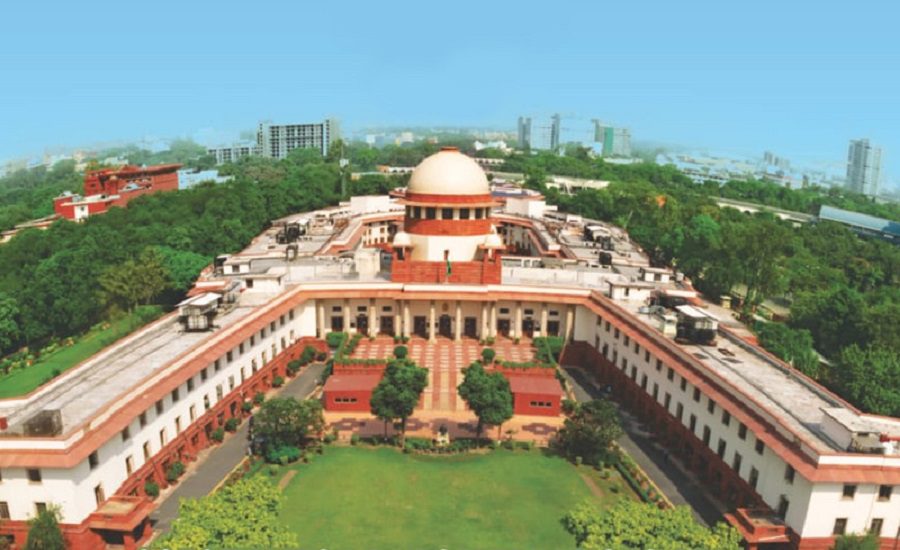
New Delhi: In a stern rebuke of police practices in Madhya Pradesh (MP), the Supreme Court of India has taken an extraordinary step to discipline a Station House Officer (SHO) over allegations of repeatedly using the same witnesses across hundreds of criminal cases.
The bench described the conduct as so concerning that it appears the officer has operated beyond acceptable policing standards. The Court directed that he be removed from all police duties until further orders.
Details of the MP Police SHO Stock Witness Case
A two-judge bench of the Supreme Court comprising Justice Ahsanuddin Amanullah and Justice R. Mahadevan expressed deep concern about a pattern of police conduct that reportedly undermines the integrity of the criminal justice process.
Read also: A Big Blow to Contractual Employees: Supreme Court Rejects Equal Pay Demand by Contractual Workers
The Court was informed that the SHO in question, identified as Indramani Patel, had repeatedly relied on a pair of “stock witnesses” in multiple cases — specifically, 195 cases and 215 cases, respectively — raising questions about the authenticity and independence of such testimony.
Senior Advocate Sanjay Hegde, appearing as an intervenor in the matter, highlighted that these same witnesses continued to be used even after the matter was before the Supreme Court, signaling a disregard for judicial scrutiny.
Hegde also noted that the Madhya Pradesh High Court had previously taken notice of the practice in at least one case.
What is Stock Witness Practice
In criminal law, eyewitness testimony often plays a crucial role in securing convictions. However, when the same individuals are repeatedly presented as witnesses across unrelated cases, the legitimacy of their testimony can be seriously compromised.
Such “stock witness” practices have been warned against in legal circles, with courts often emphasizing that prosecution evidence must be carefully scrutinized to prevent miscarriage of justice.
Stock witnesses can be vulnerable to coaching or fabrication, casting doubt on the fairness of trials and the credibility of convictions.
The Supreme Court’s reaction underscores the judiciary’s intolerance of patterns that might suggest systemic misuse of prosecutorial processes.
Supreme Court’s Directives on MP Police SHO Stock Witness Case
After hearing the arguments, the Supreme Court issued a clear directive:
- Pending further orders, the SHO shall not be posted or assigned any duty at any police station.
- The Indore Police Commissioner has been held personally responsible should the officer attempt to intervene in any police matter despite the order.
- The Court reiterated that any breach of its directive would expose the Commissioner to direct liability before the apex court.
- The matter is scheduled to return to the Supreme Court on February 3 for further hearings.
This interim step signals judicial insistence on robust internal accountability mechanisms within the police force, particularly when the credibility of core evidence is questioned.
What are the Implications of MP Police SHO Stock Witness Case
The Supreme Court’s comments carry broader implications for law enforcement conduct across India. Calling the officer a “rogue” was not just a rebuke of individual conduct — it was also a caution against lax internal controls and oversight within police departments.
Maintaining public confidence in the criminal justice system depends heavily on the integrity of evidence collection and presentation.
What’s Next in Court?
The Supreme Court has scheduled the next hearing for February 3, 2026, indicating that this matter is far from concluded.
Monitoring this case will be critical for legal professionals, law enforcement agencies, policymakers, and civil rights advocates who are tracking reforms in police accountability and evidence standards in Indian criminal proceedings.