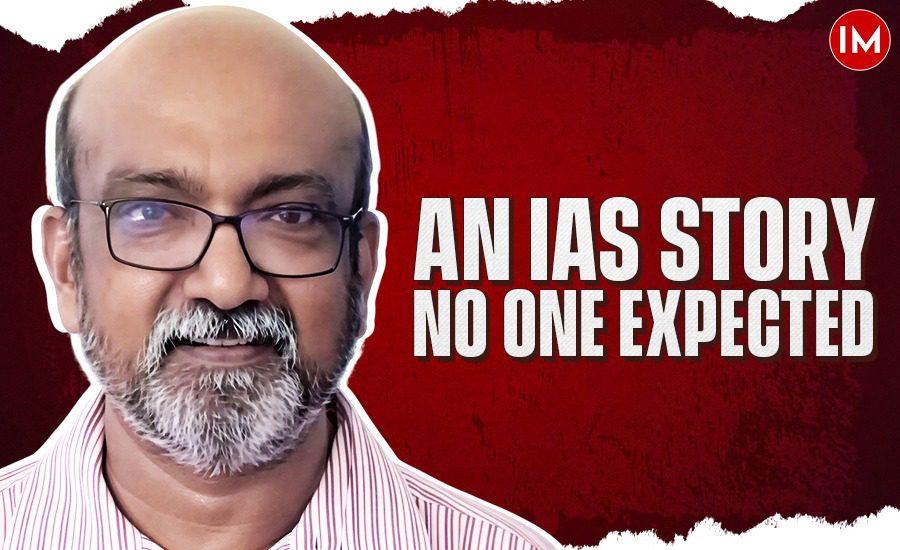
Some lives are not sculpted in classrooms of excellence or shaped by early applause. They are worn smooth by pressure, chipped by failure, and slowly refined by time. The life of IAS officer Aliasgar Pasha belongs to that quieter, harder category, one where growth came not from comfort, but from constant friction with circumstance.
A CHILDHOOD MARKED BY SCARCITY AND CARE
Born the youngest in a family of five children, Aliasgar Pasha grew up in a rented lane house in Palakkad during years when resources were stretched thin. His father was a professor at Victoria College, deeply immersed in research on flowers and organic products such as flower juices, elixirs, and extracts. Behind their modest home stood a shed that doubled as a laboratory and workplace.
As a boy, Aliasgar assisted his father whenever he could, passing on technical tips to his mother and contributing whatever small earnings he made to the household kitchen. Those few rupees often decided the quality of the day’s meals. Hardship was not abstract – it was physical and immediate. Once, while collecting firewood, he was bitten by a snake. Long hours spent bottle-sealing tested patience and stamina at an age when most children were shielded from such labour.
Yet, he remained deeply attached to his family, emotionally present and aware of shared struggle. Those early years quietly shaped his sense of responsibility.
THE PLAYGROUND ACROSS THE ROAD, AND THE BACKBENCH IN CLASS
Their house stood directly opposite the Victoria College playground. As the son of a professor, Aliasgar had access to nearly every sporting event held there. He absorbed sport not as recreation alone, but as discipline. He played basketball for the college team for three years and went on to represent Palakkad district in handball.
Academics, however, told a different story. He was an average student; by his own admission, “a master of none”. His SSLC score stood at 264 marks, a number that closed the doors of regular colleges. When government colleges introduced the shift system, effectively doubling seats, he found a narrow opening. Still, his place was often on the backbench, where he scraped through pre-degree and degree courses with third-class results.
ARABIC, FAILURE, AND A MOMENT THAT CHANGED EVERYTHING
One subject became a recurring wall: Arabic. His father, an Arabic professor with a vast personal library, insisted that Aliasgar take it as his second language. Starting from alphabets, the struggle was intense and emotionally charged. Expectations remained high; results did not follow.
In the pre-degree examination, he failed only one subject, Arabic, scoring just five marks. That failure hit hard. Years later, he would call it his turning point. Seeking help, he approached a dedicated lower primary school teacher. Under patient guidance, he cleared the paper.
Even then, his father insisted on Arabic for his BA. Aliasgar complied, graduating once again with a third class, effectively shut out from MA admissions in regular colleges across Kerala.
REJECTION, RESOLVE, AND AN UNEXPECTED FIRST RANK
After being turned away by nearly a dozen colleges, Aliasgar registered as a private candidate at the University of Calicut. His elder brother was studying there as a regular student and had secured the university’s second rank. Using the same notes, Aliasgar studied with a discipline he had never applied before.
The result stunned many, including himself. He secured first class and first rank in MA History!
Seeing his parents’ names printed alongside his photograph in newspapers marked a defining emotional shift. Years of manual work, academic struggle, and quiet persistence had finally converged. “That was the moment I understood that effort, when sustained, does return something,” he shared with Indian Masterminds.
FROM DEFENCE SERVICES TO A WIDER HORIZON
Buoyed by this success, Aliasgar cleared the Combined Defence Services Examination. He joined, then chose to resign, seeking a wider canvas. What followed was a remarkable run: selection in nearly two dozen competitive examinations, including admission to the integrated M.Phil–PhD programme at Jawaharlal Nehru University.
Alongside academics, friendships shaped his worldview. His bond with Anantha Krishna Viswanatha Iyer, a former merchant navy engineer, and interactions with foreigners during college years deepened his interest in nature and environmental balance. Tree planting became instinctive: fruit-bearing plants near home, saplings in college compounds, and care without expectation.
WORK, LOSS, AND A SON’S LAST GIFT
Throughout his higher education, Aliasgar worked in parallel colleges – Arts Academy, run by renowned writer Vaikom Chandrasekharan Nair (Vaishakan), and Mercy College at Vadakara, managed by philanthropist Balettan. These stints supported him financially and intellectually.
One memory stands above all others: handing ₹500 to his father just days before his death. For a man who had once failed Arabic with five marks, that gesture carried more weight than any certificate.
AN OFFICER WHO NEVER STOPPED SWITCHING OFF LIGHTS
As an IAS officer, Aliasgar Pasha carried his lived experiences into governance. He treated petitioners not as files, but as reflections of his own past. “I always saw myself as one among them,” he has said. Compassion, for him, was not policy; it was instinct.
Small acts mattered. He routinely switched off unused lights, fans, and computers in offices. Even within the Secretariat, these habits caught on, quietly influencing colleagues and staff.
JALANIDHI, OISCA, AND A LIFE ROOTED IN THE EARTH
His association with the World Bank–aided Jalanidhi project brought him closer to OISCA International, an organisation working on sustainable and eco-friendly initiatives. Familiarity grew into commitment. He went on to become president of the OISCA Wayanad Chapter and later the Kerala State Chapter.
Through OISCA, he represented India in Japan, Taiwan, and at a United Nations meeting in Paris. Japanese punctuality and work culture left a lasting impression.
Back home, his environmental work took tangible form. Thousands of trees, such as sandalwood, mahogany (Swietenia), and African bamboo, were planted and protected in and around the Wayanad Collectorate and beyond. Survival, not symbolism, was the goal.
A LIFE SHAPED BY PRESSURE, NOT PRIVILEGE
Aliasgar Pasha carries no bitterness about his past, only gratitude. His journey from a struggling student denied college admission to a socially committed administrator was not scripted. It evolved.
“Life doesn’t shape you through ease,” he once observed, “it shapes you through what you are forced to push against.”
In serving people and nurturing the environment, Aliasgar Pasha did not merely find a career. He found alignment between memory and responsibility, between where he began and what he chose to protect.