“Many concentric circles ripple out when a stone is flung into the quiet and still waters of a lake bordered by fig and olive trees and the star-shaped night-blooming jasmine. Don’t they?… Wait a minute, there’s no need to go all poetic…No, I won’t digress or my story will become incoherent. Besides, most of you intelligent people accept that there are many crests and troughs in life which is like a forked road, awash with tragedy or comedy or a little of both…”
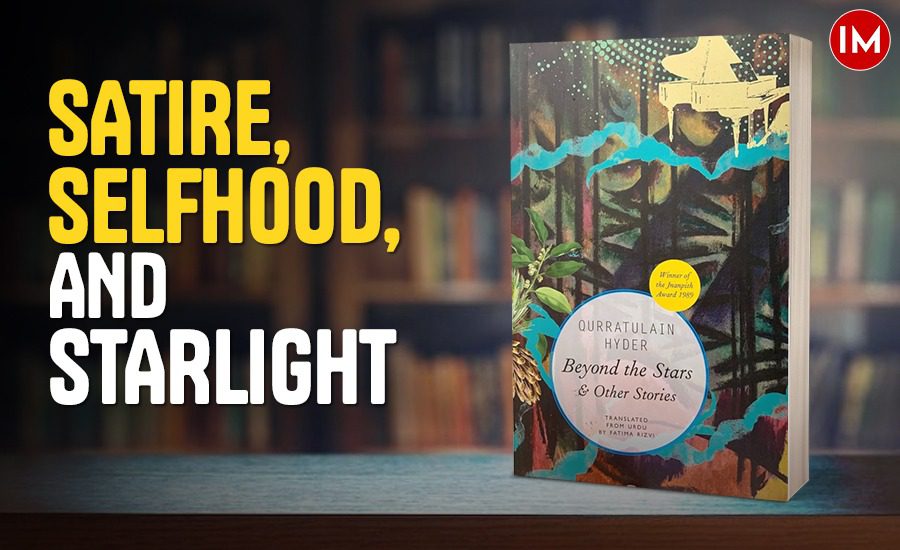
This is from ‘Star Crossed’, one of fourteen stories in a collection titled Sitaaron Se Aage by Qurratulain Hyder (1927-2007), translated from the Urdu by Fatima Rizvi. Hyder is a very difficult author to translate—her stories do digress often and deliberately, experimenting with interior monologue and narrative streams of consciousness alongside song lyrics and the onomatopoeic “tap-tap-tap” of raindrops or “splish-splash-splish” of a boat’s oars in a river. Her writing is always complex, sometimes convoluted, and never lacking in coherence, although it demands attention from readers whom she presumes intelligent enough to follow the labyrinths of her mind and characters traversing a milieu which is simultaneously cosmopolitan and culturally rooted.
Hyder’s family and friends were part of an elite ecosystem who benefited from their privileged location and language – skating in Mussoorie and very correct English – but this world too was worthy of being documented in observation so sharp that it frequently cuts as satire. “The Progressives accused me of glorifying the bourgeoisie and the feudal classes,” wrote Hyder once. “It was hard to explain that mine was a tongue-in-cheek ‘Studies in a Dying Culture,’ that all those who belonged to those classes were not ogres.” There was indeed a great deal of criticism from the literary world against her writing. One strand was from Ismat Chughtai in a scathing essay titled “Pom-Pom Darling”; Hyder is said to have referred to her later as “Lady Changez Khan” in turn. Both women transformed the landscape of Urdu literature with their honesty—although the experiences they had and thus portrayed were quite different.
Modernist poetry and popular ghazal blend on the same page in Hyder’s stories about girls who “express their opinions regarding China’s communist policies and military ambitions, and deliver long and insightful speeches about Indonesia’s freedom, with the same grace they display while dancing Manipuri, kathak or the rumba… we have a knack for adorning our hair because ours is a country of flowers, fragrances and melody—understand?”. This is one of the stories (‘An Evening in Avadh’) in which “Miss Hyder” is herself a character, and this line may be attributed to her although it is quick-fire dialogue without specific character names for each sentence. The recurring “I” of her stories is an obvious extension of her as author and individual. In ‘Stray Thoughts’, she writes: “The other day Razia said to me that I had lost my mental balance because I spend too much time reading. She also remarked that our country didn’t need romance, it needed food. She was right. Yes! India is a country of clerks and labourers. But what can I do about this all by myself?”
Ironic and self-aware about contradiction, she muses in ‘Mona Lisa’: “It’s important to remind yourself of your self-worth. Perhaps I dwelt snugly in ivory palaces in cloud-cuckoo-land, so I could never appreciate anything or anybody else. Life mocks me and I mock life, then life mocks itself.” This could be seen as fashionable cynicism or ennui-fatalism, but is layered within the paradoxical realities of her time: facing the changes wrought by the second World War and a fight for Independence increasingly split between two faiths. Australian and American soldiers people her stories alongside British officers and friends from around the world who dance away evenings to escape the melancholy of their world changing for the worse.
“So, this is how we are—we, the people! Have you taken note of this? It’s better if you haven’t! Meet me—I, who am proud of my accomplishments. I studied a little French at my convent school as a child. I remember nothing, but employ a few French words now and then… I have other brilliant attributes—I’m an excellent conversationalist. And in the days I enjoyed playing lawn tennis I could have easily beaten Sumant Misra. Now, I’ve started writing short stories and in every story, I find it essential to mention a Studebaker or a Packard.”
When “Ainie” is a full-fledged character in ‘The Caravan Rested Here’, she writes: “It occurred to me, while putting the final touches to one of my paintings—the new moon of life, above and beyond the limitations of laughter, tears and dreams, doesn’t rise from a rosiness that spreads across the sky during the rising or setting of the sun. We fall asleep, tired of waiting for it, and then night falls. With it comes the silence of the night and then death—the death of ardour. Despite this, we believe that life is fascinating and worth living. These little things—Rupert Brook’s poems; Maharashtrian style classical music; waltz tunes; James Mason’s films; these useless, fleeting things, the folly of being alive.” And later in this same autobiographical story: “One evening, at tea time, I announced merrily that my short stories were going to be published. Nobody believed me. One of Bhaijan’s friends remarked with utter seriousness, ‘Make sure you publish a detailed explanation along with them so people can understand what you’ve written!’”
A character in ‘The Gomti Flows On’ laughs at Ainie Aapa for always having fantastically lovely protagonists and English songs set against descriptions of the moonbeams, to which she responds:
‘Keep strutting! I am a writer. I will, as the saying goes, I will write in the middle of the fields if I have to, and I have also come up with a suitable title: “On the Quiet”.’
‘It’s quite nice—though if you’re looking for something more sophisticated, in a manner betokening the Progressives, then here’s one: “And the Road Was Built”, “And the Train Moved On”, “And the Gomti Flows On”, “And the Rain Fell”, “And the Flute Played On”…’
The title of this short story collection is from Iqbal: “Sitaaron se aage jahaan aur bhi hain, abhi ishq ke imtehaan aur bhi hain; Tahi zindagi se nahin ye fazaayein; Yahaan saikron kaarvan aur bhi hain.There are other worlds beyond the stars, yet other trials of love. These spheres are not devoid of life, for there are several other caravans in them.” (Shafique, Iqbal: An Illustrated Biography) Much of Hyder’s fiction was later ‘transcreated’ by her personally into English, sometimes radically departing from the originals. This particular collection, written when she was still in her late teens, was never revisited. Her later writing became even more ambitious and capable. Ship of Sorrows (also published by Women Unlimited in an excellent translation by the late great Saleem Kidwai) draws its title from Faiz’s “Subah-e-Azaadi” written on the eve of an Independence which fractured the South Asian subcontinent — “Ye daagh daagh ujaala, ye shab-gaazida seher; Voh intezaar tha jiska, ye woh seher toh nahin… Falak ke dasht mein taaron ki aakhri manzil; Kahin toh hoga shab-e-sust mauj ka saahil; Kahin toh ja ke rukega safina e gham-e-dil. This stained light, this night-bitten dawn; This is not that long-awaited day break… In heaven’s wide void, the stars’ final resting place; Somewhere the shore of night’s slow-washing tide; Somewhere, an anchor for the ship of heartache.” (Hashmi, Love and Revolution: Faiz Ahmad Faiz).
“‘Do these faint stars actually shine upon the quiet pathways of our destiny?’” asks one of the characters from ‘An Alchemist in the Heavens.’ The circle of young friends – some radical revolutionaries, some sleepy socialists, some dashing deewanas – have different perspectives which the story validates differently in its conclusion. We know the sweep of their lives and loves. We can imagine the same for their author and all those she has touched—immortal in her writing, in concentric circles which still make waves.