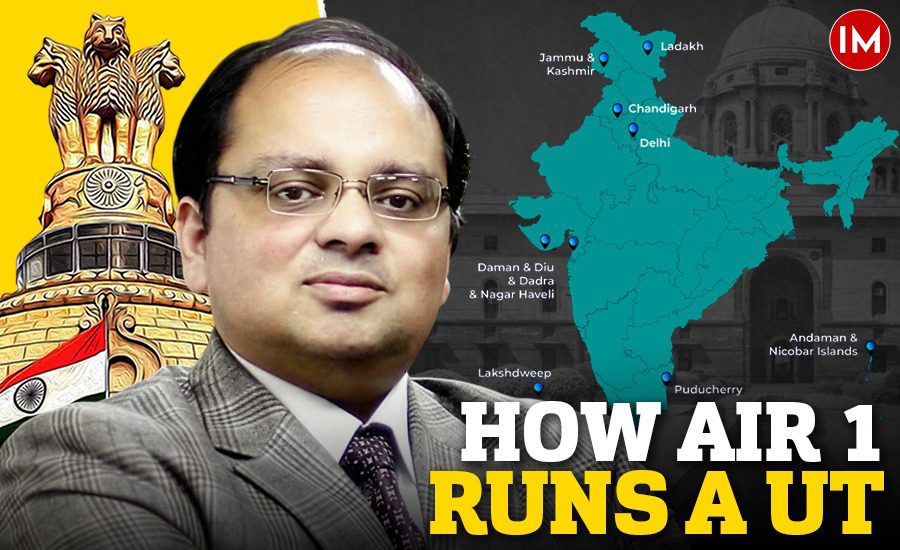
In a quiet, academically charged household in Patiala, ambition arrived early. Ankur Garg grew up watching medicine practised with precision—his father a plastic surgeon, his mother a paediatrician—absorbing discipline as daily routine. The idea of public service took shape when he was still in primary school, not as a distant aspiration but as a goal he began planning for, step by careful step.
IIT CLASSROOMS, A WIDER HORIZON
That focus carried him to the Indian Institute of Technology Delhi, where he earned a B.Tech in Electrical Engineering. Engineering sharpened his logic; campus debates broadened his view of policy and people. While peers chased corporate ladders, Garg kept one eye on the Constitution, the other on the country.
A NATIONAL MOMENT AT TWENTY-TWO
The UPSC Civil Services Examination of 2002 turned a private plan into a national headline. On his first attempt, Garg secured All India Rank 1, one of the youngest ever to do so, and joined the IAS in 2003, allotted to the demanding AGMUT cadre. The posting map was wide, the learning curve steep, and the exposure unmatched.
LEARNING THE STATE FROM THE STREET UP
Early roles took him into municipal administration and core economic departments. As a Deputy Commissioner in Delhi, he grappled with the daily mechanics of a megacity. In power and taxation, he learned how policy meets pressure—how numbers affect neighborhoods, how decisions ripple across markets. The work built a habit he would keep: combining field sense with data.
A SCHOLAR’S RETURN TO POLICY
Mid-career, Garg stepped back into classrooms—this time at Harvard University—to study international development policy. The experience refined his thinking about growth, public finance, and institutional design. He returned to service with global frameworks but local priorities firmly in mind.
FAMILY, BALANCE, AND A PRIVATE CENTER
Married to Swati Sharma and a father of two sons, Garg keeps his personal life deliberately grounded. Colleagues describe a routine that makes room for family even amid heavy portfolios—an anchor that steadies the pace of public office.
HOW A UNION TERRITORY IS RUN AND WHERE GARG FITS
Union Territories function differently from states. They are administered by the President of India through an Administrator or Lieutenant Governor. Policy direction comes from the Centre, while day-to-day governance rests with senior officers who hold multiple, cross-cutting portfolios. Coordination is constant; accountability is direct.
As Advisor to the Administrator of Dadra and Nagar Haveli and Daman and Diu, Garg operates at that nerve centre. His charge spans Home (including police and prisons), Vigilance, Parliamentary Affairs, and key institutional roles such as Managing Director of the UT’s development corporation and Chair of the Staff Selection Board. The work blends law and order with recruitment and oversight with development—often in the same day.
STYLE IN OFFICE
Those who work with him note a preference for clear dashboards, tight reviews, and decisions grounded in evidence. Languages come easily—Hindi, English, Punjabi, Bengali, French—useful in a cadre that moves across cultures. Public communication is measured; the emphasis is on systems that outlast postings.
THE ARC CONTINUES
From Patiala to IIT, from topping UPSC to shaping a Union Territory’s administration, Ankur Garg’s story is not a sprint but a long, deliberate arc. It is a career built on early clarity, constant learning, and the belief that governance works best when ideas meet execution—quietly, persistently, and in full public view.