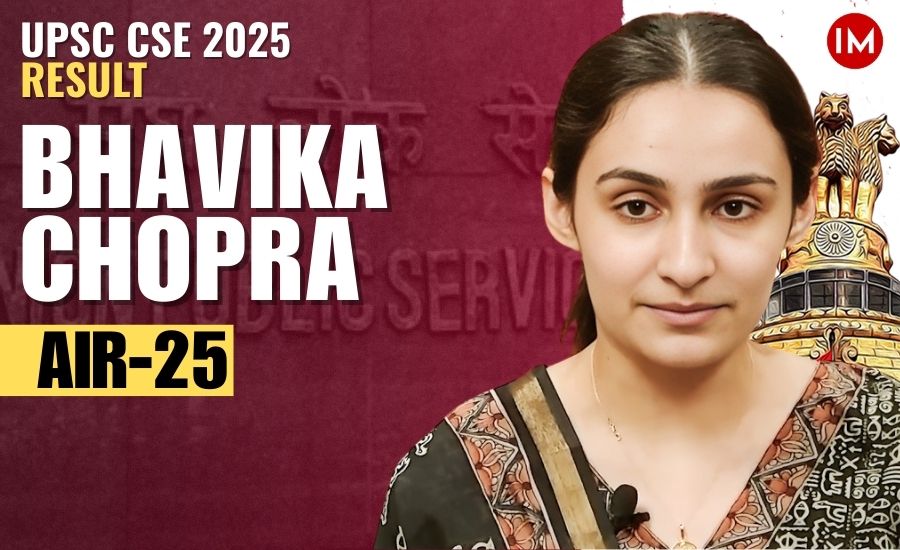
On the day the UPSC Civil Services Examination 2025 results were declared, Bhavika Chopra’s phone did not stop ringing. Messages poured in from friends, relatives, teachers, and well-wishers, each celebrating her remarkable achievement—All India Rank 25. But behind the congratulatory flood lies a story shaped not just by ambition, but by reflection, intellectual curiosity, and a deeply personal turning point.
For Bhavika, the journey to the civil services was not a straight path defined early in life. It was, instead, a gradual shift—one that began with ideas and eventually transformed into a sense of purpose.
THE POWER OF IDEAS
Bhavika credits an important part of her inspiration to the works of Nobel laureates Abhijit Banerjee and Esther Duflo. Introduced to their books during her academic years, she found herself drawn to Poor Economics and Good Economics for Hard Times—works that go beyond abstract theory and explore how economic policies impact real lives.
These books did more than just add to her reading list. They reshaped how she saw governance and public service. The gap between theory and implementation became increasingly visible to her, and with it came a question: what if she could be part of the system that bridges that gap?
For Bhavika, civil services offered that possibility—the chance to translate ideas into action, to move from understanding problems to addressing them on the ground.
ACADEMIC FOUNDATIONS AND EARLY CAREER
Bhavika’s academic journey reflects a consistent engagement with learning. A graduate in economics from St Stephen’s College, she built a strong conceptual foundation that would later shape her approach to the UPSC syllabus.
Before stepping into full-time preparation, she also experienced the corporate world during her stint at Ernst & Young. While the job provided exposure and stability, it also prompted introspection. The routine of corporate life did not align with the kind of impact she wanted to create. Over time, the pull towards public service grew stronger.
A PERSONAL TURNING POINT
The decision to prepare for UPSC was not driven solely by academic curiosity or career ambition. It was influenced by a deeply personal experience—the loss of a loved one during the COVID-19 pandemic.
That period forced Bhavika to confront a difficult reality: the limits of individual control in times of crisis and the importance of systems that function effectively. She recalls feeling a sense of helplessness, questioning whether she could do more beyond her immediate role.
It was this moment that became the starting point of her UPSC journey. What began as a response to personal loss gradually evolved into a sustained commitment to public service.
THE LONG ROAD TO RANK 25
Bhavika’s preparation journey spanned nearly four years, with focused efforts beginning in early 2022. Like many aspirants, she navigated uncertainty, self-doubt, and the demanding nature of the examination.
Interestingly, her approach leaned heavily towards self-study. Rather than relying entirely on coaching institutions, she structured her own preparation strategy. However, she made a conscious exception for test series. For her, they served as an essential benchmarking tool—offering a sense of where she stood among thousands of aspirants.
This balanced approach—independent study combined with external evaluation—helped her refine both her knowledge and exam temperament.
THE ROLE OF SUPPORT SYSTEMS
No long journey is undertaken alone, and Bhavika’s story underscores the importance of a strong support system.
Her parents stood by her decision to leave a stable job and pursue a highly uncertain path. Their belief in her choices created a sense of security that allowed her to focus entirely on preparation.
Equally significant was the role of her mentor. Bhavika speaks of her mentor not just as a guide but as someone who witnessed every phase of her journey—the highs of progress and the lows of setbacks. This consistent guidance helped her stay grounded and motivated.
Friends and family, too, played their part—offering encouragement, distraction when needed, and emotional balance during intense phases of preparation.
A READER SINCE CHILDHOOD
Bhavika’s comfort with books did not begin during UPSC preparation. It traces back to her childhood, shaped largely by her mother’s influence. Growing up in an environment that encouraged reading, she developed a habit that would later become one of her greatest strengths.
Reading, for her, is not just a tool for exams—it is a way of understanding the world. This habit also helped her engage deeply with subjects, rather than approaching them mechanically.
LIFE BEYOND THE BOOKS
Despite the demanding nature of UPSC preparation, Bhavika ensured that she remained connected to her interests outside academics. Running and reading continued to be part of her routine, providing both physical and mental balance.
She also speaks fondly of fencing, a sport she pursued until college and hopes to return to. These pursuits reflect an important aspect of her journey—maintaining a sense of identity beyond the examination.
MESSAGE FOR ASPIRANTS
Bhavika’s advice to future aspirants moves away from rigid formulas and fixed strategies. Instead, she emphasises mindset.
She believes that the UPSC journey should be approached as a process of learning rather than mere result-chasing. An open mind, curiosity, and the willingness to adapt are, in her view, far more valuable than sticking to a single “perfect” plan.
At the same time, she cautions against unhealthy comparisons. The examination sees lakhs of candidates every year, many of whom are equally capable. Success or failure in a single attempt does not define one’s worth or potential.
Her perspective brings a refreshing honesty to the conversation around UPSC—acknowledging both the scale of competition and the individuality of each journey.
How Abhijit Banerjee & Esther Duflo Inspired Bhavika Chopra to Crack UPSC 2025
On the day the UPSC Civil Services Examination 2025 results were declared, Bhavika Chopra’s phone did not stop ringing. Messages poured in from friends, relatives, teachers, and well-wishers, each celebrating her remarkable achievement—All India Rank 25. But behind the congratulatory flood lies a story shaped not just by ambition but also by reflection, intellectual curiosity, and a deeply personal turning point.
For Bhavika, the journey to the civil services was not a straight path defined early in life. It was, instead, a gradual shift—one that began with ideas and eventually transformed into a sense of purpose.
THE POWER OF IDEAS
Bhavika credits an important part of her inspiration to the works of Nobel laureates Abhijit Banerjee and Esther Duflo. Introduced to their books during her academic years, she found herself drawn to Poor Economics and Good Economics for Hard Times—works that go beyond abstract theory and explore how economic policies impact real lives.
These books did more than just add to her reading list. They reshaped how she saw governance and public service. The gap between theory and implementation became increasingly visible to her, and with it came a question: what if she could be part of the system that bridges that gap?
For Bhavika, civil services offered that possibility—the chance to translate ideas into action, to move from understanding problems to addressing them on the ground.
ACADEMIC FOUNDATIONS AND EARLY CAREER
Bhavika’s academic journey reflects a consistent engagement with learning. A graduate in economics from St Stephen’s College, she built a strong conceptual foundation that would later shape her approach to the UPSC syllabus.
Before stepping into full-time preparation, she also experienced the corporate world during her stint at Ernst & Young. While the job provided exposure and stability, it also prompted introspection. The routine of corporate life did not align with the kind of impact she wanted to create. Over time, the pull towards public service grew stronger.
A PERSONAL TURNING POINT
The decision to prepare for UPSC was not driven solely by academic curiosity or career ambition. It was influenced by a deeply personal experience—the loss of a loved one during the COVID-19 pandemic.
That period forced Bhavika to confront a difficult reality: the limits of individual control in times of crisis and the importance of systems that function effectively. She recalls feeling a sense of helplessness, questioning whether she could do more beyond her immediate role.
It was this moment that became the starting point of her UPSC journey. What began as a response to personal loss gradually evolved into a sustained commitment to public service.
THE LONG ROAD TO RANK 25
Bhavika’s preparation journey spanned nearly four years, with focused efforts beginning in early 2022. Like many aspirants, she navigated uncertainty, self-doubt, and the demanding nature of the examination.
Interestingly, her approach leaned heavily towards self-study. Rather than relying entirely on coaching institutions, she structured her own preparation strategy. However, she made a conscious exception for test series. For her, they served as an essential benchmarking tool—offering a sense of where she stood among thousands of aspirants.
This balanced approach—independent study combined with external evaluation—helped her refine both her knowledge and exam temperament.
THE ROLE OF SUPPORT SYSTEMS
No long journey is undertaken alone, and Bhavika’s story underscores the importance of a strong support system.
Her parents stood by her decision to leave a stable job and pursue a highly uncertain path. Their belief in her choices created a sense of security that allowed her to focus entirely on preparation.
Equally significant was the role of her mentor. Bhavika speaks of her mentor not just as a guide but as someone who witnessed every phase of her journey—the highs of progress and the lows of setbacks. This consistent guidance helped her stay grounded and motivated.
Friends and family, too, played their part—offering encouragement, distraction when needed, and emotional balance during intense phases of preparation.
A READER SINCE CHILDHOOD
Bhavika’s comfort with books did not begin during UPSC preparation. It traces back to her childhood, shaped largely by her mother’s influence. Growing up in an environment that encouraged reading, she developed a habit that would later become one of her greatest strengths.
Reading, for her, is not just a tool for exams—it is a way of understanding the world. This habit also helped her engage deeply with subjects, rather than approaching them mechanically.
LIFE BEYOND THE BOOKS
Despite the demanding nature of UPSC preparation, Bhavika ensured that she remained connected to her interests outside academics. Running and reading continued to be part of her routine, providing both physical and mental balance.
She also speaks fondly of fencing, a sport she pursued until college and hopes to return to. These pursuits reflect an important aspect of her journey—maintaining a sense of identity beyond the examination.
MESSAGE FOR ASPIRANTS
Bhavika’s advice to future aspirants moves away from rigid formulas and fixed strategies. Instead, she emphasises mindset.
She believes that the UPSC journey should be approached as a process of learning rather than mere result-chasing. An open mind, curiosity, and the willingness to adapt are, in her view, far more valuable than sticking to a single “perfect” plan.
At the same time, she cautions against unhealthy comparisons. The examination sees lakhs of candidates every year, many of whom are equally capable. Success or failure in a single attempt does not define one’s worth or potential.
Her perspective brings a refreshing honesty to the conversation around UPSC—acknowledging both the scale of competition and the individuality of each journey.