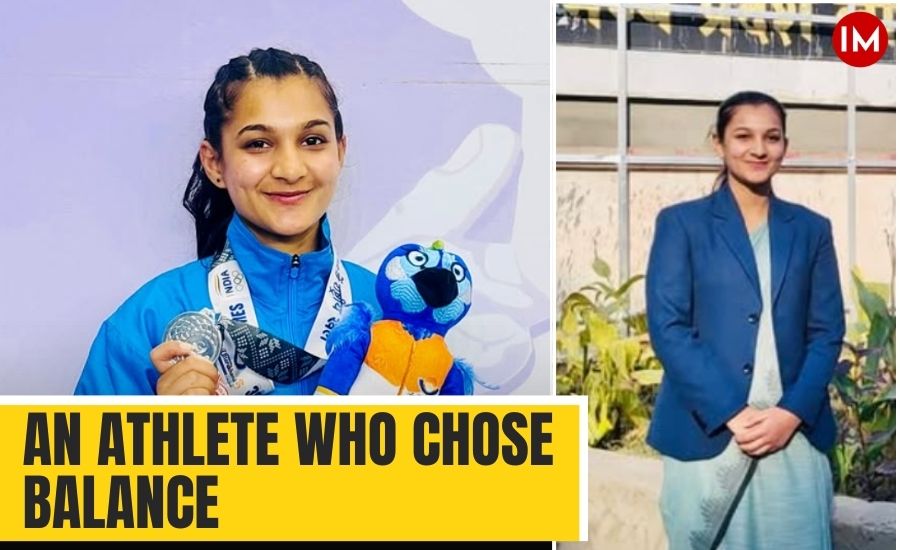
At a time when athletes are often asked to make a clear choice between sport and stability, Bhooraksha Dubey chose uncertainty. From a district with limited sports infrastructure, she trained in a discipline most people around her barely recognised.
She competed internationally without always knowing whether the next tournament would be financially possible, pursued higher education alongside physically demanding training schedules, and later prepared for a state service examination while recovering from a ligament injury. There was no straight roadmap in her journey—only a steady decision to continue, even when outcomes remained unclear.
Bhooraksha was born and raised in Ashok Nagar, a small district in Madhya Pradesh. Her father is a doctor, her mother a homemaker, and she grew up with two sisters in a family that valued education and discipline.
Like most children in similar settings, her early years were structured around school rather than sport. Academics came naturally to her, and there was no initial plan to pursue athletics professionally.
ENTERING A SPORT WITHOUT A PLAN
Wushu entered Bhooraksha’s life in 2009, not as a career decision but as a logistical one. Her younger sister enrolled in a summer sports camp organised by the government, and their parents decided to send Bhooraksha along as well. At that time, sports training in Ashok Nagar was basic—multiple disciplines taught together, limited equipment, and no clear competitive structure.
“I didn’t join because I wanted to become an athlete,” Bhooraksha said in an exclusive conversation with Indian Masterminds. “It was just something I was doing alongside school.”
In the beginning, she was not emotionally invested in the sport. But consistent participation led to steady improvement, and opportunities slowly followed. By 2011, she represented India internationally for the first time—an unexpected turn for someone who had once viewed sports as an extracurricular activity.
FAMILY SUPPORT AMID SOCIAL DOUBT
While her parents stood firmly behind her choices, Bhooraksha recalls that support did not extend uniformly beyond her immediate family. Wushu was not a known sport in her district, and pursuing it seriously raised questions.
“There were doubts—not always directly, but you could sense them,” she says. “People wondered what kind of future this sport could offer.”
Her parents remained clear in their stance. They encouraged her to continue, assuring her that effort mattered more than social approval. That belief became the foundation on which she built the next phase of her career.
STRUCTURED TURNING AND NATIONAL RECOGNITION
In 2013, Bhooraksha was selected under the Sports Authority of India’s National Centre of Excellence scheme. From that point onward, SAI sponsored her training and competitions, providing a level of stability that many athletes in non-mainstream sports lack.
Wushu, a Chinese-origin martial art, has two components: Sanda (combat) and Taolu (performance). Bhooraksha specialises in the performance category, which involves executing technically demanding routines with weapons, jumps, and precise movements, all evaluated on difficulty and execution.
“People think martial arts are only about strength,” she explains. “But what I do requires control, balance, timing, and mental discipline.”
Her performances began earning recognition. She became the first international Wushu medalist from Ashok Nagar and the first from her district to receive the Eklavya Award in the junior category. In 2022, she was honoured with the Vikram Award—the highest sports honour in Madhya Pradesh for senior athletes—making her the only recipient from her district so far.
“When one person breaks through, others start believing they can try too,” she says.
That impact was visible. Today, around 100 young athletes train at the academy, many of whom were drawn to the sport after watching her progress.
EDUCATION AS A PARALLEL PRIORITY
Despite rising success in sport, Bhooraksha never treated education as secondary. She completed a bachelor’s degree in Commerce and later transitioned into physical education after recognising its relevance to athletic development. She pursued her graduation in Bhopal and completed her master’s degree from Lovely Professional University, Jalandhar, where she received a full scholarship.
“I always felt that sport and education should support each other,” she says. “One shouldn’t exist at the cost of the other.”
Her daily routine reflected this belief. Training sessions began early in the morning and often extended into the evening. Afternoon breaks—typically reserved for rest—were used for academic study. The schedule was physically taxing, but she maintained continuity in both areas.
INTERNATIONAL EXPOSURE AND FINANCIAL CONSTRAINTS
Internationally, Bhooraksha competed in the Asian Championships twice—finishing sixth in Shanghai and winning a bronze medal in Busan, South Korea. Several other international opportunities did not materialise due to financial limitations, as assistance from sports authorities is often selective.
“There were times when I had the qualification but not the resources,” she says. “That’s a reality many athletes deal with quietly.”
INJURY AND A TURNING POINT
In May 2024, Bhooraksha suffered a ligament injury that forced her to pause competitive training. The injury coincided with a critical phase in her life—she had already appeared for the MP Public Service Commission examination.
“That injury made me think beyond immediate competition,” she reflects. “I realised I needed a role where I could contribute to sports even when my physical limits change.”
Already employed under the Madhya Pradesh government due to her Vikram Award, she aimed for a position with greater scope. Clearing the MPPSC in her first attempt, she was recently selected as a Sports Officer under the Higher Education Department.
“I didn’t want a role where I only followed instructions,” she says. “I wanted one where decisions could influence systems.”
VISION AS A SPORTS OFFICER
As a Sports Officer, Bhooraksha will work primarily with colleges and universities—spaces where many athletes struggle to balance training and academics.
“There are students who come only for sports and ignore education completely,” she explains. “And there are others who study but lose touch with the ground. Both approaches limit long-term growth.”
Her goal is to create awareness about balanced development, encouraging athletes to pursue physical education and academic learning alongside competitive sport.
LOOKING AHEAD
Currently undergoing rehabilitation, Bhooraksha plans to return to competition once medically cleared. Upcoming Asian and World Championships remain on her radar.
“I haven’t stepped away from being an athlete,” she says. “This role just adds another responsibility.”
For athletes and aspirants, her advice remains practical: “Manage your time honestly, respect your body, and don’t disconnect from learning. Stability doesn’t come from one achievement—it comes from balance.”
Bhooraksha Dubey’s story does not rely on dramatic turns or overnight success. It is shaped by years of showing up—at training grounds, in classrooms, and later in examination halls—without certainty, but with intent. In choosing uncertainty early on, she created options for the future, not just for herself, but for the many young athletes now watching her path more closely.