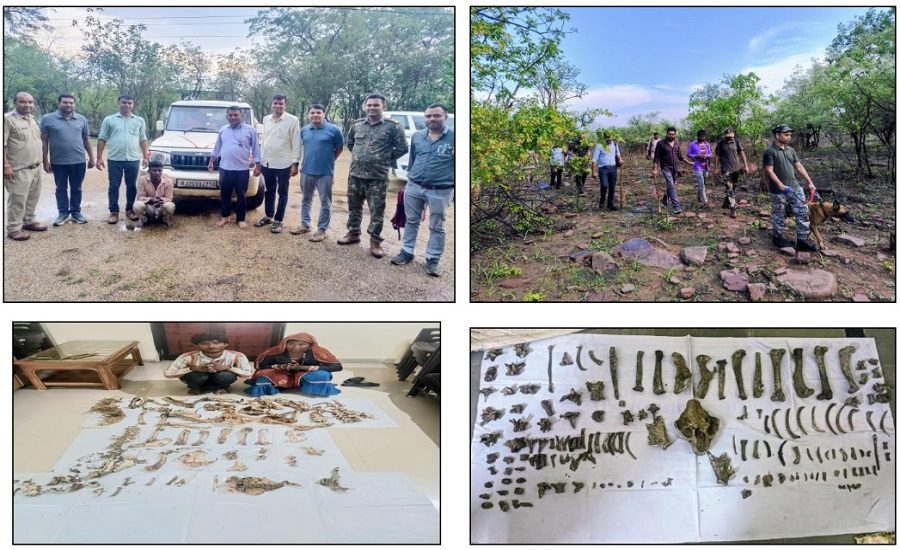
A significant breakthrough in wildlife crime has sent shockwaves through conservation circles. An inter-state poaching syndicate involved in the illegal hunting of tigers and other wildlife has been busted following a joint operation by the Madhya Pradesh State Tiger Strike Force (STSF), Rajasthan Forest Department, and Sawai Madhopur-based NGO. The operation, conducted on June 4–5, 2025, revealed a horrifying cache: 225 pieces of animal remains, including bones and skulls, many of which have been confirmed to belong to at least three tigers and one leopard.
The discovery points to a well-organized poaching network operating across state borders and possibly connected to international wildlife trafficking rings.
Indian Masterminds interacted with 2005-batch IFS officer K.R. Anoop, Field Director of Ranthambhore Tiger Reserve, and senior officials from the Madhya Pradesh State Tiger Strike Force to learn more about the incident and its broader implications.
COORDINATED ACTION: INTELLIGENCE-LED STRIKE
On instructions from the Principal Chief Conservator of Forests (Wildlife), Madhya Pradesh, the STSF built an intelligence network involving its regional units in Bhopal, Shivpuri, and Sheopur. These units acted swiftly to cordon off the Sawai Madhopur–Sheopur–Karail Road on June 4, arresting three individuals and seizing the wildlife remains.
Two forest crime cases were registered under the relevant wildlife protection laws.
Later, based on interrogation and forensic inputs, three more individuals connected to the gang were arrested, bringing the total number of accused to six.
ARRESTED ACCUSED AND THEIR BACKGROUNDS
Following the arrests, sustained interrogation and forensic-backed investigations led to the capture of three additional suspects. Altogether, six individuals have been arrested. These individuals are currently lodged in Central Jail, Shivpuri under judicial custody, with bail pleas rejected by the Hon’ble Sessions Court, Shivpuri. Several have prior criminal records and convictions for wildlife crimes.
SEIZURES: WILDLIFE PARTS, VEHICLES, AND GADGETS
The forest department seized 225 pieces of wildlife parts, primarily bones and skulls, Mahindra Bolero, three motorcycles, and four mobile phones, believed to have been used in the illegal trade.
These items are believed to have been used in the hunting, transportation, and coordination of illegal wildlife trade.
FORENSIC CONFIRMATION: TIGER KILLINGS VERIFIED
Preliminary forensic analysis conducted in Jabalpur confirmed that the bones belonged to at least three tigers and a panther. The samples have been forwarded to the National Centre for Biological Sciences (NCBS), Bengaluru, for DNA testing to determine the origin of the tigers.
The DNA results are expected in a few weeks and may provide crucial evidence on whether the poached tigers were among the five missing tigers from Ranthambore Tiger Reserve between June 2022 and May 2024 – specifically, tigers T79, T131, T138, T139, and T2401.
RANTHAMBORE IN THE CROSSHAIRS: TIGERS AT RISK
Given the proximity of Sheopur (30 km) to Ranthambore Tiger Reserve, authorities suspect the poachers targeted tigers from this area. In contrast, Madhav Tiger Reserve lies more than 100 km away and Panna Tiger Reserve over 300 km, making Ranthambore the most likely source.
Ranthambore Field Director Anoop K. R. confirmed in a report that several bones appear to be of tigers and that a joint investigation between MP and Rajasthan forest departments is underway to determine the origin of the remains.
INTERNATIONAL LINKS: HAWALA & DIGITAL PAYMENTS
The investigation points toward the possibility of an international poaching network with connections extending beyond Indian borders – potentially to Nepal and Myanmar.
The forest department also suspects that payments for poaching activities were facilitated through digital platforms and hawala networks, a fact currently under investigation by cybercrime and intelligence units.
WHAT’S NEXT: AWAITING DNA RESULTS AND DEEPER PROBES
While forensic analysis has already confirmed that at least three tigers and one leopard were killed, the DNA matching process at NCBS is expected to take a few weeks. The results will be critical to determine whether the missing Ranthambore tigers are indeed the ones killed.
A senior forest officer in Bhopal remarked, “Given the area and migratory patterns, the poached tigers were almost certainly from Ranthambore. Panna is over 300 km away, and Madhav Tiger Reserve has only five tigers.”
A HISTORY OF CRIME: LEGACY OF POACHING
One of the arrested poachers, Dauji Bhil belongs to the Mogiya tribal community, traditionally associated with poaching. He is reportedly linked to Devi Singh, a notorious poacher who admitted to killing five tigers in Ranthambore between 2002 and 2004. This disturbing legacy suggests a multi-generational involvement in tiger poaching from this region.
CONSERVATION IMPLICATIONS: A GRIM REMINDER
This incident is a stark reminder of the vulnerabilities in India’s wildlife protection framework. The loss of three tigers and a leopard underscores the urgent need for inter-state cooperation, advanced surveillance, and community engagement to combat poaching.
Wildlife conservationists warn that the incident could signal a resurgence of poaching activity in India’s premier tiger reserves if not addressed with firm and systemic action.
THE INVESTIGATION CONTINUES
As the DNA results from NCBS are awaited, forest authorities in both Madhya Pradesh and Rajasthan are intensifying efforts to track the full extent of the poaching network. The cooperation between tiger reserves, forensic labs, NGOs like Tiger Watch, and legal enforcement agencies is seen as a model for future wildlife crime investigations.
This case may well become a landmark in India’s fight against wildlife trafficking – if it leads to strong convictions and improved protective measures for its endangered tiger population.