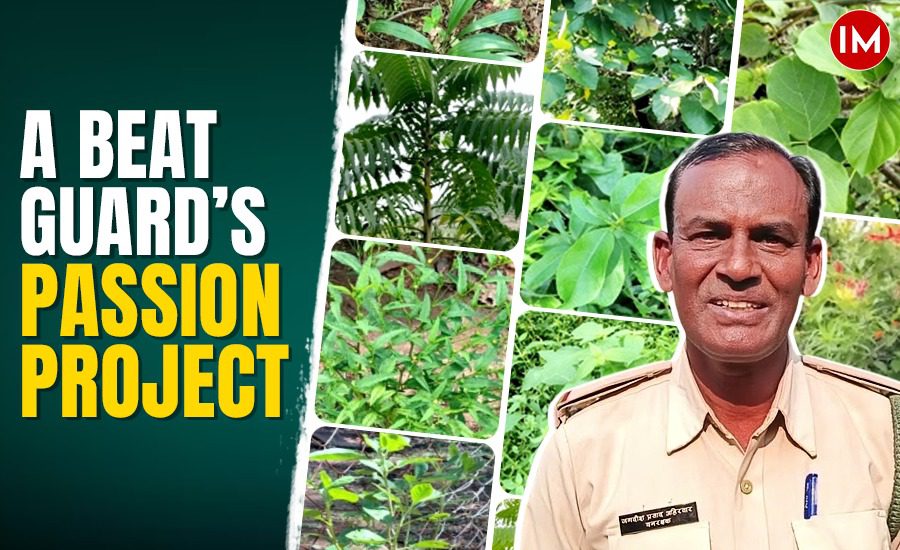
Every day, as most of the world rushes through routines, Jagdish Prasad Ahirwar walks into the forest—not just out of duty, but as a quiet pursuit of discovery. A forest beat guard from Madhya Pradesh’s Panna, Mr Ahirwar has spent nearly two decades protecting and observing the landscape around him. Over time, this daily engagement with nature transformed into something far more meaningful: a personal documentation of nearly 130 medicinal plant species found in the region.
What began as routine patrols gradually turned into a habit of noticing, recording, and understanding the richness of forest life. Armed with a mobile phone, occasional access to official cameras, and a deep curiosity, Mr Ahirwar started photographing plants and cataloguing their uses. Today, his work is not just a personal collection—it is a growing resource for researchers, students, and local communities.
“I have collected approximately 130 types of medicinal plants. The inspiration for this came from our respected DFO Sir, Anupam Sharma, who encouraged me to begin this work,” Mr Ahirwar said in an exclusive interview with Indian Masterminds.
Mr Ahirwar began focusing specifically on medicinal plants in 2025. What followed was a year of consistent effort—searching, identifying, and documenting species that often go overlooked despite their value.
FINDING JOY IN THE FOREST
Mr Ahirwar describes himself simply as a nature lover who finds joy in his work. His daily patrols are not limited to monitoring illegal activities or checking boundaries; they have become opportunities to observe changes in the ecosystem, discover rare species, and capture them through his lens.
“Taking photographs of rare species makes my day joyful,” he shares.
With 18 years of experience in the forest department, Mr Ahirwar has developed a strong familiarity with the flora of the Panna region. This long association has helped him identify most species without major difficulty. For verification and accuracy, he refers to departmental books and existing literature on medicinal plants.
“I did not face much challenge in identifying them. This work was enjoyable for me,” he explains.
MOMENTS THAT STAY WITH YOU
His work is not limited to plants alone. Mr Ahirwar has also documented wildlife encounters—some of which have left a lasting impression. One such moment occurred while he and his team were photographing a plantation area using a drone.
“Once we were using a drone camera to capture plantation images. A leopard hiding nearby started reacting to the drone. When we reached the gate, the leopard came to the same spot where we had flown the drone. We managed to capture it on camera. It was a memorable moment,” he recounts.
BEYOND PROTECTION
Mr Ahirwar is clear about the broader responsibilities of a forest guard. His role includes groundwater conservation work, plantation drives, and engaging with local communities to build awareness around forest protection. Through village committees and outreach efforts, he encourages people to see forests not just as resources but as shared responsibilities.
His efforts have begun to reach beyond the forest. Researchers, universities, schools, and local committees have taken note of his work. His compiled documentation of medicinal plants is being used as a reference, and many people now reach out to him for guidance.
“It has proved useful, especially for understanding important medicinal plants of South Panna,” he says.
Recognition for his work reached a national level when Prime Minister Narendra Modi mentioned Mr Ahirwar’s efforts in the 130th episode of Mann Ki Baat on January 25, 2026.
“I express my gratitude to the Honourable Prime Minister Narendra Modi Ji for mentioning my work in Mann Ki Baat. I am truly thankful. I also thank my DFO Sir Anupam Sharma Ji for guiding me and giving me this identity,” he says.
A MESSAGE FOR NEXT GENERATION
Despite the recognition, Mr Ahirwar remains focused on his work and its purpose. He believes that forests are central to life and that more people—especially young individuals—should contribute to their protection.
“I want to appeal to nature-loving youth to contribute to protecting forests and the environment. Without forests, life on earth is not possible,” he says.
He also highlights the importance of traditional knowledge systems, particularly the use of indigenous medicinal plants. According to him, documenting and promoting these resources can benefit both health and conservation efforts.
Jagdish Prasad Ahirwar’s journey shows how consistent effort, curiosity, and a sense of responsibility can turn everyday work into something that benefits a much wider community. His story is not about extraordinary tools, but about observation and intent.
In the forests of Panna, where every patrol could have remained routine, Jagdish Prasad Ahirwar chose to look closer—and in doing so, created something that continues to inform and inspire.