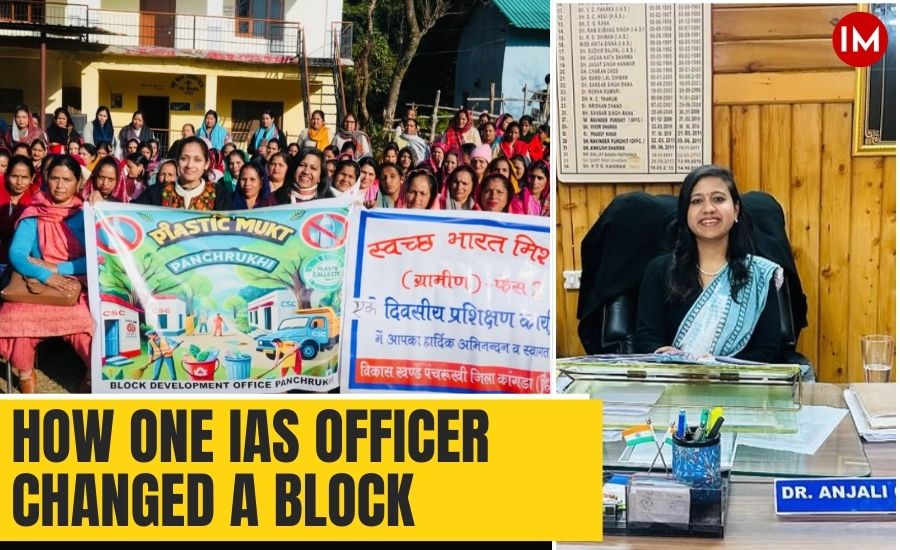
When Dr Anjali Garg (2023 batch, Himachal Pradesh cadre) took charge as Block Development Officer (BDO) of Panchrukhi in Himachal Pradesh, she stepped into a role that demanded more than administrative familiarity with rural development schemes. It required on-ground observation, difficult conversations, and a willingness to confront systemic gaps that had been normalised over time.
What followed was a 40-day effort that resulted in Panchrukhi becoming the first block in Himachal Pradesh to formally engage sanitation workers for Community Sanitary Complex (CSC) cleanliness and village sanitation, along with setting up a complete plastic waste management system.
IDENTIFYING THE FIRST GAP
During her initial field visits, Dr Garg noticed two connected problems that were affecting daily village life. Plastic waste was lying unmanaged across panchayats, and Community Sanitary Complexes—built under government schemes—were locked, uncleaned, and largely unusable.
“When I joined as BDO Panchrukhi, my field visits revealed that there was no proper mechanism for waste processing or disposal. This was the first major gap that needed immediate attention,” Dr Garg shared in a conversation with Indian Masterminds.
The absence of a waste management system had led to practices such as burning plastic in the open, posing serious health and environmental risks. At the same time, CSCs—intended to improve sanitation—were failing in purpose due to lack of ownership and maintenance.
UNDERSTANDING THE GROUND REALITY
Rather than rushing to implement a top-down solution, Dr Garg spent time understanding the issue from multiple perspectives.
“I spoke extensively with my staff, field teams, local residents, and even the media to understand the issues. These conversations gave me a comprehensive picture of the problem and its impact,” she says.
These interactions revealed that while infrastructure existed on paper, operational clarity and accountability were missing. Panchayats were unsure about fund utilisation, sanitation workers had no defined role, and villagers lacked awareness about waste segregation and its long-term consequences.
BUILDING A FULL-CIRCLE SYSTEM
The solution Dr Garg envisioned was not limited to cleaning existing waste. It involved creating a full-cycle system—from household-level segregation to block-level processing. The plan included land transfer for a Plastic Waste Management Unit (PWMU), mobilisation of funds, hiring sanitation workers, procurement of a collection vehicle, and sustained community involvement.
One of the earliest hurdles was land transfer, a process that often takes months. Dr Garg chose to personally monitor progress and ensured administrative coordination at every level.
“I monitored the process personally and appointed a nodal officer to give me daily updates. I also requested support from the SDM, District Revenue Officer, ADC, and DC sir, which helped expedite the land transfer,” she explains.
With land secured, the block administration moved swiftly to operationalise the PWMU at the block level.
CONVINCING STAKEHOLDERS AND MANAGING FUNDS
Another challenge lay in convincing elected representatives and panchayat secretaries to allocate funds from the 15th Finance Commission for sanitation services—something that had not been attempted in this manner before.
“Initially, there was apprehension among elected representatives. But after multiple meetings and open discussions, they began supporting the initiative wholeheartedly,” Dr Garg says.
Once confidence was built, panchayats agreed to manage sanitation-related expenses collectively. Sanitation workers were formally engaged, CSCs were unlocked and cleaned regularly, and segregated sheds for waste collection were established in each panchayat.
COMMUNITY PARTICIPATION AS THE BACKBONE
Beyond administrative decisions, the success of the initiative depended heavily on people’s participation. Mahila Mandals, local volunteers, and village residents were actively involved in awareness campaigns and monitoring cleanliness.
“Through regular meetings and dedicated workshops, we clarified doubts, built trust, and ensured that everyone felt included in the process,” Dr Garg notes.
Training sessions focused on waste segregation, the health risks of burning plastic, and the importance of maintaining shared sanitation spaces. This consistent engagement helped shift attitudes at the household level.
CHANGING DAILY PRACTICES IN VILLAGES
One of the most visible changes came in how villagers dealt with plastic waste.
“Earlier, people would burn plastic waste. After awareness activities, they understood the health hazards and shifted to collecting plastic at home and handing it over to Panchayat collection centres,” Dr Garg explains.
Collected plastic was then transported to the PWMU for processing, completing the waste management cycle.
OUTCOMES AND RESPONSE
Within 40 days, Panchrukhi block had a structured sanitation workforce, clean and functional CSCs, segregated waste sheds across panchayats, and a working Plastic Waste Management Unit.
“The community has been hopeful and appreciative. They can see the positive change in their surroundings and living conditions,” she says.
Villages reported cleaner public spaces, reduced open dumping, and improved use of sanitation facilities.
A MILESTONE IN EARLY SERVICE
For Dr Anjali Garg, this initiative held special significance. Panchrukhi was her first independent charge during IAS training, making the experience professionally and personally important.
The Panchrukhi experience highlights how administrative intent, when combined with consistent engagement and institutional coordination, can translate schemes into lived outcomes. It also underscores the role of young officers in redefining how rural governance addresses everyday challenges like sanitation and waste management.
As Panchrukhi’s model draws attention, it offers a practical reference for other blocks looking to strengthen sanitation systems—not through isolated interventions, but through integrated planning and community ownership.