Artificial Intelligence is emerging as a transformative force, redefining how nations grow, govern, and deliver services. For developing countries, it offers a rare chance to leapfrog traditional pathways and build smarter, more inclusive systems. With its multi-modal and multi-lingual capabilities, AI can expand access, scale public benefits, and unlock opportunities long denied to many, turning technology into a strategic driver of equitable growth.
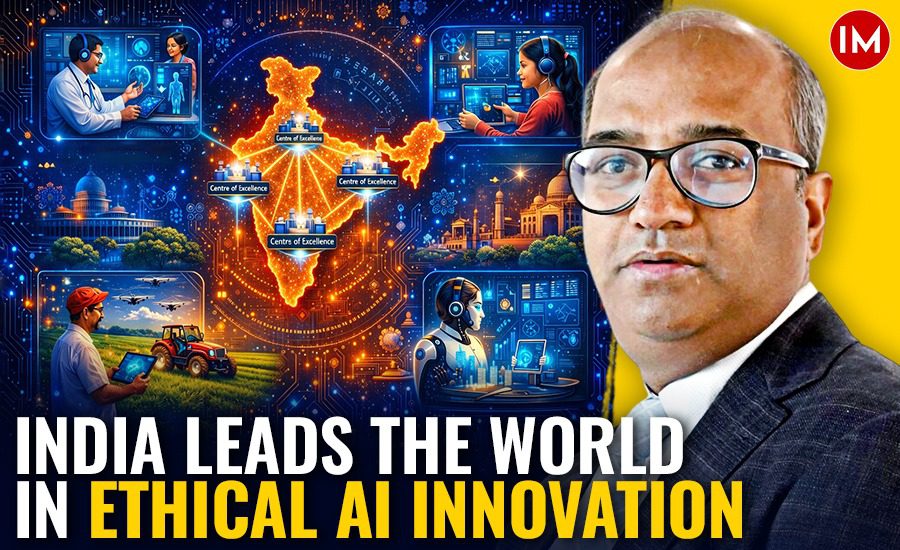
Our achievements speak for themselves: Over 30 AI applications across agriculture, healthcare, education, and governance. We’ve established four Centres of Excellence that have already enhanced telemedicine consultations and provided AI-recommended diagnoses to millions of citizens. India now leads globally in AI skills according to the Stanford AI Index 2024.
Imagine a farmer in a remote village calling a toll-free number and asking, “What should I do for my crop?” This is not imagination this is a reality today. AI-powered chatbots provide real-time advice on soil health, pest management, and crop optimization in local languages. Our drone-based precision farming has improved yields by 20–30% while reducing input costs by 15%.
Through platforms integrated with our education ecosystem, AI personalizes learning for every child. Whether it’s a student with learning disabilities or a brilliant mind in a remote village, AI ensures that quality education reaches everyone. Our AI-powered diagnostic tools can now detect autism early, giving every child the chance to reach their full potential.
Our AI-enhanced eSanjeevani platform has revolutionized telemedicine. Rural mothers can now access expert medical advice, and our AI systems predict extreme climate events that affect public health. We’re not just treating diseases; we’re preventing them through intelligent prediction and early intervention.
In the realm of scientific research, AI is proving to be a powerful ally. AI-driven drug discovery is revolutionizing medicine, with AI-designed drugs achieving 80–90% success rates in trials compared to traditional 40–65% rates. Development timelines are shrinking from decades to just 3–6 years, potentially saving millions of lives through faster access to life-saving treatments.
AI is helping us decode the mysteries of protein structures, predict molecular interactions, and identify new therapeutic targets. We are leveraging these capabilities to address diseases that disproportionately affect our population, ensuring that scientific breakthroughs serve our people first.
We have taken up the Gyan Bharatam project wherein our ancient manuscripts in languages like Pali, Prakrit, Brahmi are being digitised and being made accessible to all by enabling translation and transcription.
Our approach to AI must be grounded in the principles of fairness, transparency, accountability, privacy and Non-harm. We must ensure that AI development follows the path of Dharma, prioritizing the welfare of all beings over narrow commercial interests. This means building AI that is inclusive, accessible, and beneficial to the most vulnerable sections of our society.
As we look towards February 2026, when India will host the IndiaAI Impact Summit, we envision an AI ecosystem that truly embodies “Sarve Bhavantu Sukhinah” let all be happy. The Summit is around:
One Mantra
Our three Sutras are – People, Planet & Progress and we are working on seven themes – Human Capital, Inclusion for Social Empowerment, Safe and Trusted AI, Resilience, Innovation & Efficiency Science, Democratizing AI Resources, and AI for Economic Growth & Social Good.
The Summit will also focus on not just building technology; we will showcase to the world as to how India is building a future where: every farmer has access to AI-powered agricultural advice, every student receives personalized education, every patient gets timely, accurate medical care, every citizen can interact with government services in their native language and every researcher has access to powerful computing resources for breakthrough discoveries.
Our vision extends beyond India’s borders. Just as our ancient wisdom has enriched global thought, our AI innovations will serve humanity worldwide. We’re working toward establishing India as the “use case capital” of AI, demonstrating how technology can solve real-world problems at scale.
We are not just technologists or policymakers — we are trustees of humanity’s future. The AI we build today will shape generations to come. Let it be guided by the eternal principles of truth, compassion, and universal welfare.
The Rigveda teaches us: “Ekam sat vipra bahudha vadanti” Truth is one, but the wise call it by many names. Whether we call it artificial intelligence, machine learning, or digital transformation, the truth remains the same technology must serve life, enhance human dignity, and promote universal flourishing.
Let us ensure that our machines not only compute but also care, not only analyze but also empathize, not only optimize but also inspire. This is our dharmic duty, our sacred responsibility. May the AI we build today become a source of liberation from ignorance, poverty, and suffering. May our collective efforts create an AI-enabled world where every being can achieve their highest potential.
(This article is written by IAS Abhishek Singh, CEO of India’s AI Mission, Director General of National Informatics Centre (NIC) and Additional Secretary, MeitY. He is 1995-batch IAS of Nagaland cadre.)