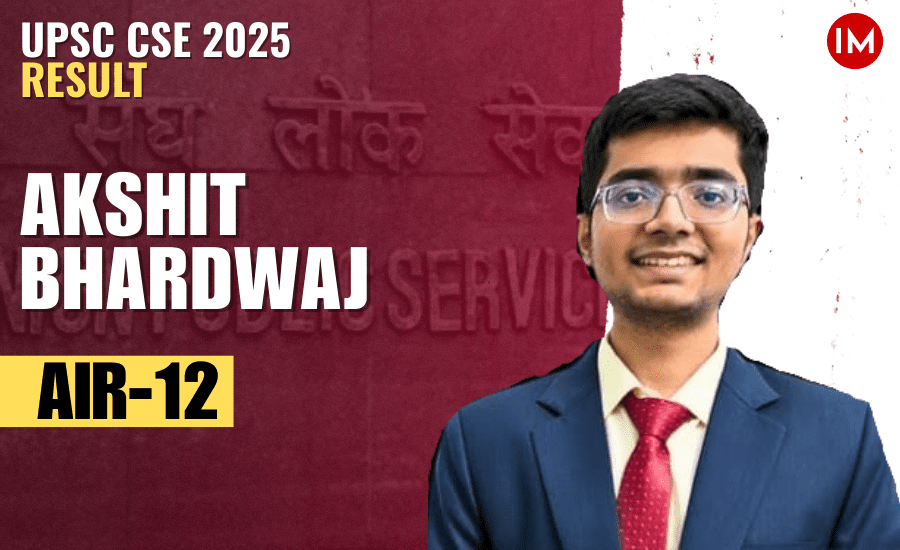
When the results of the Union Public Service Commission Civil Services Examination 2025 were declared, one name that quietly entered the top ranks was Akshit Bhardwaj, who secured All India Rank 12.
At just 23 years old, the Indian Institute of Technology Delhi graduate achieved what thousands of aspirants spend years pursuing. But the story behind the rank is not one of a straight path. It includes confusion, a failed prelims attempt, a major optional subject change, and months spent figuring out how the exam actually works.
“I’m still not able to process it,” Akshit admitted soon after the result, in an interview with the media. “It still feels kind of unbelievable.”
A YOUNG ASPIRANT WITH AN ACADEMIC EDGE
Born on 4 September 2002, Akshit Bhardwaj hails from Delhi and completed his B.Tech from IIT Delhi, one of India’s most competitive engineering institutions.
During college, like many high-performing students, he was exposed to several career possibilities. Yet he chose the path of public service and began preparing for the Civil Services Examination conducted by the UPSC.
His interests extended well beyond academics. Akshit enjoyed Pounce and Bounce quizzing, played Fischer Random Chess, and spent time reading non-fiction, hobbies that shaped his curiosity and analytical thinking.
But when he started preparing for the civil services, he quickly realized that the exam required a completely different mindset.
UNDERSTANDING THE EXAM THE HARD WAY
Akshit began preparing for the UPSC roughly two to two-and-a-half years before the result, during the final year of his engineering degree.
Initially, he joined a foundation course and later began studying independently. However, when he appeared for his first prelims in 2024, he did not qualify.
The experience was eye-opening. That moment became a turning point in his preparation. He soon realized that the first challenge in UPSC preparation is not reading books but figuring out what the exam really demands.
Once he began putting in full effort, his understanding of the exam gradually changed.
THE ROLE OF FRIENDS AND SHARED PREPARATION
Preparation for UPSC can often feel isolating. For Akshit, the presence of friends made a major difference. He and several of his close friends were preparing together, living nearby and studying alongside each other.
One of those friends, however, could not clear the exam that year — a reminder of the exam’s unpredictability. Akshit himself described the process as one shaped by many forces beyond preparation.
“This exam is very uncertain. It’s about luck, faith, what God wants, and the blessings you receive from teachers, friends, and family.”
A BOLD MOVE: CHANGING OPTIONAL SUBJECT
After the failed prelims in 2024, many aspirants would have paused or reconsidered their strategy. Akshit did something more radical: he changed his optional subject.
He switched to Mathematics and began studying it from scratch. For the next six months, he focused intensely on Mains preparation, covering General Studies paper-wise while simultaneously building his optional foundation.
It was an ambitious move because Mathematics is widely considered one of the toughest optional subjects in the UPSC examination. But Akshit leaned into its demands.
LEARNING THE ART OF ANSWER WRITING
Another major shift in his preparation was structured answer writing practice. Instead of relying on discipline at home — which he found difficult — he treated test series as his primary answer-writing practice.
Through this process, he wrote 15–20 tests for General Studies and a remarkable 30 tests for Mathematics. Since mathematics demands continuous problem solving, this volume of practice helped him maintain speed and accuracy.
WRITING BEFORE READING: A STRATEGIC SHIFT
One of the most useful lessons he learned during preparation was to think about the answer before reading the material. This approach helped him filter information. It also helped him tackle unexpected questions.
In UPSC Mains, several questions often appear from areas that aspirants have not directly prepared.
“In every paper there are always seven or eight questions that hardly relate to anything specific,” he noted. “You still have to structure an answer.”
THE FINAL STRETCH BEFORE PRELIMS
By March, Akshit had completed one full reading of nearly the entire syllabus. He worked intensely that month, covering all subjects except environment.
By April, things began to stabilize. Mock test scores varied between 80 and 140, but he did not attach too much importance to the numbers.
Instead, he focused on identifying whether mistakes were coming from topics he had already studied. When the actual Prelims exam arrived, he scored 140 marks, a comfortable margin above the cutoff.
Yet even after scoring well, he made a mistake he now warns others about.
“I wasted a week waiting for the result.”
PREPARING FOR MAINS: FOCUS ON REVISION
The months leading to the Mains examination were dedicated almost entirely to revision and practice. Akshit did not maintain elaborate notebooks during the preparation phase. Instead, he created one-page or two-page revision sheets for each subject shortly before the exam.
These sheets contained:
- key data points
- examples
- value-addition material
- economic statistics
The approach helped him keep information accessible during the final revision cycle.
INSIDE THE UPSC MAINS EXAMINATION HALL
During the Mains examination, Akshit followed a simple principle: write excellent answers for the questions he knew well and present reasonable answers for the rest.
The first paper, GS-1, began well for him. The opening question was on the Indus Valley Civilization, a topic he had specifically prepared because it marked the 100-year anniversary of its discovery.
But the next question — on Indian sculptures — caught him off guard. He adapted quickly. He also added historians’ quotes in his answers, something many aspirants overlook.
The next paper, GS-2, felt particularly challenging. But the confidence from the previous paper helped him maintain momentum.
MATHEMATICS OPTIONAL: THE HIGH-SCORING GAMBLE
Akshit chose Mathematics with a clear expectation. He hoped to score around 300 marks. In mock tests he often scored around 420 out of 500, which typically translates to about 280–290 marks in the actual exam.
Interestingly, he felt the Mathematics paper that year was easier than usual, which worried him slightly because easier papers often lead to tighter scaling.
But by the time results arrived, those concerns no longer mattered.
PREPARING FOR THE INTERVIEW
After the Mains examination, Akshit took a short break. Still, he stayed intellectually active by holding nightly group discussions with friends, where they asked each other questions and debated issues.
He also continued solving mathematics problems to keep his mind sharp. For the interview stage, he increased his newspaper reading, sometimes going through three newspapers daily.
HIS ADVICE TO ASPIRANTS
Having navigated the exam in his first serious attempt, Akshit now shares a few clear suggestions for future aspirants. First, complete the first reading quickly.
Second, dedicate at least two months exclusively to mock tests and revision for prelims. Third, understand that prelims preparation involves a large amount of memorization.
He developed a personal technique to aid memory: writing short initials for topics every few pages, allowing him to revisit dozens of points quickly.
He also emphasized the importance of Previous Year Questions (PYQs) and logical elimination. Out of his 140 prelims marks, he estimates about 110 came from knowledge and around 30 from elimination or guesswork.
A MOMENT THAT STILL FEELS UNREAL
Despite the structured preparation and months of effort, the result itself still feels surreal to him. When asked how he felt after seeing his rank, Akshit simply said:
“I’m still not able to process it.”
Yet the result speaks clearly.
At 23, a B.Tech graduate from IIT Delhi, who once failed prelims because he did not fully understand the exam, now stands among the top 15 candidates in the country.
And for Akshit Bhardwaj, the journey that began with uncertainty has now opened the door to a career in public service.