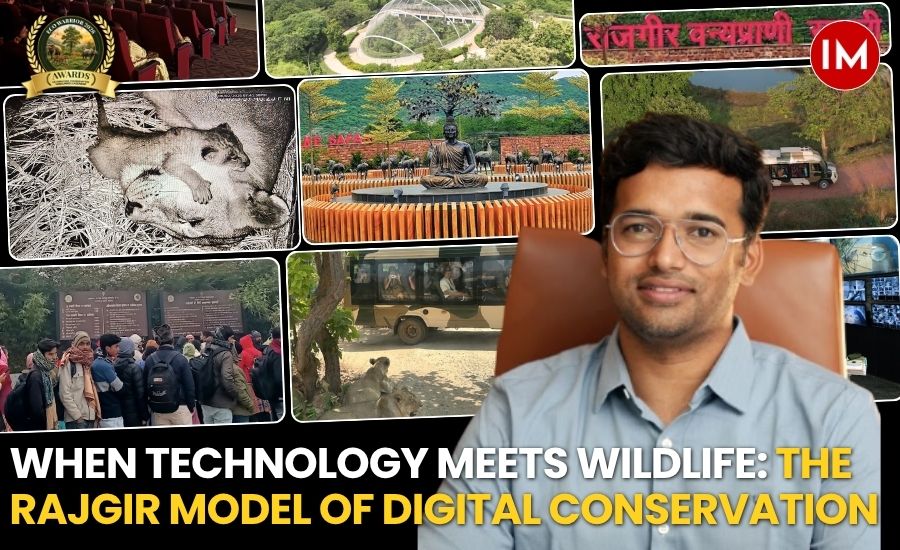
A visit to a wildlife safari is usually imagined as a slow journey into nature. At Rajgir Zoo Safari in Bihar, however, the journey begins much before visitors enter an enclosure. It begins with a ticket, a time slot, a QR code and a carefully managed flow of people and vehicles.
For Ramsundar M, an IFS officer of the 2019 batch and Bihar cadre, the challenge was to make this process as smooth as entering a metro station or an airport, without taking away the wild experience that visitors had come for.
Since taking charge as Director of Rajgir Zoo Safari, he has pushed a series of technology-led changes covering ticketing, crowd management, surveillance, safari buses and conservation awareness. The idea was not to add technology simply for the sake of it. It was to solve everyday problems that visitors and staff faced.
Speaking to Indian Masterminds, Ramsundar M explained that the biggest challenge was not the absence of visitors, but the amount of time they spent waiting.
It is also important to acknowledge the vision behind the safari itself. Dr Gopal Singh, IFS, then Regional Chief Conservator of Forests and Chairman of the Project Monitoring Committee for Rajgir Zoo Safari, played a key role in creating the safari. His vision for developing the destination and improving tourist facilities continues to guide the institution. While that foundational vision created the platform, Ramsundar M has focused on carrying it forward through technological improvements and a more seamless visitor experience.
FROM LONG QUEUES TO REAL-TIME BOOKING
Before the latest digital interventions, visitors could spend 20 to 30 minutes at ticket counters. Online booking existed, but it did not provide the same level of real-time convenience.
During busy days, tourists could arrive early in the morning hoping to get tickets. Once they reached the safari, they also had to wait for manual validation. Staff members had to check ticket details, verify identification and count the number of people covered by each booking.
Also Read – How Bihar Is Quietly Building India’s Next Big Eco-Tourism Destination
“Earlier, tourists had to wait in queues at the ticket counter and again during manual ticket validation. We have reduced both these waiting points through technology,” Ramsundar M told Indian Masterminds.
The new system allows visitors to check ticket availability and book slots in real time. At the entry point, QR-based validation has replaced lengthy manual checking.
Visitors now simply scan their QR code. If the ticket is valid for the particular time slot and number of people, the system allows entry.
The change has reduced waiting time and paperwork. It has also reduced paper waste and created a digital audit trail that can help in monitoring transactions, resolving grievances and improving accountability.
A DIGITAL CONTROL ROOM WATCHING THE SAFARI
The digital transformation does not stop at the ticket counter.
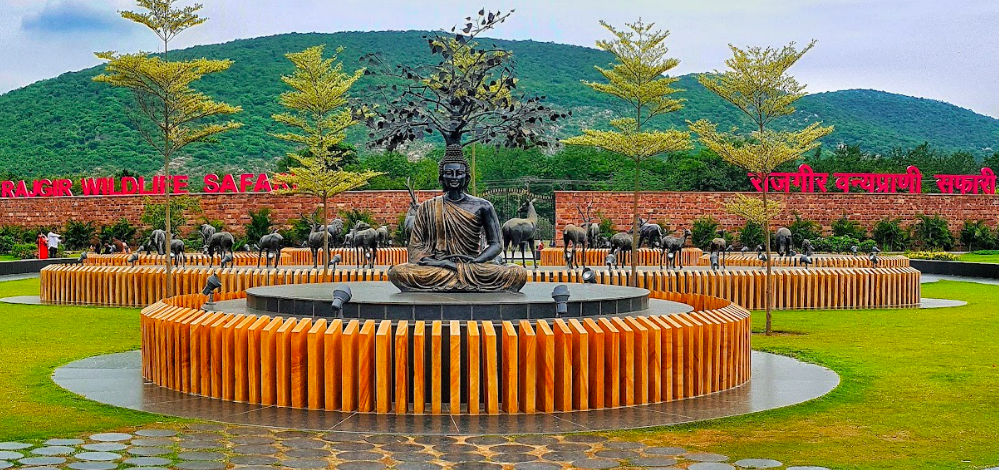
Rajgir Zoo Safari now uses a large network of CCTV cameras connected to a central control room. The cameras cover visitor areas as well as animal zones. This allows the management team to understand where crowds are building up and respond before congestion becomes a problem.
“If there is a crowd at one waiting area, we can direct tourists towards another facility. The CCTV inputs help us manage the flow instead of allowing everyone to gather at one place,” Ramsundar M said.
The system gives the team a broader picture of what is happening across the safari.
The digital dashboard can show how many tourists are inside, how many have completed the safari and how many are still waiting. Staff can use this information to distribute visitors more efficiently.
This becomes especially useful during peak periods, when a small delay at one point can quickly create a chain reaction elsewhere.
Instead of depending entirely on manual coordination, the team can now make decisions using live information.
GPS TRACKING FOR ANIMAL SAFETY
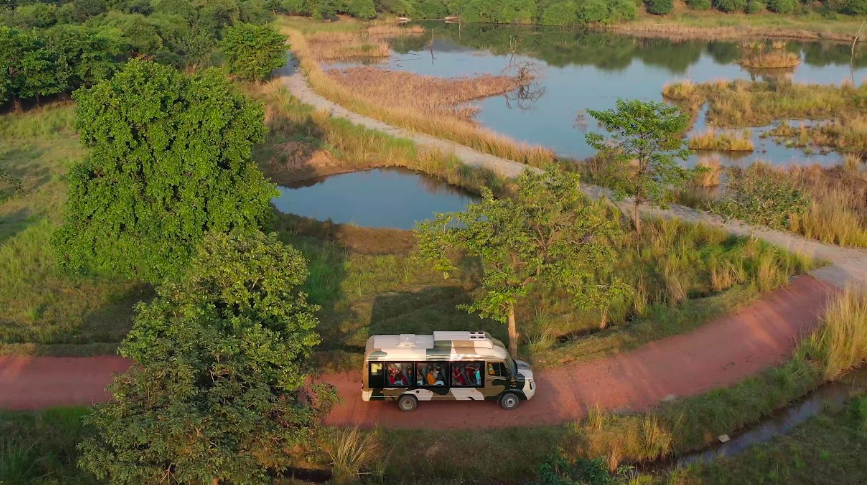
One of the more interesting innovations is the use of GPS technology for safari buses.
The GPS is not attached to the animals. Instead, the safari vehicles are tracked so that the control room knows how many buses are inside each enclosure.
Rajgir Zoo Safari has several large animal zones, including lion, tiger, bear and leopard enclosures. If too many buses enter one enclosure, the control room can ask vehicles to wait or redirect them to another enclosure.
“We wanted visitors to feel that the animals are in a natural environment and not surrounded by too many vehicles. GPS tracking helps us know how many buses are inside each enclosure and manage them accordingly,” Ramsundar M told Indian Masterminds.
The idea is to prevent the safari from becoming a procession of vehicles around an animal.
Too many vehicles can disturb wildlife, make animals uncomfortable and affect their natural behaviour. By controlling the number of buses inside an enclosure, the system creates more space for animals and a better viewing experience for tourists.
If one enclosure is crowded, vehicles can be directed towards another enclosure. The control room therefore becomes an important link between visitor management and animal welfare.
SLOT-BASED ENTRY CHANGES THE VISITOR EXPERIENCE
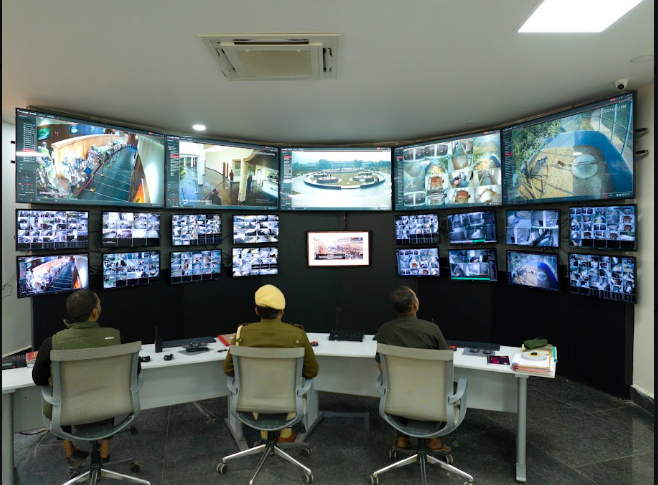
Another important change has been the introduction of stricter slot-based entry.
Earlier, manually checking whether a visitor had arrived at the correct time could be difficult. A tourist who had booked an earlier slot could arrive much later, creating confusion for staff and disrupting the planned movement of visitors.
The digital system makes the time commitment clearer.
Visitors know when they are expected to arrive. The system also makes it easier for the safari administration to maintain a predictable flow.
This is similar to the experience people have at airports, metro stations and other modern public facilities, where a specific time, ticket and validation process determine movement.
The objective is not to make the safari feel mechanical. It is to remove unnecessary uncertainty so that visitors can spend more time enjoying the actual experience.
MORE TOURISTS WITHOUT MORE BUSES
The impact of these changes can also be seen in the numbers.
Tourist footfall increased from 3,58,602 in 2024-25 to 4,07,433 in 2025-26, a growth of about 13.6 per cent. Revenue rose from ₹9.26 crore to ₹11.07 crore during the same period, an increase of around 19.6 per cent.
But Ramsundar stresses that the safari did not achieve this by simply adding more buses or increasing the number of slots.
Rajgir is surrounded by historical, archaeological and religious attractions. Tourists often want to cover several destinations within a short trip. The city attracts visitors interested in Buddhist and Jain sites, ancient ruins and other historical attractions.
Earlier, the perception that a safari could take three to four hours, including queues and waiting, could discourage visitors.
“We have not increased the number of buses or the number of slots. We only improved the information and convenience available to tourists. Now they know that they can complete the safari in around two hours and visit other places in Rajgir as well,” he said.
This small change in perception had a larger impact.
The safari also installed LED displays showing live ticket availability. This addressed another problem: the belief among some local visitors that tickets would sell out early in the morning.
When people could see the availability themselves, they were more confident about making the trip.
MAKING A SAFARI FEEL LIKE AN AIRPORT OR METRO
For Ramsundar, the transformation was also about changing an old perception of forest tourism.
Forest and wildlife destinations are often seen as places where systems are largely manual and technology plays a limited role. Rajgir was designed to challenge that assumption.
“There is often a perception that forest tourism is mostly offline and less technology-driven. We wanted to change that. We wanted Rajgir Zoo Safari to provide an experience comparable to a modern airport, metro station or international tourist destination,” he told Indian Masterminds.
The inspiration came from the way modern public spaces use technology to reduce friction.
At airports, passengers use digital tickets and automated validation. At metro stations, commuters can enter quickly after scanning a ticket. At Rajgir, the same principle has been adapted to a wildlife setting.
The difference is that the final destination is not a platform or boarding gate. It is a natural enclosure where the experience depends on animals and their behaviour.
TURNING WILDLIFE AWARENESS INTO A STORY
Technology at Rajgir is not only about administration.
One of its most visible educational initiatives is The Wild Call, an immersive animated film created for the safari’s 180-degree theatre.
The film takes viewers on a journey through India’s diverse ecosystems and introduces them to Indian wildlife and environmental challenges. It features species such as the Royal Bengal Tiger, Asiatic Lion, Indian elephant, snow leopard, Great Indian Bustard, Indian wolf, Great Indian Hornbill, Olive Ridley Sea Turtle and several other species.
The story follows a lion cub and a tiger cub as they travel through India’s major biodiversity landscapes.
Their journey takes audiences through the Indian Ocean, the Western Ghats, the Himalayas and the Thar Desert. Along the way, the film introduces environmental problems such as plastic pollution, ghost nets, climate change, avalanches, habitat loss and uncontrolled development.
The idea was to make conservation easier to understand, especially for young audiences.
Unlike many commercially rented wildlife films, the project was created with Indian wildlife in mind. Indian animators worked on the film, while a biologist was included in the team to ensure that animal behaviour and habitats were represented accurately.
The film has received recognition at animation and film festivals. By June 2026, it had been watched by more than 5.48 lakh visitors.
FROM ENTERTAINMENT TO CONSERVATION EDUCATION
For Ramsundar, The Wild Call is not simply a movie shown before or after a safari.
It is part of the larger visitor experience.
A person may come to Rajgir to see a tiger or a lion. But through the film, that visitor is also introduced to species and ecosystems that may be thousands of kilometres away.
The experience therefore moves beyond entertainment.
A child who comes to see animals in a safari can leave knowing about plastic pollution in the ocean, habitat destruction in the desert and climate threats in the Himalayas.
This creates another layer of conservation communication.
The safari is no longer only a place where people look at wildlife. It becomes a place where they learn why wildlife and habitats need protection.
AI, CHATBOTS AND VIRTUAL WILDLIFE EXPERIENCES
The transformation is still evolving.
Rajgir Zoo Safari already has an AI chatbot named “Tillu”, after the first female lion born at the safari. The chatbot is being developed to help tourists with information about bookings, facilities, travel plans and other attractions.
“We are trying to introduce more AI tools so that tourists can interact with Tillu and get information about the safari, how to travel, what facilities are available and what other places they can visit,” Ramsundar said.
The safari is also exploring AI-based applications and VR-based interpretation.
One proposed experience could allow visitors to virtually explore underwater ecosystems. Through VR technology, people could experience environments and species that cannot be physically recreated inside the safari.
The idea is to use technology to expand the visitor’s understanding of nature rather than replace the real-world experience.
BUILDING A NEW MODEL FOR WILDLIFE TOURISM
Rajgir Zoo Safari, spread across more than 191 hectares, was inaugurated in February 2022 and has already attracted more than 17 lakh visitors.
Under Ramsundar M’s leadership, its transformation demonstrates how technology can support a government wildlife institution without compromising its core purpose.
The most important lesson is that innovation does not always mean building something expensive or futuristic. Sometimes, it means identifying a simple problem and removing it.
A QR code can remove a queue. A GPS device can prevent too many buses from entering an enclosure. A dashboard can help staff manage crowds. An LED screen can correct misinformation. An animated film can make conservation memorable. An AI chatbot can answer a tourist’s question before the journey even begins.
For Ramsundar, these are all parts of the same approach.
“The main idea was to improve the tourist experience and bring technology into wildlife tourism. We want people to feel that a safari destination can be as organised and technology-enabled as any modern public facility, while still keeping nature and animals at the centre,” he told Indian Masterminds.
At Rajgir, the experiment is therefore not about making the wild more artificial.
It is about using modern systems to make the journey into the wild smoother, safer and more meaningful.
Also Read – How IFS Officer Kumar Ashish Is Rebuilding Palamu Tiger Reserve